
What is the difference between GDD, CHU and RM? Why and when are they each important?


By Morgan Cott, Agronomy Extension Specialist – Special Crops, Manitoba Crop Alliance
This is such a great question and I understand the reasons for asking. First of all, I think it is understood that GDD & CHU both basically measure how efficiently a day’s heat will benefit a growing or developing crop. One main difference between the two measurements is that CHU does account for extremely high temperatures (>30oC) that negatively affect crop development. CHU also looks at both the nighttime low temperatures (4.4oC as the base) and daytime temperatures between only 10oC (base) and 30oC (optimum ceiling).
GDD has historically been used to help estimate certain agronomic events like insect emergence, weed emergence, frost-free days and specific crop staging. My understanding is that CHU is used more for maturity than for the ability to accurately predict these different timelines throughout the season. This might be why certain seed companies use CHU and RM for maturity ranking and GDD for staging references.
Pride Seeds is an example of this, because they break down maturity with both CHU and RM, in addition to two key reproductive stages in GDD accumulation.
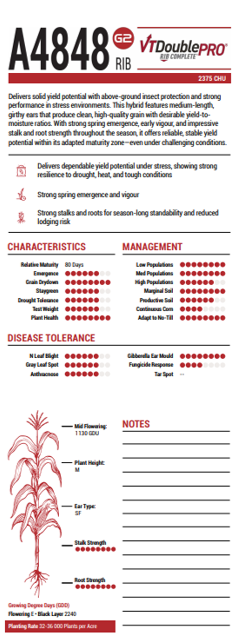
When calculating GDD or CHU, you will start from the day after corn was planted. It takes from 100 – 120 GDD for corn to emerge following planting, which is in ideal conditions, including soil moisture and soil temperature, which were variable this spring (and every spring). Start your calculations from day 1 until the day of emergence and see if that fits the above. Now that corn has emerged and is actively growing in your current conditions, continue to monitor accumulating GDD with the following formula. This will give you a head start on expectations during the growing season. When to expect pollination, for example. Note that this GDD accumulation in relation to corn staging is all in relation to each individual hybrid. A shorter season hybrid will need fewer GDD or CHU to reach black layer than a longer season hybrid, of course.