How much 10-34-0 can be applied with my corn seed?

Oddly, I have had this conversation more this winter/spring than ever before. On paper, there is a finite answer. Anecdotally, there are a few different options and it is all dependent on soil type and soil conditions, moisture, etc.

First of all, side-banding any type of fertilizer is much safer than placing it with the seed. Some fertilizers are safe in certain quantities with the seed, but very few. Side-banding is much safer and provides quick access to the roots. Midrow banding is the safest method, but roots take that much longer to access the fertilizer row, which negates the “starter” effect. The other factor that indicates the level of safety is soil moisture; the drier the soil, the more risky it is to place any fertilizer with or near the seed.

I’m guilty of thinking that fertilizer toxicity to the seed is mainly due to the nitrogen content and a result of ammonia burn. Salt injury is actually more common and affects germination and early season growth, so applying fertilizers that have a low salt index in closer proximity to the seed is best, if any has to be close to the seed at all. Bonus points if there is good soil moisture at the time of fertilization.

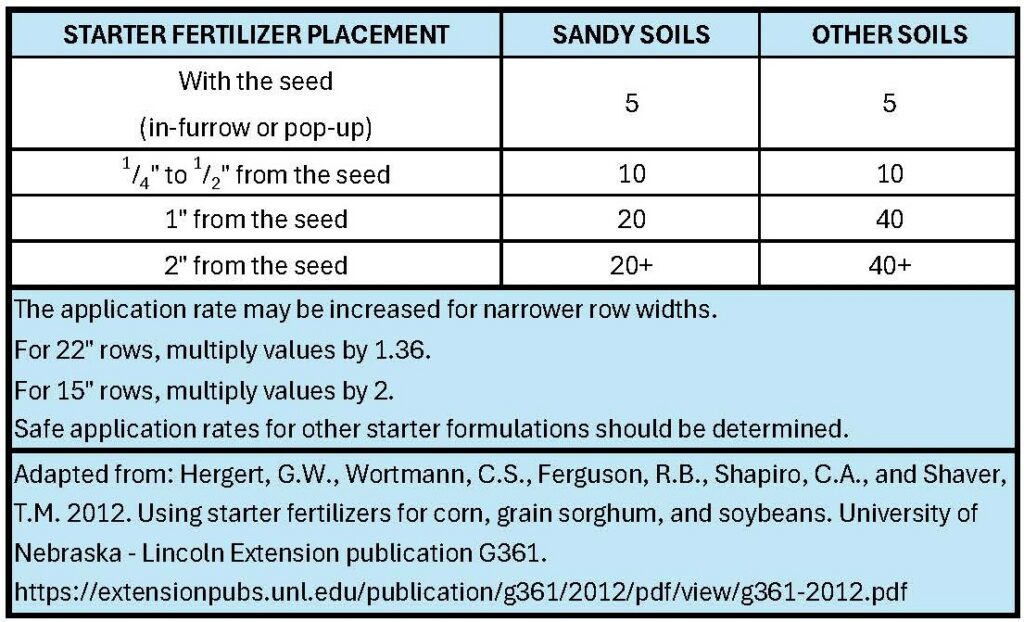
As I mentioned, on paper there are defined rates of 10-34-0 that can safely be applied in-furrow with corn on 30” rows. This table shows those rates and placement that will help to avoid salt injury to the corn crop.

Table: Amount of 10-34-0 (gal/acre) to help avoid salt injury to corn grown in 30” rows.

After having some discussions with Manitoba corn farmers on various soil types, I did get some reasonable responses explaining increasing rates in heavier, wetter soils. But more importantly, decreasing the above rates in dry and/or lighter soils. These were purely anecdotal and not research-based.

I recommend being very conservative in 10-34-0 rates if you are new to trying this method of application, and especially if you are planting in dry conditions and/or coarse soil textures. Start small and have many conversations with your peers on their experiences with various rates of 10-34-0 in-furrow. Use that information to make a conservative decision of your own.

Remember, start your season with success and make smart choices. Do not make decisions that could get your crop off to a bad start. We live in Manitoba – Mother Nature is hard enough on us in spring.

New, promising flax varieties for Manitobans

Manitoba flax farmers (and upcoming flax farmers) will soon have full access to a new flax variety, CDC Esme. As of spring 2025, CDC Esme is available to seed producers across the province, as long as they have been able to access it from seed dealers. 

As stated in the Secan Technical Bulletin for the variety, CDC Esme is a large seeded, high yielding brown seeded flax variety with good lodging resistance and late maturity. Esme proves to be a strong yielder in MCVET trials across several site years, with oil content similar to check varieties. Statistics show an average of 2 cm shorter than CDC Glas, which is a beneficial trend in Manitoba, where farmers are trying to reduce flax straw and residue. 

Dr. Bunyamin Tar’an and his team at the Crop Development Centre in Saskatoon developed CDC Esme and have several more flax lines that have strong potential for registration on the Canadian Prairies. Most recently, Tar’an had an experimental flax line that has been recommended for registration via Canadian Food Inspection Agency. This line, currently named FP 2608, will undergo a registration process and could likely be available for seed production in the next two years. 

FP 2608 has been a promising yielder in the Flax Co-op trials performed in Manitoba and is a consistently strong yielder. It appears to be quite tolerant of pasmo infections in past reports, and oil content and yield has been ranked very high amongst other varieties and lines. Tar’an has noted that FP 2608 had considerably strong performance in the more northern Co-op trials in Manitoba, which perhaps displays its ability to thrive in less diverse rotations.

MCA is very proud of our relationship with Dr. Tar’an and are very excited about his future work in flax breeding. Some new work that he is working on includes “Accelerated Breeding Strategy for Flax Improvement” which looks at developing inbred populations in a shorter term than is current reality. This would mean that future varieties could potentially be brought to the market more quickly and readily than they have in the past. Another highlight of Dr. Tar’an’s work is that he is committed to reducing straw content while increasing seed production in future varieties. He has had to delve back in time and use flax’s wild ancestor, Linum bienne. By using historial genetics, Tar’an can benefit by breeding their old, shorter varieties with new modern varieties that have bushier plant structure, therefore, higher yielding qualities and improved harvestability.

Flax can have a strong future on the Prairies and Manitoba Crop Alliance is supporting that possibility for our farmers. It is a crop that requires patience and consideration, which we believe Manitoba farmers are great at and can help us solidify the flax industry on the Prairies. Discussions with farmers that have been growing flax successfully for several years tell us that it is one of the top most profitable crops on their farms because they are willing to put an extra effort in to the crop. In this case, it doesn’t mean inputs, directly. These farmers are treating flax like the special crop that it is; slowing down and using precision and sustainable practices to support the germination of a tiny seed into a beautiful and profitable crop.

Please contact the MCA’s Agronomy Extension Specialist for Special Crops if you are considering growing flax or currently work with flax and are interested in more agronomic information

Research on the Farm: Flax Plant Population Trials Summarized (2022 – 2024)

Manitoba Crop Alliance’s Research on the Farm program looks at common agronomic, crop-specific concerns on field-scale, replicated trials in commercial fields. 2024 saw the flax plant population trials completed with 19 site-years of data.

The objective of this specific trial was to quantify the agronomic and economic impacts of various plant populations in flax production in Manitoba. A lack of genetic improvements in flax varieties in recent years raises the question of whether farmers can either increase or decrease their planting populations with improvements in quality and/or yield. Farmers took to the field to make that final decision.

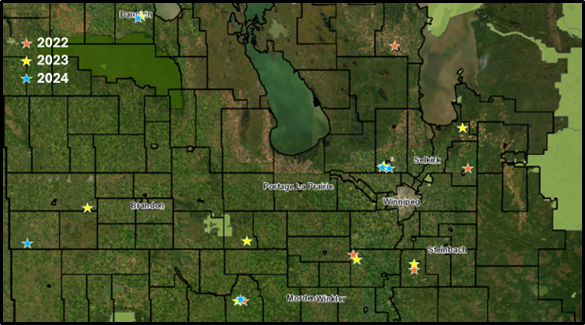
Figure 1: MCA Research on the Farm: Flax Plant Population Trial locations from 2022 – 2024

Tone Ag Consulting performs MCA’s Research on the Farm trials in all 6 of our crop-types. In this specific trial type, they are helping the farmer with planting and harvest of the plots, plus taking some key information during the growing season. This includes soil sampling in the spring followed by growth stage notes and precipitation data during the season.

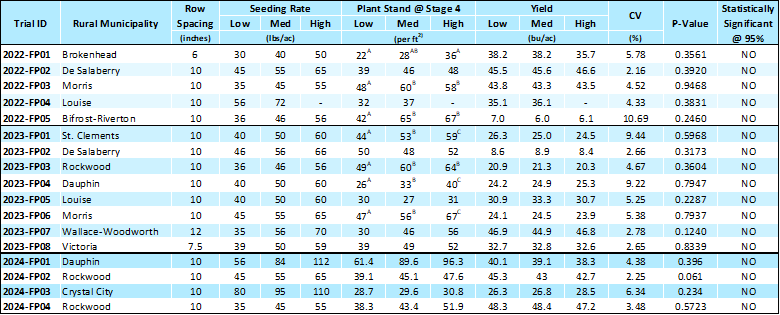
Table 1: Three-year summary of flax plant population trial for 19 site years. Zero of the 19 site-years contributed statistically significant yield differences which would provide profit for the farm, based only on seed prices.

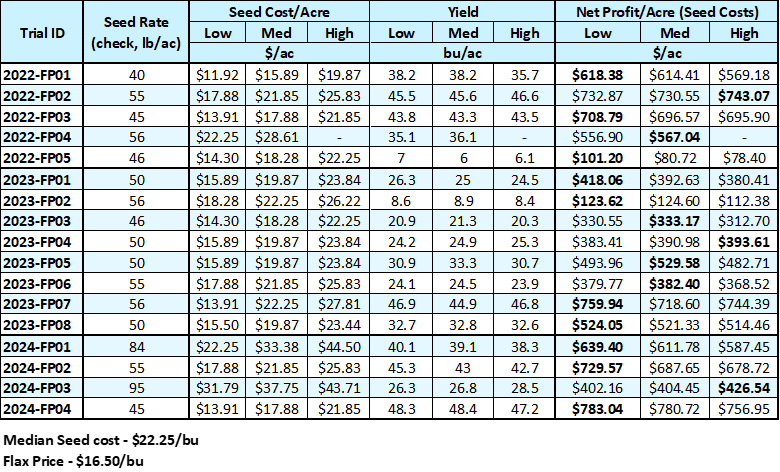
When looking at this full data set, it doesn’t necessarily give a farmer the details they are looking for. At the end of the day, they want to know the ROI for each treatment, which includes spring seed costs and flax prices off the combine. Simply stated, if the “high” planting rate outyielded the “low” and “check” planting rates, it may have only been marginally, therefore the higher seed cost of planting at a high rate was likely not the economical choice.

Table 2: Three-year economic summary of flax plant population trial for 19 site years. Net profit per acre was calculated using estimated seed cost in spring 2024 and contract pricing in fall 2024.

According to this small data set in Manitoba, farmers appear to seed on the heavier side of what is necessary for their management practices. Experience determines what works best on any given field, in addition to being mindful when it comes to general flax management. It is a special crop and requires a certain amount of care and precision to achieve profitable yield, but it absolutely is realistic in Manitoba.

Planting populations are reasonably simple to set up on-farm and MCA recommends farmers make the effort to periodically do this same testing. 2022 and 2023 were dry years in areas of Manitoba and 2024 had much more precipitation. It is important to continue to collect data in years of varying precipitation to determine planting rates that work better on your farm in all environments.

Tone Ag Consulting carries out MCA’s ROTF trials in all six of our crop-types. They assist the farmer with plot planting and harvesting, then capture key information throughout the growing season. This includes soil sampling in the spring, followed by growth stage notes and precipitation data during the growing season.

Phantom Yield Loss

Phantom Yield Loss – A phenomenon related to yield loss with little to no explanation why, aside from letting the grain dry naturally, prior to harvest.

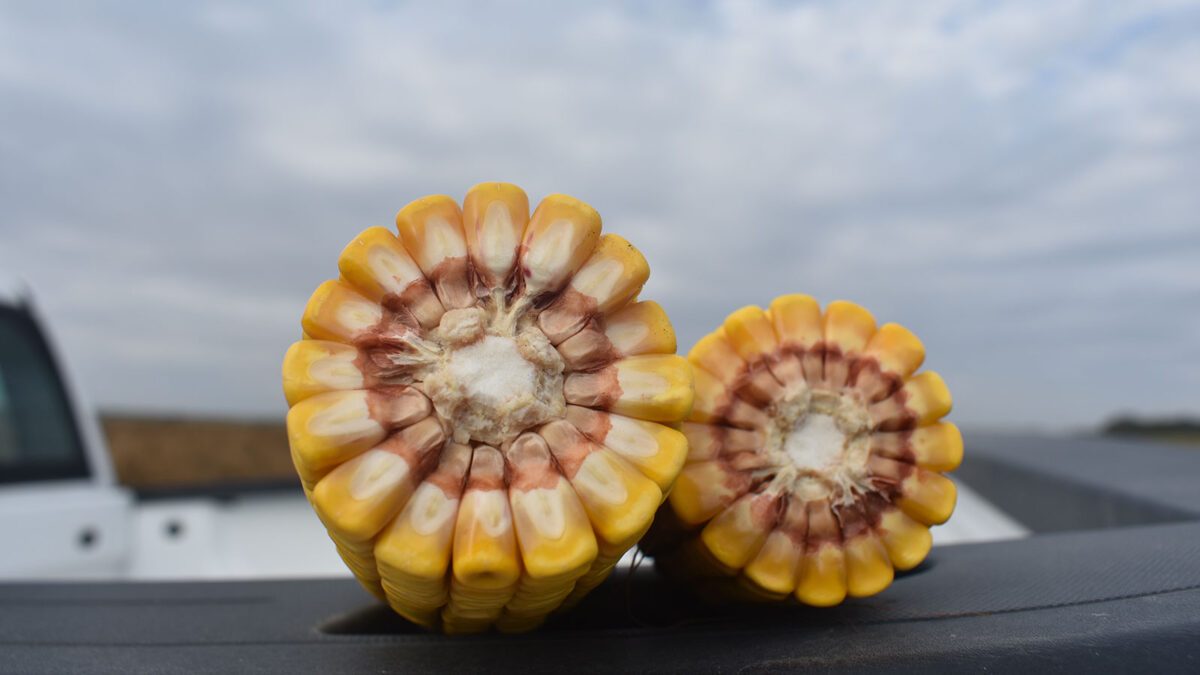
Farmers who have to pause harvest, after opening a field, do record decreased yields when they return to continue combining. A few things come to mind when considering what the losses are a result of. Could it be ear drop? Or lodging is a common occurrence, the longer the crop stands in the field and is exposed to wildlife, snow, or wind. Another consideration is that as the grain dries in the field, it does loosen from the cob and can fall to the ground when disturbed. Low moisture grain is also susceptible to cracking or breakage at harvest, resulting in losses.

Speaking to Manitoba farmers, it appears that phantom yield loss is caused by none of the above. All the obvious culprits (ear drop, lodging, kernel shattering) can be accounted for and there are yield penalties beyond these factors, still.

Purdue University performed research on this topic in the early 90’s – before the phenomenon even had a name. The project looked at three hybrids over the course of four years and measured kernel dry weight until physiological maturity and again after maturity until they were ready for harvest. The study found that kernel dry weight increased until reaching physiological maturity, which occurred at about 25% moisture for all three hybrids. Following maturity, during the dry down period, kernel dry weight decreased by an average of 1.1% for every one per cent decrease in grain moisture content. This is an average across three hybrids in the four years of study. There was one year where none of the hybrids experienced any significant changes in kernel dry weight. The “bottom line” of the project is that there is a potential average 1% yield loss per point decrease in grain moisture content. That is to say that if a field is left to naturally dry down 5 moisture points following physiological maturity, there is a potential +/- 5% yield loss.

So, how does this occur and why? We now know that this is part of the drying process, but why is so much dry matter being lost as the grain dries a small amount?

Quite simply, physiological maturity occurs and each kernel develops a “black layer” where it connects to the cob and had gained access to nutrients and water throughout the season. Once black layer is achieved, grain continues to use up the starch and sugar reserves, which decreases kernel dry weight and quality. Grain is typically alive following black layer until it has dried down to around 15% moisture, so it is not surprising that this process results in loss of dry matter.

Unfortunately, it is impossible to predict losses as a result of this phenomenon. Factors affecting losses include harvest timing, soil type, hybrid/genetics, and of course, environmental factors. That being said, it is difficult to predict what genetics are most susceptible to respiration losses following black layer, so that isn’t something that would normally factor into hybrid choices. Earlier harvest timing is the best way to avoid significant losses, in this case. As mentioned, losses are impossible to predict, but measuring drying costs against the alternate potential yield loss is key in finding the best management practice for your farm.

Top