How can I estimate the rate of drydown for my mature grain corn?

By Morgan Cott, Agronomy Extension Specialist – Special Crops, Manitoba Crop Alliance
I was hearing rumours of some grain corn being harvested last week with ranges of 25-33% moisture, which is pretty darn accurate for the last week of September. Considering a few days of fog have passed and some beautiful, mild temperatures are ahead, let’s talk about drydown rates to expect in October.
Prior to physiological maturity (black or brown layer), grain fill occurs during the reproductive stages of corn development. As grain fill progresses, dry matter replaces water content in each kernel. Water is removed from the kernel via the pedicel (point where the kernel is attached to its cob) and via evaporation during the grain fill period. As physiological maturity is reached and those cells that connect each kernel to the plant die, water is no longer lost at that point of contact and can only occur via evaporation, which is much slower.
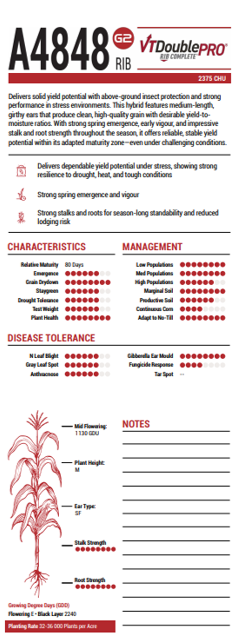
So, black layer will occur consistently when the grain reaches about 30% moisture and from that point, we rely mainly on weather for evaporation and, to a lesser degree, kernel characteristics of different hybrids. Unfortunately, September 2026 was quite humid and damp, overall, which is the opposite of what farmers require for grain drydown. Aside from environmental factors, hybrid traits also play a major role in the plant and grain’s ability to dry down in the field. Here are some noted characteristics:
- Husk leaf number – the fewer, the better for drydown;
- Husk leaf thickness – the thinner, the better for drydown;
- Husk leaf senescence – the quicker, the better for drydown;
- Husk coverage of the ear – the poorer the coverage, the better for drydown;
- Husk tightness – the looser, the better for drydown;
- Ear declination – the earlier the ears “drop”, the better for drydown;
- Cob diameter – the narrower, the better for drydown; and finally,
- Kernel type – flint-dent kernels dry down more slowly than dent types because they have a harder kernel.
Moving on to the actual question, how to estimate drydown in the field. October is starting out beautiful with sunshine and warm temperatures from mid-teens to 20oC. The only things that would make this better drying conditions would be even warmer temperatures and stronger breezes, that are also warm. The general estimation is that during these warm temperatures, you can assume up to 1% moisture loss per day, but I wouldn’t bet the farm on that information!
According to Ohio State University, when the grain is between 30 – 25% moisture, it takes approximately 30 GDD’s to lower moisture by one point. So, 150 GDD’s to lower moisture from 30 – 25%. After that, 45 GDD’s are required to lower the moisture from 25 – 20% (225 GDD total). This is the easy answer and calculation, but there are other factors at play, of course. These drydown rates won’t be the same for every hybrid and will very much depend on weather conditions. I took a quick look at Carman’s Growing Season Report and see that from Oct 4 – 5th (24 hours), we only accumulated 3 GDD in that period. However, on October 6th, as I write this, the air temperature is 21oC and the sun is warm with a gentle breeze, so I assume we are accumulating more GDD today than yesterday. I will also assume that we could be expecting drydown on days like this to be about 0.5 – 0.75% daily, if we are being conservative. As the temperatures cool a bit next week, calculate roughly 0.25 – 0.5% per day, as long as the sun is shining and there is a breeze. Using that information and the Weather Network’s 14 day forecast, my very rough estimate would be that we could lose about 6 – 10% moisture over the next two weeks, depending on potential rains and cloud cover, plus overnight low temperatures.
The only thing we can do is make a best-educated guess on how long it will take the crop to drop “x” points in moisture given the information above and what you know about the hybrids you grow. Maybe you have experience with a certain hybrid and that it took seemingly forever to drop those last 3% in the past, or maybe you have experienced the opposite. Keep detailed notes so you have a record for the future, so when you’re planting early (or late) in spring 2027, you have more decision-making tools on what to plant, and where.
Wishing you all a very safe and productive corn (and sunflower) harvest!
Other resources
- Manitoba Agriculture – Harvesting Grain Corn in Late Fall
- Manitoba Agriculture – The Facts of Corn Drydown
- OSU Extension, Agronomic Crops Network – Cool Weather and Corn Dry Down