Blog: Agronomy & Extension

Seeding Flax to Provide the Best Start

Typically, flax is seeded from May 1st to June 20th. It may be seeded the last out of all the crops as the bolls and seeds can stand and ripen in the fall without shelling while other crops like canola are being harvested. Prolonged exposure to fall weather, though, will reduce the quality of the harvested seed and make it ineligible for a food grade market. MASC data has shown that flax has good yield potential in the last week of May (Table 1), but yields decline in some areas as the calendar turns to June. MASC seeding deadline is June 20th for all of Manitoba.
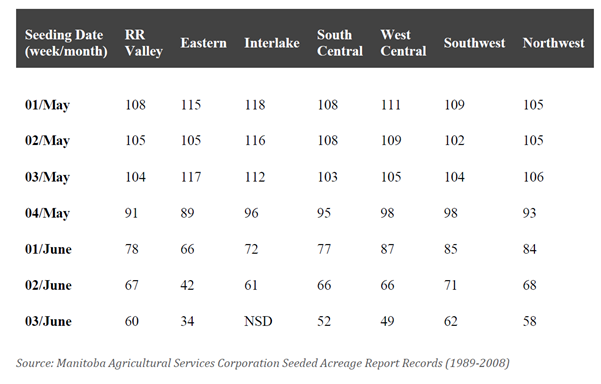
Table 2: Relative Stubble Yield Response (2011 – 2020). Source: Manitoba Agricultural Services Corporation.

Yield response data from MASC, recorded from 2011 – 2020 (10 year results), shows that flax responds best when seeded following a pea crop, with the next best response after corn (Table 2). It generally has the poorest yield response when seeded following any oilseed crop, for obvious reasons. Research has shown that flax performs poorly specifically after canola and/or mustard, and not only because of disease issues. The poorer performance of flax on canola stubble is attributed to mycorrhizae fungi which do not associate strongly with canola and decrease in presence during the canola crop’s growing season. When flax is grown on canola stubble, the mycorrhizae populations are lower, which leads to poorer early  season nutrient update, especially phosphorus, a relatively immobile nutrient in the soil that is crucial to early flax development.

Flax does well after cereals or corn. It also performs well after legume crops and alfalfa, but Rhizoctonia disease may be a problem. Flax does not do well after potatoes due to the loose seedbed and potentially Rhizoctonia in this rotation as well. According to MASC, the most common crop stubble that flax is seeded into is spring wheat in Manitoba and very few acres are seeded into pea stubble, so that flax-on-pea yield data in Table 2 could be seen as skewed. Crop rotation is extremely important when making all cropping decisions, but flax is a particularly sensitive plant to many outside factors and rotation should be paid considerably close attention to. It is recommended to have at least three years between flax crops on a field to control various soil-borne or stubble-borne diseases of flax, such as pasmo.
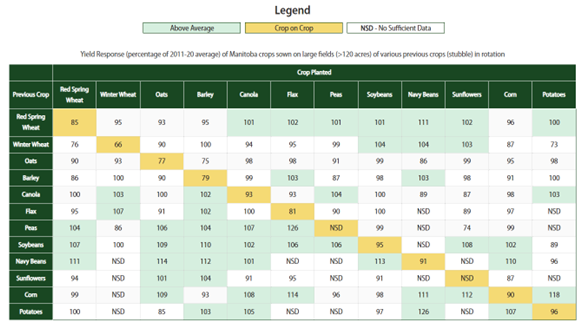
Table 2: Relative Stubble Yield Response (2011 – 2020). Source: Manitoba Agricultural Services Corporation.

For a successful flax crop, the greatest strategy is to enable the crop to emerge in a uniform and dense plant stand. This helps the crop with weed control throughout the season and allows for consistent physiological maturity down the road.

Tips for a productive flax plant stand:

  • Target 1 to 1.5 inch seeding depth to allow crop to emerge quickly
  • Do not overfertilize. Flax does not respond positively to increased rates of fertilizer. Excess nitrogen will cause prolonged maturity and potential lodging issues.
  • Target a higher seeding rate. Flax depends very heavily on adequate stand establishment and plant populations of 30 – 40 plants/ft2. Typical emergence for flax is 50% – 60% of seeding rate. Seeding rates on the high end of the recommended range should be used for ground prone to crusting when seeding late or under heavy weed pressure.
  • Do not seed flax on poorly drained soils or sandy soils because of poor water retention. Medium to heavy-textured soils are preferable. These soils may also crust in the spring, which can inhibit flax emergence.

For more information on growing flax on the Prairies, see Flax Production Resources on our website.


MCA-funded research at the 2023 Manitoba Agronomists’ Conference

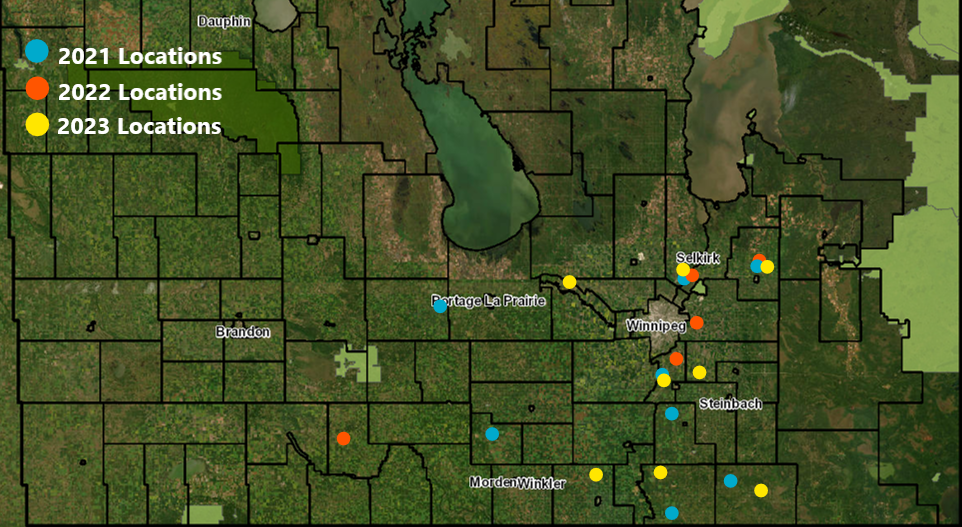
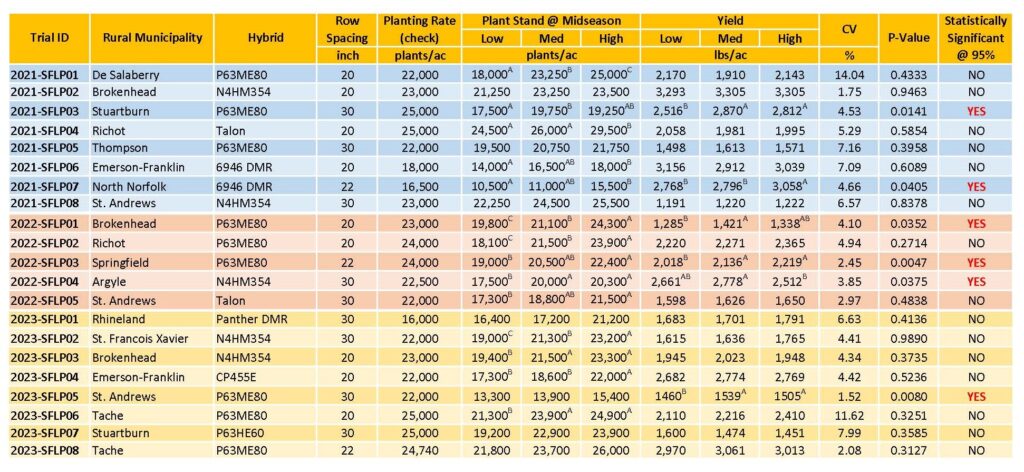
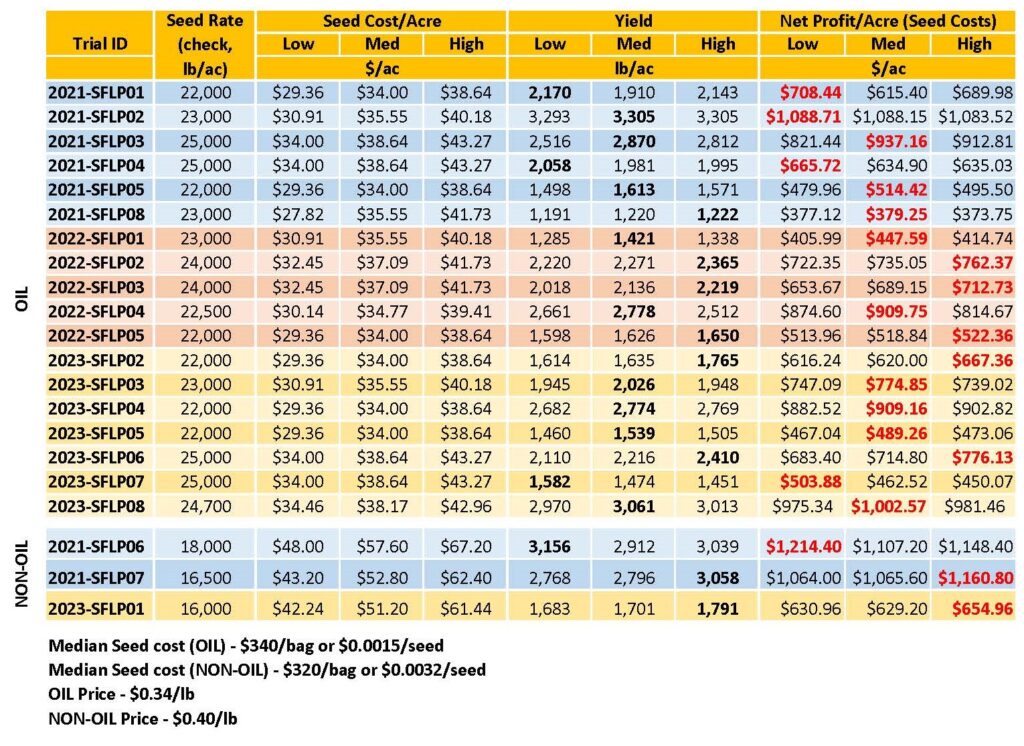
Research on the Farm: Sunflower Plant Population Trials Summarized (2021 – 2023)

New-to-flax chemistry now registered for in-crop use

It has long been known that flax farmers need stronger weed control options to successfully grow and maintain good quality and higher-yielding flax crops. BASF has been a strong supporter of flax in recent years, encouraging the growth of acres on the Prairies. In 2022, BASF announced a new registration for Heat ® LQ applied as a pre-harvest treatment aid on flax, which both MCA and SaskFlax partnered in running a field trial program for testing.

As of early November 2023, BASF announced that Armezon® herbicide is now registered for post-emergent applications to flax. This use was registered under the User Requested Minor Use Label Expansion program. Armezon® herbicide is a Group 27, post-emergent herbicide that is quickly absorbed by leaves, roots, and shoots to quickly control target weeds. The herbicide claims control of common ragweed, Eastern black nightshade, kochia (less than 10 cm), redroot pigweed, volunteer canola (prior to 6-leaf stage) and wild mustard, when applied at the recommended rate and with a specific adjuvant partner.

Manitoba flax farmers are very fortunate to have this ongoing support and can look forward to an additional tool in their toolbox to aid in successfully keeping their flax crops cleaner in 2024.

Further details on Armezon® herbicide registration in flax can be found in the accompanying documents.

Project Update: MCA Development of Long-Type Confection Sunflower Hybrids

Corn Facts: Drought and Harvest 2023

The value and importance of seed testing

If you are planning on saving seed for next year’s crop, seed testing should be considered, as weather conditions from the year the seed was grown, such as precipitation and heat, affect seed quality. Seed testing in the fall can provide growers with useful information that can save them both time and money – allowing them to plan for next year’s growing season with greater certainty.

Typically, seed tests evaluate variables such as germination, thousand kernel weight, physical purity, and vigour. As well, some labs can conduct seed-borne disease testing. Understanding these variables is important when making seeding management decisions, as seeds with poor germination and vigour or those that contain seed diseases can negatively impact crop establishment, uniformity and health. This will ultimately affect yield.

Information collected from seed tests is also integral to achieving your desired plant population, as thousand kernel weight should be used to determine optimal seeding rates. Additionally, understanding seed germination and vigour can give you a better gauge of expected seed survival and how the seed will perform in the spring.

Germination tests evaluate the percentage of seeds likely to develop or germinate under optimal moisture, light and temperature conditions. Vigour tests are similar but provide information regarding the ability for seeds to produce normal seedings in suboptimal conditions. Cold stress tests are often used to determine this, although there are multiple vigour testing protocols used by labs. Vigour testing is important, as seed vigour usually drops before the seeds ability to germinate does. More information about calculating seeding rates can be found here.

It’s important to note that long periods of storage can affect seed quality. For example, both germination and vigour levels can decrease during winter storage. Therefore, secondary seed testing in early spring may also be necessary. More information about seed testing and seed test interpretation can be found here.

Below are Seeds Canada accredited seed testing labs in Manitoba. Accredited labs can also be found across the Canadian Prairies. Growers should contact labs to understand the services they provide:


Preventing and Monitoring for Insects in Stored Grain

By John Gavloski, Extension Entomologist at Manitoba Agriculture

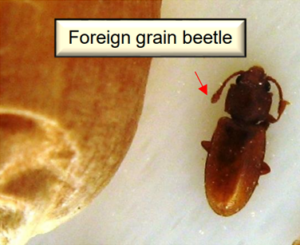
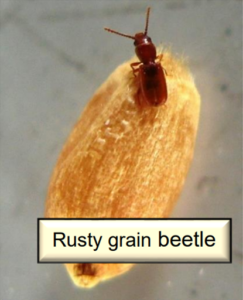
Grain beetles can be an issue in high infestation years, so it is important to review management strategies. The first step is knowing what species of beetle is present and whether it is a species that feeds on the grain itself, or more on fungus growing on the grain or in the bin. Without magnification, it can be difficult to determine the difference between rusty grain beetles, one of the more common beetles feeding directly on many stored grains, and foreign grain beetle, which is primarily a fungus feeder.

Note the club-shaped antennae on the foreign grain beetle in the photo. If placed in a glass jar, foreign grain beetles will climb up the sides, while rusty grain beetles cannot.

Preventing insects being introduced into or establishing in grain bins.

A few steps to reduce stored grain insects establishing in grain bins include:

  • Clean in and around storage facilities.
  • Inspect grain storage facilities for signs of deterioration, leaks or holes.
  • Clean equipment used to move grain. Combines, grain wagons, truck beds,
    augers and other equipment used to move grain should be cleaned of grain
    residue before being used.
  • Dry and cool grain (ideally below 15°C) as quickly as possible after harvest.

Controlling insects found in stored grain.

Knowing the species you are dealing with is important when determining the most effective and economical means of control. If it is a fungus feeder such as foreign grain beetle, practices that result in grain drying may be all that is needed.

For insects that feed directly on the grain, if the grain is being kept over the winter, lowering the grain temperature through aeration or moving the grain can kill stored gain insects.

Grain vacs, if used at a slow enough speed (such as 200 bushels per hour), can kill stored grain insects. Removing too large a volume of grain at a time results in the grain protecting the insects and reduces kill. Insect killing efficiency is greatly increased when a 90° angle is made in the grain vac pipe. The grain should be dry for this method to work well.

Depending on the crop being stored and insect pest, chemical control options can include fumigants (such as phostoxin or fumitoxin), diatomaceous earth (Protect-It, Insecto), or malathion. There are things that should be considered before using any of these chemical control options, however.

Fumigants such as phostoxin and fumitoxin are restricted to applicators with a valid stored agricultural products license. These products can not be used when the grain temperature is below 5°C, as the tablets release the gas too slowly.

Diatomaceous earth damages the cuticle of the insect, reducing the insect’s ability to retain moisture. The insect eventually dies from dehydration. It can take weeks for diatomaceous earth to control insects in grain bins, assuming the grain is dry.

Important note: Some commodities, such as canola, flax and sunflowers, should not be stored in facilities recently treated with malathion.

For more information:

Prevention and Management of Insects and Mites in Farm-Stored Grain, Manitoba Agriculture


Carbine Insecticide – Emergency Use Registration Approved for Use on Lygus Bug in Confection Sunflowers in Manitoba

Manitoba Agriculture, Manitoba Crop Alliance and FMC Canada are pleased to announce that Carbine insecticide has been approved for use to control lygus bug in confection sunflowers in Manitoba again in 2024.

The need for an emergency use registration was identified in the wake of the re-evaluation of lambda-cyhalothrin product use in Canada, which left a void in lygus bug control in confection sunflowers. This insect pest is a serious economic threat to human consumption market confection sunflowers.

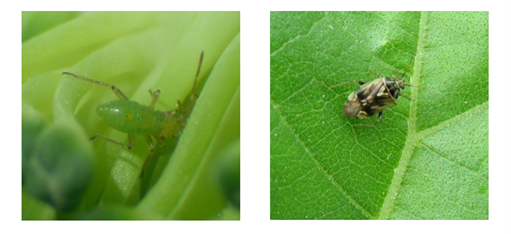
Lygus nymph and adult.

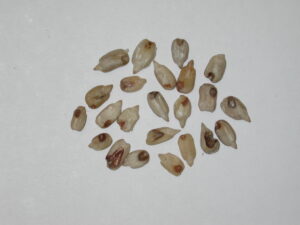
Lygus bug feed on developing sunflower seeds, which can cause kernel brown spot, a physical scar on the bare seed, and a bitter taste when consumed. Sunflower processors allow only 0.5 per cent damage in physical product. Since tolerance is at an absolute minimum, confection sunflower farmers need an insecticide product to control lygus bug to maintain the quality that is so highly demanded.

Lygus bugs can damage 30 to 35 seeds per head per adult. With the industry standard allowing for a maximum of 0.5 per cent kernel brown spot, the economic threshold for lygus bugs on sunflowers is about one lygus bug per nine heads. In research trials, damage to sunflower heads was approximately twice as severe when infestations occurred at late bud and early bloom compared to stages when heads had completed flowering. Thus, lygus bug management should be initiated prior to or at the beginning of the bloom stage if adult densities approach the economic threshold. Also, fields should be monitored for lygus bugs until flowering is complete to reduce incidence of kernel brown spot damage to confection sunflowers.


Please note that confectionary sunflower farmers interested in using Carbine on their sunflowers are recommended to contact their ag retailer as soon as possible to allow for timely delivery in case there is no local stock available.

Here are key details regarding the Carbine insecticide Emergency Use Registration:

  • Carbine® insecticide is registered for control of lygus bugs (Lygus spp.) on confection sunflowers in Manitoba from July 21, 2024 until July 20, 2025.
  • This emergency use is for Manitoba confection sunflowers only with intended sell-in markets of Canada or the U.S. Please confirm this with end purchaser prior to application.
  • This emergency use is not for oilseed sunflowers, as maximum residue levels are not set in other countries where oilseed sunflowers might be sold.

What you need to know about Carbine® insecticide:

  • Application Rate: 81 grams/acre (20 acres per 1.587kg jug); maximum of three applications per year.
  • The emergency use covers both air and ground application.
  • Application Water Volume: Thorough spray coverage essential for optimum control. Apply in sufficient water to ensure good coverage (min. of 50 L/ha for ground; 30 L/ha for air). Finished spray volumes should be increased when plant foliage is dense.
  • What to expect: Carbine® insecticide will stop lygus bug feeding rapidly and irreversibly, but it may take several days to see a reduction in lygus bug numbers, as they take time to desiccate. They will not be causing damage in this time.

Please contact your local FMC Account Manager for more information.

Funding to support sustainable practices available to Manitoba farmers

The Agricultural Climate Solutions – On-Farm Climate Action Fund (OFCAF) was established to provide funding and support to farmers in adopting practices that store carbon and reduce greenhouse gas emissions. In Manitoba, funds are available through the Manitoba Association of Watersheds and the Canola Council of Canada. Farmers may only receive funding from one organization for a given eligible beneficial management practice on a given parcel of land. More information on these programs, including a summary of eligibility criteria and beneficial management practices can be found here.

The Sustainable Canadian Agricultural Partnership (SCAP) – Sustainable Agriculture Manitoba

The Sustainable Canadian Agricultural Partnership (SCAP) is an investment by the federal, provincial and territorial governments to support the agriculture, agri-food and agri-based products sector. As part of the SCAP, the Manitoba government has now opened intake for the Sustainable Agriculture Manitoba (SAM) program, which provides funding to farmers to support the implementation of beneficial management practices that increase the environmental and economic sustainability of agriculture operations in Manitoba. Funding streams that may be of particular interest to MCA farmer members include:

Crop Land Management: Funding to support adoption of cropland management practices that optimize operations and improve productivity. Eligible beneficial management practices include:

  • Reduced Tillage Intensity
  • Low Disturbance Placement of Seed & Fertilizer
  • Preventing Soil Compaction
  • Reduced Pesticide Use
  • Soil Landscape Restoration
  • Perennial Cover for Sensitive Lands
  • Hazardous Products Storage

More information on the Crop Land Management funding stream is available here.

Water Management: Funding to support the adoption of practices that enhance the supply, efficient use, quality and management of water. Eligible beneficial management practices include:

  • Increased Irrigation Efficiency
  • Fertigation
  • Sub-surface Drainage Water Management
  • Water Quality
  • Runoff Control
  • Water Use Efficiency
  • Water Supply

More information on the Water Management funding stream is available here.

To be eligible for funding through the SAM program, farms are required to have a valid Environmental Farm Plan (EFP). Information on Manitoba’s EFP can be found here.

Application intake for the SAM program closes at 11:59 pm on Tuesday June 13, 2023. For more information on this program and other SCAP programs you may be eligible for, visit the link below.

https://www.manitoba.ca/scap/index.html

Top