Manitoba Crop Alliance (MCA) is proud to support agriculture’s next generation. MCA’s bursary program is designed to assist with the financial needs of students pursuing education in a field that will benefit the agriculture sector.
Six graduating high school students from Manitoba have been awarded with bursaries valued at $1,000 each. The six bursary recipients are Rylan Wubbe from La Riviere, Peyton Tolton from Kenton, Caroline Anne McConnell from Cromer, Taylor Unrau from Douglas, Dane Bergen from Carman, and Elizabeth Woodason from Erickson.
“I’d like to congratulate this year’s high school bursary recipients and wish them all the best as they continue their education,” says MCA chair Jonothan Hodson. “MCA is proud to support agriculture’s next generation, and I can’t wait to see these promising, young individuals make their mark on our industry.”
To qualify for these bursaries, applicants did not need to be continuing into an agriculture-specific program. However, they did need to clearly articulate how their continued studies would help them benefit the agriculture industry.
It has been one full year since Manitoba Crop Alliance (MCA) released its 2024-27 strategic plan. Over this last year, MCA staff have worked hard to achieve the vision set out by the board of directors and crop committee delegates. Below is a recap of the wins and challenges from MCA’s efforts to execute year one of the strategic plan. If you are interested in what the future of MCA looks like, click here to view year two of our strategic plan.
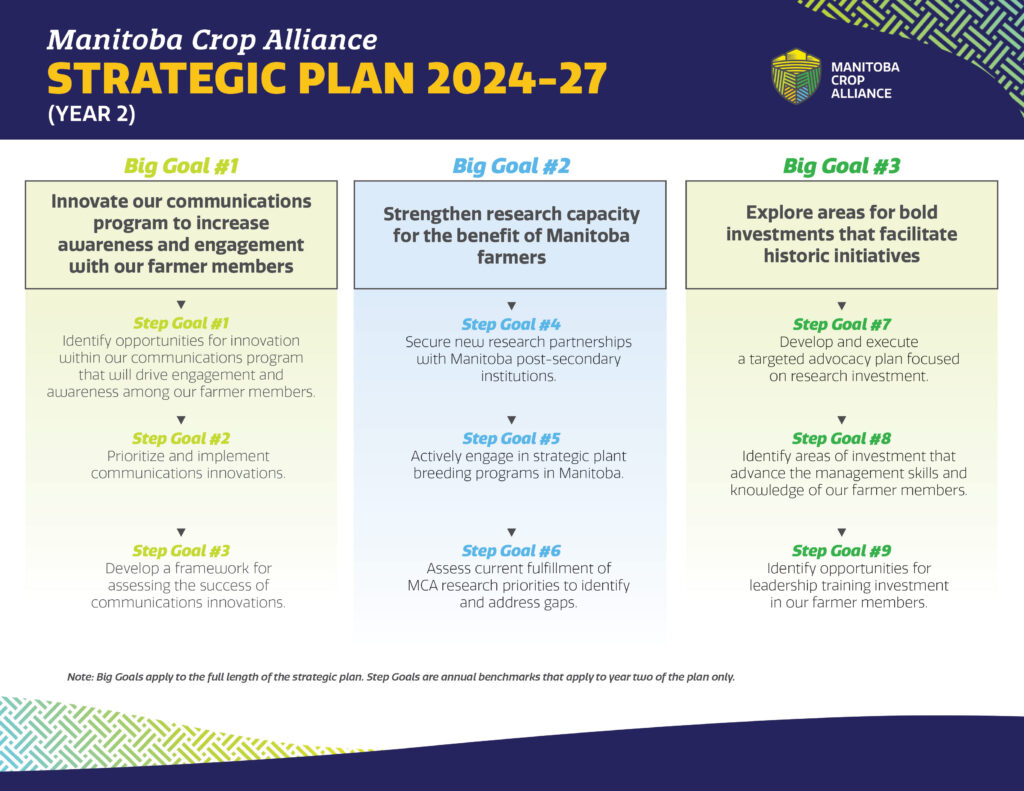
This three-year plan was developed in 2024 to consciously guide MCA’s future. The plan consists of three Big Goals that will be achieved over the next three years. The plan also consists of nine sub-goals, known as Step Goals. Each Big Goal has three associated Step Goals, which are annual benchmarks and priorities that are to be achieved in a one-year timeframe.
Big Goal #1: Innovate our communications program to increase awareness and engagement with our farmer members.
Step Goal #1:Equip MCA staff to better understand the most effective ways to engage with our farmer members.
This Step Goal required staff to redefine how they approach communicating and engaging with farmers to ensure genuine programming impact. Step Goal #1 was completed and built a strong foundation for continued innovation of MCA’s communications program.
Major win: MCA staff members completed additional communication training to better understand the most effective way of communicating with our farmer members.
Step Goal #2: Conduct audience research and generate ideas for engagement and awareness that can be implemented through our communications frameworks.
Progress on Step Goal #2 has been meaningful but delayed. Due to the breadth of Step Goal #2, robust research is required to guarantee all audience inputs are folded into the development of the new communication framework.
Step Goal #3: Identify strategic communications initiatives informed by training and research that directly address the needs of our farmers members
No progress on Step Goal #3 occurred during 2024-25.
Big Goal #2: Discover and fund ground-breaking research.
Step Goal #4: Identify key priorities for investment to build Manitoba research capacity
MCA staff identified and met with research partners to understand Manitoba’s agricultural research capacity gaps. These meetings culminated in the identification of key gaps and potential solutions.
Major win: three priorities for support were identified and brought forward to the MCA board of directors.
Step Goal #5:Secure north/south partnerships to develop mutually beneficial research collaborations and investment opportunities.
Partnerships are key relationships that increase research capacity by leveraging talents and facilities to fulfill knowledge gaps. Corn and sunflowers were identified as the two crops with an absence of research partnerships and were prioritized in this Step Goal. Through in-person and online meetings, strong connections were established with funding organizations and research institutions.
Major win: MCA became a voting member of the National Sunflower Association and collaborator with the North Dakota Corn Council. Both partnerships have led to MCA research priorities being fulfilled.
Step Goal #6:Expand Research on the Farm (ROTF) program.
Over the last year, MCA’s ROTF program grew in the number of protocols offered and trials conducted. Additionally, a revamped website presentation has made it easier for ROTF trial data to be accessed and used by farmers.
Major win: MCA introduced five new protocols for the 2025 growing season, including MCA’s first whole farm protocol.
Big Goal #3: Explore areas for bold investment that unlocks hidden potential and fuels historic progress.
Step Goal #7: Conduct a study to identify value-added opportunities in Manitoba that would open new markets for MCA commodities.
MCA encountered several roadblocks in pursuit of Step Goal #7. As a result, this Step Goal was not completed.
Step Goal #8:Increase support to consumer outreach initiatives that educate and inspire the next generation.
MCA worked with Agriculture in the Classroom – Manitoba (AITC-M) to build upon their already strong programing to ensure young people gain an early understanding of farming and where their food comes from.
Major win: MCA made a historic investment of $195,000 in AITC-M’s classroom garden program. Read the full announcement here.
Step Goal #9:Conduct a “hopes and dreams” assessment with our partners in research and market development to highlight future opportunities for investment.
MCA staff reviewed and evaluated proposals from research and market development partners. All participating organizations had a shared vision and commitment to ensuring Manitoba farmers thrive.
Major win: MCA identified multiple new opportunities for bold investment to make historic changes for Manitoba farmers.
Manitoba Crop Alliance (MCA) recently developed and released new Step Goals and tweaked Big Goals for year two of its strategic plan. The newly developed Step Goals establish a bright and bold direction for the next year, while the Big Goals tweaks focus and specify MCA’s overarching goals over the next two years. The MCA board of directors and staff worked collaboratively to make these updates. Below is the breakdown of year two of the strategic plan. For a look back on the activities, achievements and challenges from year one of the strategic plan, please click here.
Big Goal Tweaks
There were a few tweaks made to Big Goals, most notably the wording of Big Goal #2. The new wording is more descriptive, emphasizing the intent to build research capacity for the benefit of Manitoba farmers. This change has made the Big Goal more specific and will guide MCA choices towards realizing our strategic vision.
Big Goal #2: Strengthen research capacity for the benefit of Manitoba farmers.
New Step Goals
Eight new Step Goals were developed spanning all three Big Goals. Many (but not all) of the new Step Goals build on the results of last year’s.
The newly developed Step Goal #1 is a continuation of two Step Goals from last year that weren’t completed.
Below is MCA’s strategic plan for 2025-26. Stay tuned for more information regarding MCA’s strategic plan, which will be shared on our website and in our print and digital publications!
On Dec. 11 and 12, 2024, Manitoba agronomists met to discuss the latest developments in pest, crop and soil management. This year, the conference theme was “Strategies for Winning Agronomic Battles: A Case Study on Herbicide Resistant Weeds.” Much of the research shared at the Manitoba Agronomists’ Conference was funded in part by Manitoba Crop Alliance (MCA). Below is a summary of the posters shared that feature MCA-funded research.
Crop Management
Climate and Fall Shoulder Cover Crops: Where Do They Intersect? Emmanuel Agyapong, Afua Mante, Yvonne Lawley, Francis Zvomuya, University of Manitoba
Response of lodging-related morphological traits of wheat to nitrogen fertilization and plant growth regulator Gurnoor Kaur, Ginelle Grenier, Douglas J. Cattani, Pham Anh Tuan, Belay T. Ayele, University of Manitoba
Genomic analysis of preharvest sprouting associated alpha amylase activity in barley Rui Wang, Gurkamal Kaur, Belay T Ayele, University of Manitoba, Marta S Izydorczyk, Canadian Grain Commission, Dean Spaner, University of Alberta, Aaron D Beattie, University of Saskatchewan, Ana Badea, Agriculture and Agri-Food Canada
Identification of genetic loci for lodging resistance in spring wheat (Triticum aestivum L.) Ginelle Grenier, Curt McCartney, Belay T. Ayele, University of Manitoba, Muhammad Iqbal, Dean Spaner, University of Alberta, Gavin Humphreys, Agriculture and Agri-Food Canada
Optimizing Pea Production in Manitoba Rotations: Yield and Quality Ramona Mohr, Mohammad Khakbazan, Yong Min Kim, Maria Antonia Henriquez, Monika Gorzelak, Agriculture and Agri-Food Canada
On-Farm Understandings: Assessing the Impact of Seeding Rates on Wheat and Sunflower Grain Yield and Quality through On-Farm Trials Andrew Hector, Morgan Cott, Manitoba Crop Alliance
Are Intercropped Cover Crops Compatible with Canola Weed Management? Janelle Gawiak, Yvonne Lawley, University of Manitoba, Maryse Bourgault, University of Saskatchewan, Linda Gorim, University of Alberta
Effect of integrated crop management strategies on weed control and crop yield in wheat Uthpala Ekanayake, Rob Gulden, Jonathan Rosset, Dilshan Benaragama, University of Manitoba, Chris Willenborg, University of Saskatchewan
Assessing crop and weed management impacts on wheat crop and weeds through drone-based remote sensing Shirmith Nirmal, Rob Gulden, Dilshan Benaragama, University of Manitoba, Steve Shirtliffe, Christian Willenborg, University of Saskatchewan
Effects of Tile Drainage on Soil Salinity in Southwestern Manitoba Soils David Whetter, AgriEarth Consulting Ltd, Bruce Shewfelt, PBS Water Engineering Ltd
Co-Composting with Struvite: Enhancing Phosphorus Availability in Low-P Prairie Soils Amanda Desrochers, Inoka Amarakoon, Joanne Thiessen Martens, University of Manitoba
Thank you to the conference partners, University of Manitoba, Manitoba Agriculture and the Prairie Certified Crop Advisor Board, for hosting an excellent conference!
Manitoba Crop Alliance (MCA) is proud to support agriculture’s next generation. MCA’s bursary program is designed to assist with the financial needs of students pursuing education in a field that will benefit the agriculture sector.
Six post-secondary students from Manitoba have been awarded with MCA 2024-25 bursaries valued at $2,000 each. The 2024-25 bursary recipients are Mika Cleave from Ochre River, Noah Kaminsky from Brunkild, Chad Pouteau from Mariapolis, Layne Thompson from Ochre River, Jadyn Wiebe from Plum Coulee, and Abby Mazier from Justice.
“Educating and inspiring the next generation is a strategic priority for our organization,” says MCA chair Robert Misko. “Each of our bursary recipients has chosen to pursue their passion and expand their knowledge, and I hope they will eventually use that knowledge and passion to advance our industry.”
Bursary applicants needed to meet the following criteria:
Have completed a minimum of one year (two terms) of post-secondary education at the college or university level (diploma or degree) and are enrolled full-time for the 2024-25 school year in an agricultural program within Canada.
Have achieved a minimum cumulative grade point average (GPA) of 3.0.
Have an interest in wheat (spring or winter), corn, barley, flax or sunflower crops, or agriculture in general, as demonstrated in a brief, one-page letter.
Are from a farm that is a member in good standing with MCA
Have not previously been awarded an MCA post-secondary bursary (past high school bursary recipients remain eligible for a post-secondary bursary).
An independent selection committee was contracted to evaluate the applicants based on their connection to or interest in agriculture, explanation of why they decided to enrol in an agriculture-related post-secondary program, how they hope to benefit the agriculture industry once they have graduated and are in the workforce, and their academics and writing skills.
This year, the selection committee included Curtis Cavers, an agronomist with Agriculture and Agri-Food Canada based in Portage la Prairie, and Loveleen Kaur Dhillon, the agronomist in residence for special crops at the University of Manitoba.
Born and raised in southern Manitoba, Cavers holds a bachelor of science in agriculture, majoring in soil science, and a master’s degree from the University of Manitoba. Prior to assuming her current role at the University of Manitoba, Dhillon completed her PhD in plant science at the University of Saskatchewan and was working as a post-doctoral fellow.
Thank you to the selection committee for evaluating the bursary applications and congratulations to the 2024-25 bursary recipients!
The 2024 nomination period for delegates positions on our four crop committees took place from July 2 – Oct. 1, 2024.
In total, 16 farmer members were nominated for 17 available delegate positions across the four crop committees and were thereby elected by acclamation. Among those 16 delegates, eight are new to their respective committees.
Read on to learn more about the newest additions to our crop committees:
Corn
Craig Riese (St. Andrews, MB)
Craig Riese farms in the St. Andrews and Selkirk area with his wife Crystal and two sons. Together they operate Westphalia Farms Ltd., where they grow corn, soybeans, wheat and canola. They added corn to the rotation in 2016 and currently grow about 800 acres.
Riese’s past and current industry involvement has included serving as a delegate and director with Keystone Agricultural Producers, as well as a delegate with Manitoba Pork. He has found corn to be a great addition to his farm and continues to learn and adapt to the challenges that come with its nature as a late-season crop.
Patrick Gamache (Laurier, MB)
Patrick Gamache is a sixth-generation farmer who farms in Laurier with the help of his parents, grandfather and employees. Currently, their main crops are wheat, canola, soybeans, edible beans and corn, but they have also grown rye, barley, oats and meadow fescue. Apart from grain farming, Gamache was also a seed grower and co-owner in an ag retail business for several years, in addition to working with cattle. He is passionate about agriculture and aims for perfection on his farm.
Gamache attended the University of Manitoba, where he received is agriculture diploma. He has volunteered with Agriculture in the Classroom – Manitoba, does community work in his hometown and has been a volunteer firefighter for 11-plus years. He is looking forward to being more involved with Manitoba Crop Alliance.
Flax
Myles Kubinec (Holland, MB)
Myles Kubinec farms with his wife Anastasia and his father-in-law in Holland, growing both commercial and pedigreed seed. He is originally from a mixed operation in Alberta and received a degree in mechanical engineering from the University of Alberta. Kubinec and his wife have three sons that are also involved in the operation, when they’re not keeping their parents running to sports.
Amanda Ellis (Wawanesa, MB)
Amanda Ellis is co-owner/operator with her husband Simon of Black Creek Farm Ltd. and Ellis Seeds, a third-generation, 1,500-acre seed farm and retail. They grow flax, wheat, oats, peas, soybeans and canola, as well as the occasional “project” crop, such as hemp or millet.
Ellis has a diploma in business-finance from Assiniboine College and previously worked in finance at a Credit Union. She is interested in being involved in the agriculture industry, often volunteering for pilot projects and research studies. These have included participating as a panellist for University of Manitoba agriculture presentations and co-hosting farm tours for students and the public.
Ellis believes there is great market potential for flax, with growing demand in health food and pet food, as well as opportunity for research and the development of new, higher-yielding varieties. She is enthusiastic and curious to see what she can learn from and share with the flax crop committee.
Sunflower
Andrew Saramaga (Hazelridge, MB)
Andrew Saramaga is a fourth-generation farmer who works with his dad and a few employees in the Hazelridge area. Together they grow a variety of crop types, including corn, soybeans, spring and winter wheat, canola, sunflowers and various forage seeds.
Saramaga received his degree from the University of Manitoba. From there, he got involved in the early days of soybean production and marketing. This led to an opportunity to get involved with the former Manitoba Pulse Growers Association (now Manitoba Pulse & Soybean Growers), where he chaired the association for two years.
Saramaga’s farm has been growing sunflowers for about 15 years, starting with confection types and moving to black oil types in the last few years. He is excited to bring his experience to the sunflower crop committee and help further the sunflower industry in Manitoba.
Wheat and Barley
Carly Chatham (Killarney, MB)
Carly Chatham farms with her husband Cody at his family farm, Chatham Seeds, in Killarney. The Chathams are seed growers and continue to produce top-of-the-market wheat varieties. Chatham was born and raised in Carman and has been involved in the agriculture industry since she was a student.
Chatham obtained her agriculture diploma and bachelor of science in agriculture at the University of Manitoba. She has had job roles in research as a technician in small-plot work and breeding, worked at Paterson Grain as a sales agronomist and spent the last seven years as an independent agronomist at Field 2 Field Agronomy. She also holds a designation in the Prairies as a Certified Crop Advisor.
When she’s not working, Chatham enjoys golfing and a little bit of curling in the winter. She believes Canada is a top wheat-producing nation and would like to see us continue to grow the best wheat in the world.
Marcus Loeppky (Niverville, MB)
Marcus Loeppky farms in the Niverville area, where he grows wheat, oats, canola, soybeans and corn on approximately 4,800 acres with his cousin Paul. He has been married for 20 years to his wife Candice and they have two girls, Taylor (14) and Morgan (11).
Ty Ballard (Bield, MB)
Ty Ballard has been a dedicated grain farmer growing wheat, peas and canola for many years on his family farm, Rockin’ Cattle Company Inc., in Bield. He believes the increasing global demand for wheat and barley is a good opportunity for Manitoba farmers to heavily contribute to the industry and grow the market for the crop. He also believes wheat and barley are excellent choices to have in any crop rotation for a high-yielding crop.
When you’ve been farming your whole life, it’s easy to think you’ve seen and done it all – that there’s nothing else for you to learn about the job or the industry. Thanks to my decision six years ago to put my name forward to become a director for the Manitoba Corn Growers Association, I’m happy to report that couldn’t be further from the truth.
Like many farmers, my introduction to agriculture happened when I was young, growing up on the family farm. I spent some time away to go to university, and then to live and work in New Zealand for a growing season to learn about agriculture there, before returning to the family farm, where I’ve been for the last three plus decades. Through it all, I was extremely curious about the industry and thought about getting more involved, but it still took a bit of a coincidence for me to take the leap.
Six years ago, I was at the CropConnect Conference when I heard that the Manitoba Corn Growers Association was looking for new farmers to join its ranks. I said I might be interested, one thing led to another, and before I knew it, I was in. When Manitoba Crop Alliance (MCA) was formed in 2020 from the amalgamation of the Manitoba Corn Growers Association and four other crop commodity organizations, I stayed on to become a delegate of MCA’s corn crop committee, and then had the privilege to be nominated to serve as one of the inaugural directors for the organization.
I understand there are a lot of reasons people are reluctant to put their name forward. You might be nervous you’re not going to be able to offer much or feel like your opinion might not be needed, but that isn’t at all the case. In fact, it was completely the opposite. The committee and the organization were very welcoming from day one and showed me there was nothing to worry about. My input and perspectives were valued, and it quickly became clear each member of the organization had something unique to offer.
MCA staff are there to support you every step of the way and answer any questions you might have. They are passionate about finding innovative ways to help producers in the province now and into the future, and it feels meaningful to be a part of that important work.
One reason I encourage all farmers to get involved is to help determine where your check-off dollars are invested. Ensuring those investments align with the priorities of farmer members across the province is a major responsibility and one I don’t take lightly. The second reason is just as valuable: becoming a delegate is an incredible opportunity for personal growth.
My time as an MCA delegate has been an amazing learning experience. Manitoba is a diverse province, with many different climates, soils and types of crops being grown. As a result, I leave every crop committee and board meeting having learned something I didn’t know before from one of my fellow delegates or directors. Since 2018, my personal development has been dramatic, taking me from a delegate on the corn crop committee to an MCA director and now to an additional role as a director with the Grain Growers of Canada. During that time, everything I learned about agriculture in Manitoba and across Canada has made me a better farmer and a better advocate for our industry.
None of this would have been possible without taking the first step. As my dad always said, “You can’t finish until you start.” Looking back with those wise words in mind, my only regret is that I didn’t get involved sooner.
So, don’t make the same mistake I did – regardless of where in the province you call home, how long you’ve been farming or how much you think you know, the time to “start” is now.
Jonothan Hodson is a director and corn crop committee delegate with Manitoba Crop Alliance, as well as a director with the Grain Growers of Canada. He and his family farm near Lenore, MB.
Manitoba Crop Alliance (MCA) is proud to support agriculture’s next generation. MCA’s bursary program is designed to assist with the financial needs of students pursuing education in a field that will benefit the agriculture sector.
Six graduating high school students from Manitoba have been awarded with bursaries valued at $1,000 each. The six bursary recipients are Alara Krahn from Mather, Laura Delichte from St. Alphonse, Riley Jorgensen from Cromer, Madisyn Robertson from Neepawa, Zenith Vanstone from Miami, and Evan Whetter from Alexander.
“I’d like to offer my sincere congratulations to our inaugural high school bursary recipients and wish them well in their continued studies,” says MCA Chair Robert Misko. “MCA is committed to supporting agriculture’s next generation and expanding our bursary program is one way we have demonstrated that commitment.”
To qualify for these bursaries, applicants did not need to be continuing into an agriculture-specific program. However, they did need to clearly articulate how their continued studies would help them benefit the agriculture industry.
An independent selection committee was contracted to evaluate the applicants based on their connection to or interest in agriculture, how they hope to use their education to benefit the agriculture industry, and their academics and writing skills.
This year, the selection committee included Adelle Gervin, program manager with Agriculture in the Classroom – Manitoba; Sonia Wilson, oilseeds specialist with Manitoba Agriculture; and Santosh Kumar, research scientist at Agriculture and Agri-Food Canada’s Brandon Research and Development Centre.
Gervin graduated with a bachelor of science in agriculture (animal systems) from the University of Manitoba in 2019. She strives to educate today’s youth on our agricultural story and show them her perspective as a cattle rancher and “agvocate.”
Wilson recently started her role with Manitoba Agriculture, which includes focusing on special crops such as flax and sunflower. She has a background in agriculture focused on plant genetics and research.
Kumar completed his master’s degree at the Indian Agricultural Research Institute in New Delhi, India, before moving to Canada for his PhD. As a PhD student at the University of Manitoba, he worked on barley physiology and genetics. His current area of research includes wheat variety development, climate resilience and clean environment trait introgression, and targeted trait manipulation.
Thank you to the selection committee for evaluating the bursary applications and congratulations to the recipients!
Agricultural research is fundamental to the continued productivity and sustainability of Manitoba farmers and supporting high-quality research is foundational to the mission and vision of Manitoba Crop Alliance (MCA).
The research needs of farmers are unique, accounting for diverse geographic regions and crop types, and constantly evolving in response to consumer demand, climate and other factors. As a result, Manitoba’s research community must be well positioned to meet the current needs of farmers, while also anticipating the challenges they will face in the future.
We recently engaged Backswath Management to execute a study evaluating the existing crop research capacity in Manitoba. Most public and private research institutes contacted in the Backswath survey were interested in collaborating with MCA to meet farmer research objectives, but many cited barriers to initiating or expanding collaboration.
The study identified four main challenges facing research capacity in Manitoba:
Equipment was frequently cited as a limitation to meeting the research needs of Manitoba farmers. Increased demand on existing equipment and the need for new or specialized research equipment were emphasized in several survey responses. Barriers to addressing equipment challenges were often related to funding programs and reduction in funding at research institutions.
Infrastructure and access to land has created challenges for numerous private and public researchers in Manitoba. At public institutions, existing infrastructure is aging and not keeping pace with current demand or technological advancements. Meanwhile, the creation of new infrastructure has been slow, or non-existent. Demand for currently owned land at research stations is high and renting land from farmers can be challenging.
Program funding was strongly correlated to existing limitations of equipment, infrastructure and land access. Many funding programs limit the ability to offset the cost of capital expenses and do not allow expenditures related to ongoing maintenance and repair. Current funding structures were also noted as limiting the capacity to address certain research questions. Many funding programs are limited to a three- to five-year research project. As research questions become more complex, the need to fund longer-term studies is critical to adequately address these challenges. Funding programs have also become increasingly time consuming, placing strain on researchers and their staff to undertake administrative responsibilities, which take up time that could otherwise be spent conducting research.
Human resources are a significant challenge to research capacity. Recruitment and retention, as well as identifying skilled workers, were noted as limitations for both private and public research institutions. Competition from private industry outside the research field and adequate compensation were noted as barriers to addressing human resource related challenges in research.
We will carry out additional in-depth discussions with both private and public partners to determine the next steps to increase research capacity in Manitoba. We recognize the importance of fostering strong relationships between industry and research. By pursuing direct engagement with the Manitoba research community, we hope to improve communication, provide context for Manitoba farmers’ research objectives and identify opportunities to collaborate with new and existing members of Manitoba’s research landscape.
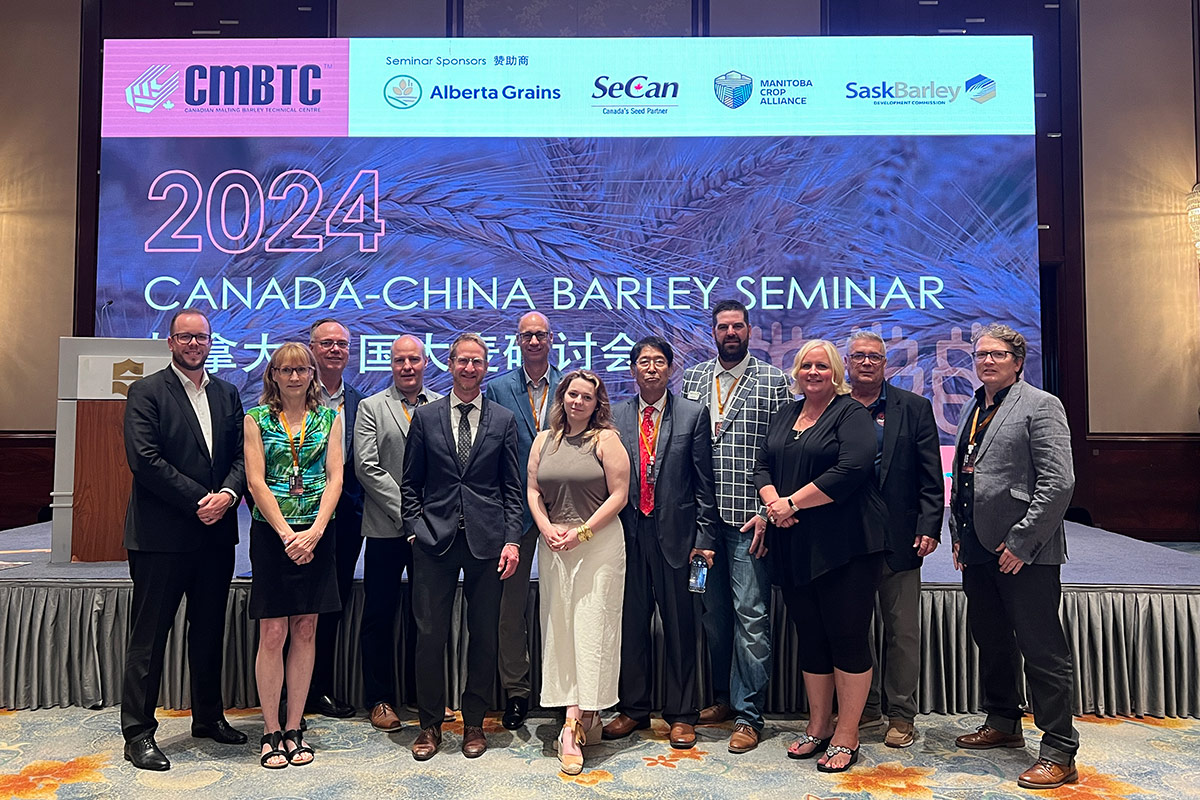
As member of the Canadian Malting Barley Technical Centre (CMBTC), Manitoba Crop Alliance (MCA) participated in the 2024 Canada-China Barley Seminar in Qingdao, China, from June 19-20. This CMBTC-hosted seminar aimed to strengthen relationships with a key market for Canadian barley by connecting the Canadian barley value chain with Chinese maltsters and brewers.
“The seminar provided a unique platform for the Canadian barley value chain to engage directly with Chinese maltsters and brewers to cover critical aspects of Canadian barley supply and quality, production practices and sustainability,” says CMBTC chair Jon White. “China is a key market for Canadian barley. This event was pivotal in showcasing our superior quality to our end users.”
Farmers, as well as representatives from Canada’s world class barley breeding programs and grain suppliers, represented the Canadian barley value chain at the seminar.
Meetings were held at Tsingtao Brewery and Hyaline Malting Co., with a concurrent conference. Tsingtao Brewery was founded in 1903 and is ranked in the top five global brewers. Hyaline Malting, a former naval air base turned into a malt processing plant, has supplied Tsingtao Brewery with malt since 2005.
MCA director and wheat and barley crop committee delegate Sheila Elder travelled to Qingdao to represent MCA. She joined two other farmers and a representative from Richardson on a panel discussing the sustainability of Canadian grain production.
Elder was asked about Manitoba’s “much wetter” climate compared to the other two Prairie provinces. “Although the last couple of years have not felt so wet, this year is a different story,” she says.
“This led me to talk about how yield is not our only objective when choosing a variety; we need a variety that has resistance to Fusarium and is not as prone to lodging as earlier varieties were. Fortunately, thanks to our world-class breeders, we have great options to choose from.”
On the theme of collaboration, Elder also highlighted some of the resources farmers have access to in Canada to help them make the best management decisions throughout the growing season. These include access to highly trained experts, such as crop pathologists, entomologists, weed specialists, crop specialists and agronomists, as well as commodity organizations like MCA who have agronomists on staff.
The importance of farmer participation in the seminar was evident. Farmers like Elder could address Chinese maltsters and brewers’ specific questions and concerns about barley production, fostering trust and strengthening the relationship between our two countries.
Sheila also talked about how much pride farmers take in growing the best crops possible, as well as the importance of collaboration within the industry.
At one meeting with brewers, glyphosate came up as a concern. White, who in addition to being chair of CMBTC is also a merchandiser with Viterra, addressed this by explaining how malt barley samples are probed and tested at many different stages, reinforcing how well malt barley is tested for glyphosate.
It was evident to Elder that having many parts of the barley value chain represented at the seminar was important for the Chinese maltsters and brewers. “It was quite clear they value building relationships through face-to-face meetings and would like to see those from the value chain more often.”
With China’s doors open to trade with Australia, the seminar arrived at an important moment. Canada’s barley is well known for its high quality, but that quality comes at a premium, partly due to longer shipping distances and related costs when compared with Australia, for example.
“In today’s competitive global market, seizing opportunities to foster trusted and mutually beneficial relationships at home and around the world is crucial” says CMBTC managing director Peter Watts.
“End users are keenly interested in the systems and standards that distinguish Canada’s barley supply, quality and performance. This seminar was tailored to address the evolving needs and interests of international end users, who seek products that will meet their current and future needs, as well as insights into the Canadian system.”
From left to right: Jon White (Viterra), Sheila Elder (farmer, MCA), Roy (Leroy) Newman (farmer, Alberta Grain), Peter Schutz (Richardson), Peter Watts (CMBTC), Aaron Beattie (University of Saskatchewan Crop Development Centre), Hayley Stacey (CMBTC), Yueshu Li (CMBTC), Cody Glenn (farmer, SaskBarley), Jackie Oakes (Cargill), Al Morris (independent grain buyer) and Matt Enns (farmer, SaskBarley).
Qingdao (home to Tsingtao Brewery) is where the sailing events were held for the 2008 Olympics. This large, red sculpture symbolizes the Olympic flame.

















 By Jonothan Hodson