
You’ve Got to be Chitting Me: What are Rapid Visco Analysis and Falling Number?


By Andrew Hector, Agronomy Extension Specialist – Cereal Crops, Manitoba Crop Alliance
This year’s challenging harvest has put a focus on not only grain yields but also grain quality. A major concern has been pre-harvest sprouting (PHS) in wheat and barley grains. PHS is the premature spouting of mature wheat and barley, while the grains are in the head prior to harvest. In the malting barley industry, this is also known as chitting.
Environmental conditions (precipitation, relative humidity, and temperature) at harvest have a large influence on the severity of PHS, with rain and heavy dews contributing significantly. Genetics also influence PHS risk, with some varieties having more PHS resistance than others. For spring wheat, sprouting resistance levels can be found in Seed Manitoba.
Two measurements are frequently used when discussing PHS: falling number (FN) and Rapid Visco Analysis (RVA). Each test is used for a different crop type and use different protocols. Both tests indirectly measure alpha amylase enzyme activity/levels in the grain. In the early stages of germination, alpha amylase converts kernel starches into sugars, feeding the sprout. More alpha amylase equals increased starch breakdown, resulting in lower FN and RVA number.
Although neither of these measurements are official CGC grain grading factors, they have become more common in grain contracts and are routinely conducted by grain buyers and end users. More information about both tests can be found below:
Falling Number:
- Used to understand and assess grain quality and PHS damage in wheat.
- Importance:
- Low FN affects end use quality of baked goods. Ex. loaf volume and poor crumb structure.
- Domestic and international end users prefer wheat with a falling number between 250-300 seconds1. It is important to note, that FN can also be too high, impacting baked goods quality1.
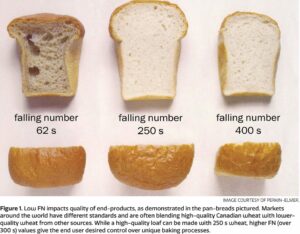
- Managing low FN:
- Segregate impacted grain.
- Get your grain tested.
- The relationship between alpha amylase and FN is not linear. Thus, proportional blending will not work. If blending use caution.
- Additional Resources:
Rapid Visco Analysis:
- Used to understand and assess grain quality and pre-germination in malting barley2.
- Importance:
- PHS is detrimental to grain germination energy (GE). The GE of stored PHS malting barley will deteriorate more quickly, compared to non-sprouted grain. The extent of PHS influences how long PHS grain can be stored before losing GE.
- RVA values provide a general risk level of potential rapid germination loss in stored grain due to PHS3. However, grain moisture, temperature, relative humidity and other storage conditions will impact the safe storage durations.
Table 1. Summary of RVA values and the associated risk of GE loss in stored barley grains2.
|
Risk of rapid germination loss in storage |
RVA Final Viscosity (RVU) |
|
Low |
>120 |
|
Intermediate |
50-120 |
|
High |
<50 |
- Managing low RVA malting barley:
-
- Get your grain tested. Knowing the degree of PHS will give you an idea of risk GE loss.
- Segregate impacted grain.
- Additional Resources: