Loveleen Dhillon, agronomist in residence special crops, University of Manitoba

Follow @LoveleenKaur024 on X.

Loveleen Kaur Dhillon joined the University of Manitoba (UM) as its agronomist in residence for special crops in February 2025, a new five-year position funded by Manitoba Crop Alliance (MCA). She grew up on a farm in Punjab, India, and has always been fascinated by what makes crops adapt and thrive across varied soils, seasons and climates.

Dhillon earned her bachelor’s and master’s degrees in agricultural biotechnology at Punjab Agricultural University, then completed her PhD in plant science at the University of Saskatchewan. After her PhD, she worked as a postdoctoral fellow on agronomy and plant breeding-related projects before moving to Winnipeg in 2024. She lives with her husband, two-year-old son and mother-in-law.

What got you interested in this area of work?

My interest in agriculture really initiated in Grade 12, when a guest speaker from an agricultural university came to our school. I was already used to talking with my dad about crops, and I had always been fascinated by how a tiny seed could push through the soil and grow into a plant. When I entered university, something just clicked, and I knew this was the field for me. I had the chance to learn from experts in rice and wheat breeding, and being from Punjab, where nearly 70 per cent of people are connected to agriculture, it felt like a natural path.

Can you tell us about your role at UM?

As the agronomist in residence for special crops, my research looks at corn, flax and sunflowers. Currently, my focus is finding the critical period for weed control in these crops. This year I had trials running across different locations in Manitoba, working with the diversification centres, private contractors and trials at UM’s research farm at Carman.

Apart from weed control, I’m collaborating with researchers from Agriculture and Agri-Food Canada (AAFC) Ottawa on corn cold tolerance trials. They’ve generated corn inbred lines that can be seeded in cold soils, which could be exciting for Manitoba because of our shorter, colder growing season. I’m also looking at different seeding windows for corn, testing various seeding dates and varieties to see what works best for Manitoba.

Research planning takes a lot of my time. Being new to my position at the university this year, I had to set up my lab, develop protocols and manage the administrative work, while also being on the road most of the summer. Once the plants were out of the ground, I was busier than ever, but it was fun to be outside visiting sites and watching the crops grow.

This winter my focus will shift to extension, going to conferences, meeting farmers and communicating what we’ve found this summer. I’m excited to see the results and hope to have more to share once I analyze the data over the winter.

What can you say about the value of farmers providing funding and support to your program?

One word: thanks! It’s incredibly motivating to know that farmers are investing in my work. It tells me that they are open to exploring new possibilities for their farms, and it challenges me to deliver research that truly makes a difference. Farmers’ support means everything, and for that I am deeply thankful.

How does that farmer funding and support directly benefit farmers?

Farmers invest in this research because they see potential in these crops and want answers to the challenges they face. My role is to take those questions about weeds, fertility or management and turn them into practical solutions. It really is a partnership – farmers provide the support, and we work to deliver research that helps improve their operations. That funding directly translates into recommendations on what fertilizer works best, when to apply it or how to manage weeds more effectively. I’m deeply grateful for their trust, and I hope they continue to grow these special crops. They’re called “special” for a reason – they can bring real value to their farms.

What do you like to do outside of work?

Life with a two-year-old can be busy, but I enjoy cooking and reading.

What is the best part about your job?

From an early age, I knew I wanted to contribute to advancing farming practices, and that’s what excites me most about my job. I get to do exactly what I always dreamed of doing. During my PhD, I worked on promoting the adoption of field peas in Saskatchewan, and now I’m focused on special crops, supporting the adoption of these crops that can strengthen agriculture and promote sustainability. Every new project I take on is designed with farmers in mind. For me, the best part of this job is being able to use science to make a real difference in farmers’ lives.

What are you excited about for the future of agriculture?

What excites me most is how fast agriculture is evolving. We’re updating the basics, yes, but also stepping into a future shaped by plant breeding breakthroughs, faster cropping systems and AI-driven tools. These innovations are transforming farming in ways we couldn’t have imagined a few years ago. Agriculture has always been resilient, and I believe its future is brighter than ever.

Who or what inspires you?

My greatest inspiration comes from the farmers themselves. The trust they place in me through MCA, and even a simple letter from a farmer sharing their excitement about this agronomist role, reminds me that this work matters. Their support, both personal and financial, drives my commitment to stay honest, dedicated and focused on research that serves them. In many ways, their confidence is what drives me to give my very best.

Follow @LoveleenKaur024 on X.

Grains Week 2025: Farmers Take Their Priorities to Parliament Hill

Every year, Grain Growers of Canada (GGC) brings grain producers to Ottawa for Grains Week, a focused day of meetings, discussions and events designed to ensure that growers’ priorities are front and centre with parliamentarians. It is one of the most important advocacy efforts we undertake each year, connecting the realities of grain farming directly to the policy decisions that shape our sector.

This year’s Grains Week featured more than 30 meetings with ministers, secretaries of state, MPs, senators and senior staff, capped off by a well-attended Parliamentary reception that drew more than 150 guests from Parliament Hill. Farmers were divided into regional groups to cover as much ground as possible, sharing how federal decisions impact operations and outlining solutions to strengthen the competitiveness of Canadian grain.

In a single day of co-ordinated meetings, GGC members from across the country met with key decision-makers, beginning with a breakfast meeting with Minister of Agriculture and Agri-Food Heath MacDonald, to discuss how grain farmers and government can work together to advance shared priorities. Throughout the day, producers met with many others, including Leader of the Official Opposition Pierre Poilievre, Parliamentary Secretary to the Prime Minister Kody Blois and Parliamentary Secretary to the Minister of Agriculture and Agri-Food Sophie Chatel.

Meetings also included influential voices such as Finance Committee Chair Karina Gould, Secretary of State for Rural Development Buckley Belanger, Parliamentary Secretary to the Minister of Finance Ryan Turnbull, as well as critics and committee members from across party lines. In the Senate, we met with long-standing agricultural advocates, including senators Rob Black and Mary Robinson.

Across every meeting, our message was consistent: producers are ready to be part of the solution, but they need government to remove the barriers holding the sector back.

Our advocacy focused on four key issues. Farmers emphasized the need to reset Canada’s trade relationships and defend tariff-free access to key markets like the United States and China. With more than 70 per cent of Canadian grain exported, trade disruptions and new tariffs have a direct impact on farm incomes. Attendees urged the government to make agriculture a top priority in trade negotiations and to actively defend CUSMA in the upcoming 2026 review.

The second focus was trade-enabling infrastructure. Canada’s grain supply chain is under pressure, with the Port of Vancouver already at capacity and chokepoints like the Second Narrows Rail Bridge leaving the system vulnerable. Farmers made it clear that without urgent federal investment in ports, rail and bridges, delays will continue to erode both income and market confidence.

The third issue was the urgent need to reinvest in agricultural research and development. Total public spending in research has declined by nearly $200 million over the past decade, putting farmers at a disadvantage globally. We called for renewed federal support for Agriculture and Agri-Food Canada’s breeding and innovation programs, along with stronger partnerships that keep farmers directly involved in setting research priorities.

Finally, farmers reinforced the need to protect family farms by permanently reversing the capital gains tax increase. While government has signalled a possible reversal, the hike remains scheduled for January 2026, leaving uncertainty for farm families. For producers, their land and equipment are their retirement savings, and this tax would make it harder for the next generation to take over.

Beyond meetings, our message was visible throughout Ottawa. Advertisements downtown and in The Hill Times, along with targeted digital outreach, reinforced farmers’ priorities for trade, infrastructure, research and fair taxation.

The week concluded with GGC’s board of directors meeting and participation in stakeholder receptions, where members connected with industry partners and set advocacy priorities for the year ahead. To cap off the week, we were able to celebrate the association’s first ever recognition, receiving a Canadian Society of Association Executives (CSAE) Award of Excellence for our Protect Family Farms campaign that opposed the capital gains tax hike.

Grains Week is about ensuring farmers are heard where it matters most. By bringing producers face-to-face with decision-makers, we are making sure the future of Canadian grain farming is shaped by those who know it best.

Photo Gallery

The Fence Post: Fall/Winter 2025

Download The Fence Post: Fall/Winter 2025 (pdf)

Table of Contents


  • Message from the Chair: Cheers to five years
  • Message from the CEO: MCA at five
  • What’s new at MCA 
  • Five Questions with Andrew Hector
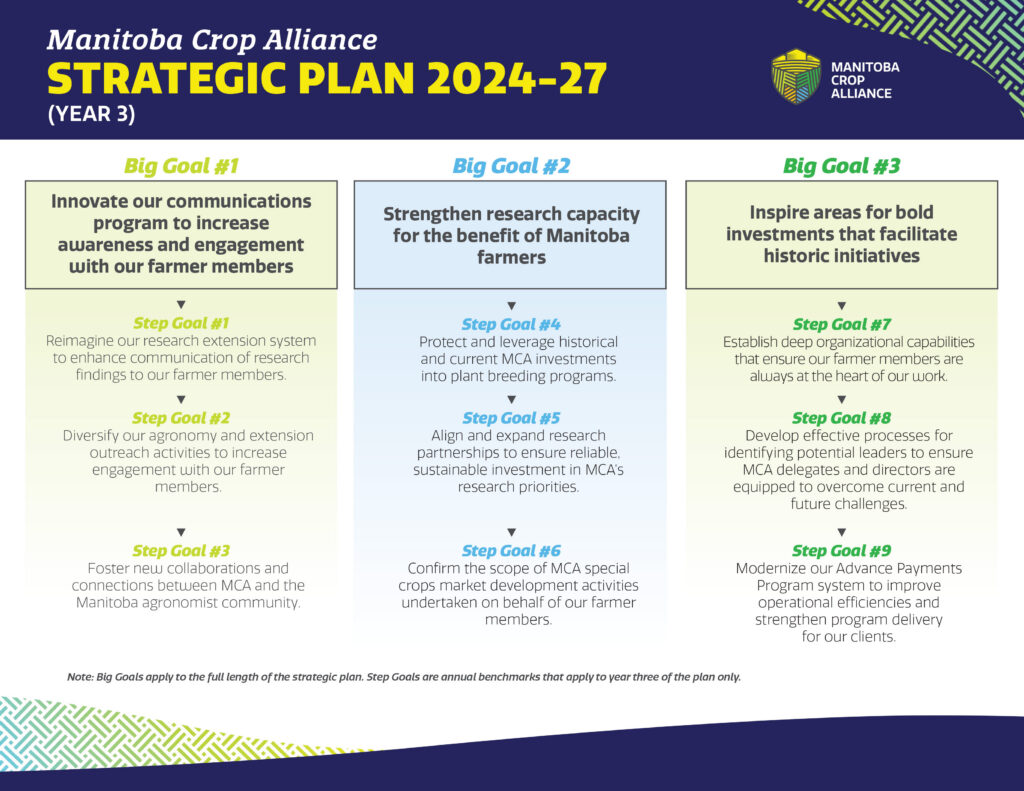
  • Cover: Manitoba Crop Alliance at five
  • Research & Production
  • Market Development
  • Advocacy
  • Strategy

Filiz Koksel, associate professor, University of Manitoba

Connect with Filiz Koksel on LinkedIn.

Filiz Koksel is an associate professor in the Department of Food and Human Nutritional Sciences (FHNS) at the University of Manitoba (UM). She was appointed Manitoba Strategic Research Chair in Sustainable Protein in July this year.

Born in Winnipeg while her father was completing graduate studies at UM, Koksel grew up in Turkey, where she earned her bachelor’s and master’s degrees in food engineering from Middle East Technical University in Ankara. She later returned to Winnipeg to complete her PhD in food science at UM and joined the Department of FHNS as a faculty member in 2017.

She lives in Winnipeg with her husband and their five-year-old daughter.

Tell us a bit about what you’re working on at UM.

My research focuses on food processing, transforming ingredients, both plant-  and animal-based, into nutritious, appealing foods. These processes range from mixing or milling for bakery applications, to extrusion cooking, which is a process used for making puffed snacks like Cheetos or breakfast cereals like Cheerios. Extrusion also allows us to produce a wide range of plant-based meat alternatives.

Broadly, my research explores how to process different ingredients from cereals, pulses, oilseeds and other materials into foods that are both nutritious and appealing to consumers. We test at the ingredient, processing and food levels, and measure a wide range of quality attributes.

We look at nutritional quality; for example, whether proteins or starches are digestible. Starch digestibility affects how quickly blood sugar spikes, while protein digestibility affects how efficiently our bodies absorb amino acids, the building blocks of proteins.

Another key area is techno-functionality, which refers to how food components interact with other components in their environment (e.g., water or oil). Can they bind oil and water? Form stable emulsions or strong gels? These properties are important for shelf life, stability and product texture.

Finally, we study the physical and sensory quality of the products, including appearance, texture and mouthfeel, all critical to consumer acceptance. Are high-protein snacks as crispy as their starchy counterparts? Do high-fibre cereals remain crunchy in milk? Why are plant-based meats sometimes chewier or gummier?

We’re also exploring advanced oxidative processes (AOP) in the “Decontaminating stored flax’ project funded by Manitoba Crop Alliance (MCA) and the Sustainable Canadian Agricultural Partnerhip (a joint federal, provincial and territorial program). Led by Dr. Jitendra Paliwal in collaboration with Dr. Claudia Narvaez, this project aims to reduce the microbial load in flaxseed – a growing concern, as flaxseed is increasingly consumed raw, such as sprinkled on yogurt. The decontamination work (a combination of UV light, hydrogen peroxide and ozone treatment) happens in Dr. Paliwal’s lab and my team studies whether flaxseed’s techno-functional properties, like water binding and gel formation, change after treatment.

What got you interested in this area of work?

My biggest influence was (and still is) my father, also a food scientist specializing in cereal products. He worked in a government lab in Turkey, and I remember visiting him as a child on Take Our Kids to Work Day. Watching cereal scientists test bread dough quality felt like playing in a giant Play-Doh factory, it was fascinating.

I was also very fortunate to have Dr. Martin Scanlon, now the dean of the Faculty of Agricultural and Food Sciences at UM, as my PhD supervisor. He gave me the freedom to explore areas that genuinely interested me, which shaped both my research direction and how I mentor students.

What can you say about the value of farmers providing funding and support to your organization?

Farmer support is essential for sustaining my research program. Their funding enables us to train students who often stay in Manitoba and become future industry experts. It also ensures that research findings flow back to the people who make the work possible. We regularly share reports and are always open to discussing results and implications directly with farmer organizations.

How does that farmer funding and support directly benefit farmers?

Food safety in flax and other grains is a major issue. While my focus is on techno-functionality, our team includes Dr. Claudia Narvaez, a food microbiologist, so we can address multiple aspects of the problem.

As flax becomes more popular for its nutritional benefits, microbial contamination has become a growing concern. Conventional treatments exist, but they can be costly or compromise quality. We are looking for safer, more cost-effective methods that maintain product functionality and help farmers expand markets, improve product quality and gain economic value from their crops.

How do you spend your time outside of work?

Five years ago, before I had my little one, my answer would have been very different! Most of my time now revolves around caring for my family. When I can, I enjoy live music and discovering new restaurants and cafes around Winnipeg.

What is the best part of your job?

Definitely being around students. While much of my time is spent writing grants and papers, I still spend time in the lab. I have a great team of M.Sc. and PhD students, research assistants and post-doctoral fellows. Their energy and curiosity keep the work exciting, and some days, I learn more from them than they do from me. It’s rewarding to watch them grow into the next generation of scientists and mentors.

What are you excited about for the future of agriculture?

Although my research has mainly focused on plant-based foods, my new chair role expands into hybrid and animal-based systems. I’m excited to explore how both sectors can work together toward sustainable and balanced protein production, which is vital for Manitoba’s agricultural future.

What is your favourite food or meal to cook?

I love baking bread. I have this passion for bread since my PhD, which focused on bubbles in bread dough, as they play a crucial role in texture and quality. Gas bubbles make up 10–15 per cent of dough after mixing and expand to 70–80 per cent in the final loaf. Without them, you’d have a dense brick instead of soft bread! For me, baking is meditative—a chance to slow down, unplug and just enjoy the process (even if the results aren’t always perfect).

Check out @foodprolab on Instagram or connect with Filiz Koksel on LinkedIn.

Roots to Results Webinar Series: tips, tricks and strategies for successful farm businesses

MCA_SM_Webinar Roots to Results series Generic X

Want to brush up on your farm business management skills and learn new ways to maximize value for your operation?

Our Roots to Results Webinar Series is your one-stop-shop for grain marketing strategies, tax considerations, farm finance tips, innovative crop insurance options and so much more.

All five presentations in the series are now in the books, but you can get caught up by reading key takeaways or watching the full recordings at the links below. 

Roots to Results Webinar Series Lineup

Planning Without Prediction: Using Data to Improve the Odds
Speaker: Chuck Penner, LeftField Commodity Research
Date: Nov. 18, 2025
Key takeaways
Watch the recording

Harvesting the Future: Farm Succession Planning & Tax-Smart Strategies
Speaker: Edith Frison, MNP
Date: Dec. 2, 2025
Key takeaways
Watch the recording

Staying Ahead of the Curve
Speaker: Evan Shout, Maverick Ag
Date: Jan. 6, 2026
Key takeaways
Watch the recording

Beyond Basic Coverage: Unlocking the Value of Crop Coverage Plus
Speaker: David Van Deynze and Scott Clayton, Manitoba Agricultural Services Corporation
Date: Feb. 4, 2026
Key takeaways
Watch the recording

Smart Financing for Manitoba Farmers
Speaker: Darcelle Graham, Manitoba Crop Alliance
Date: March 3, 2026
Key takeaways
Watch the recording

Justin Pahara, research scientist, Agriculture and Agri-Food Canada

Follow @jpahara on X.

Justin Pahara is a research scientist and project lead in nanotechnology (biotic stresses and adaptation) at Agriculture and Agri-Food Canada (AAFC) in Lethbridge. He earned an undergraduate degree in immunology and infection and a master’s in cell biology (cancer research) at the University of Alberta before completing a PhD in chemical engineering and biotechnology at the University of Cambridge in the United Kingdom.

Pahara lives on one of the longest-running family farms in Lethbridge County, established in 1918.

Where did you work before AAFC?

Before AAFC, I was in commercial entrepreneurship at Amino Labs, an educational biotechnology company that creates kits and tools for high school teachers and home learners to learn about genetic engineering and biotechnology. I created the main core technology for the company.

What got you interested in this area of work?

When I was young, I wanted to be a doctor, but during undergrad I became more interested in how medicines were created and who created them rather than prescribing them. That led me more toward research.

I was drawn to a gap within the space: most labs focus on developing RNA, but few focus on how to reliably deliver it to targets. I already had a background in nanotechnology from my chemical engineering studies, and the bigger question became how to apply it to agriculture. This felt like an area where I could make an impact.

Tell us a bit about what you’re working on at AAFC.

We focus on molecular delivery, engineering nanostructures about 10,000 times smaller than a human hair to go into different organisms. A current project funded in part by Manitoba Crop Alliance is “Screening RNA penetration to achieve gene knockdown in plants for the development of Smart Crop Technologies.”

Most crop treatments today are broad-spectrum, like insecticides or herbicides, and can impact a lot of different organisms and plants in our ecosystem beyond the target. As part of our program, we are working on building highly targeted crop treatments that only target what we want.

That is where RNA interference comes in. Plants and cells have mini-immune systems that chop up harmful RNA, from a virus for example, to prevent it from replicating. By sending in smaller pieces of RNA with the nanostructures we’re developing, we can tell plants to knock down or lower the expression of specific genes.

The challenge is delivery. Our focus is getting these nanostructures into plants, insects and fungi so they could be used by farmers. We’re looking at crop treatments like seed coatings or sprays that could work in the field.

This project began in April 2025, building on past research and learnings within our programs. We are targeting two genes to show proof of principle within this project. One is green fluorescent protein from jellyfish in engineered plants, which glows green under UV light. The other is EPSPS, the enzyme targeted by glyphosate (Roundup). Kochia, a widespread weed across the Prairies, is becoming very resistant to glyphosate. By studying it, we’re hoping to find new approaches for controlling this highly resistant weed.

What can you say about the value of farmers providing funding and support to your organization?

It’s important because farmers decide what matters most to them, and most of our research is externally funded by farmers. Our lab is engineering technology focused, and we want to build things that are useful to farmers.

Funding from producer groups is a step towards creating something useful, rather than “pie in the sky” research that may only be useful decades later. Our goal is to de-risk these sophisticated technologies so the industry can carry them forward. Ideally, we enable small and medium-sized enterprises in Canada to develop these technologies since they often lack the capacity or resources of multinational companies.

Without farmers, this research wouldn’t happen and we’d have to rely on multinational companies, who may or may not pursue these types of solutions.

How does that farmer funding and support directly benefit farmers?

Although the benefits aren’t immediate, we hope by the end of the decade to start getting some next-generation crop treatments out the door. We focus on crop treatments that farmers need, while navigating regulatory aspects, since nanotechnology and RNA applications are very new.

One of the cool things about RNA is that it can be tweaked like code. There’s a very high likelihood that we’ll be able to invent a system with RNA and the nanoparticle that goes into a target, and if that target develops resistance, we can adjust the code slightly and the overall product stays effectively the same. Regulators currently treat each change as a new or different formulation, so part of our work is learning more about regulation and opening dialogue to help pave the way for more efficient adoption.

I’m also open to hearing from farmers about their challenges. Feel free to email me at justin.pahara@agr.gc.ca. This helps us make our nano formulations more practical. For example, we’ve built specialized spray chambers that allow us to safely spray these nano formulations, and we used industrial nozzles like a farmer would. This allows us to develop treatments in a realistic context early on, rather than finding out later that something won’t work in the field.

How do you spend your time outside of work?

We do a lot of gardening and grow a lot of food we eat. I’m into clean energy, we have solar systems and I’m also writing a sci-fi novel for fun.

What’s the best part about your job?

Exploring the unknown. Our lab builds things that don’t exist. We don’t know how they’ll work or how to get there, which makes the little wins exciting. A big part of that is working with a great team.

Follow @jpahara on X (formerly Twitter).

Flax Diseases: A 2025 Overview

Crop disease surveys are performed for several reasons. MCA looks to this project as being useful for extension purposes, as well as providing data to support research priorities in Manitoba.

The disease survey is conducted each August – September, depending on maturity. Eight to ten fields are scouted, primarily for pasmo incidence and severity, but also for Alternaria, aster yellows, fusarium, powdery mildew, rust and sclerotinia. These are all uncommon in Manitoba, and considering only 100 plants are being rated for the above diseases, it is rare to have incidence of anything other than pasmo and aster yellows reported. The last time aster yellows were reported in the flax disease survey was 2023, when incidence was relatively high in a small number of tested fields. Since then, there has been low incidence but it can still be found on the odd plant. Mainly because it is easy to identify and the infected plants stick out among “normal” plants.

In the 2025 flax disease survey, 10 fields were surveilled, which equivalates to one field for every approximately 2,800 acres of flax. For larger acreage commodities, there would typically be one field surveyed for every 5,000 acres in a Rural Municipality.

Due to dry weather conditions in 2025, disease incidence was very low to zero for every pathogen looked at. In fact, only three of the 10 fields scouted showed signs of pasmo in the 100 sampled plants. In those three fields, incidence was 10%, 14% and 2%, which is to say that only 10, 14 and two plants in the 100 plants sampled in each field had pasmo present. Severity refers to the total area on the plant that is infected with pasmo, expressed as a percentage. In the three fields with pasmo present, severity ranged from 1% to 30% on the plants affected. Overall, incidence and severity were both lower than normal; likely an effect of dry conditions early in the season. Pasmo, like several other pathogens, spreads rapidly in high temperature, damp conditions.

Pasmo is a fungus that attacks above-ground parts of flax and overwinters in the soil on infected flax stubble. Flax is most susceptible to pasmo in the ripening stage. Pasmo can cause defoliation, premature ripening and can weaken the infected pedicels resulting in heavy boll-drop by rain and wind. Depending on the earliness and severity of the infection, pasmo reduces the yield as well as the quality of seed and fibre. Most commercial varieties lack resistance to this fungus. Pasmo is characterized by circular and brown lesions on the leaves and by brown to black infected bands that alternate with green and healthy bands on the stem. The best control is achieved by early seeding at the recommended rates to avoid high moisture conditions in the fall, using clean seed, treating seed with a fungicide, controlling weeds, and following a rotation of at least three years between flax crops.

Pasmo-infected flax stalk.

Aster Yellows is a very random disease, infecting plants that have been fed on by aster leafhoppers that are specifically infected by the aster yellow phytoplasma. Aster yellows affect many different crops, with canola being the most economically significant in Manitoba. Aster leafhoppers are sucking insects that transmit aster yellow phytoplasma directly into the phloem of a healthy flax plant, thereby infecting that plant. Damage is evident in misshapen or unproductive bolls.

Flax aster yellows.

In preparation for the 2026 flax crop, farmers will want to follow some key tips for disease prevention:

  • Use clean seed
  • Diversify crop rotation
  • Use seed treatments
  • Keep fields weed-free

For more information on:

A Combine to Customer experience

By Andrew Hector, Agronomy and Extension Specialist – Cereal Crops

Annually, during the winter months long after the combines have finished rolling, Cereals Canada offers a one-of-a-kind program called Combine to Customer. This program connects farmers to how their grain is used in the global marketplace. Canadian cereal grains are some of the highest-quality grains produced in the world and are used in numerous goods, such as breads, noodles, pastas, crackers and more. This program illustrates why.

Taking place at Cereals Canada’s facilities in Winnipeg, this hands-on course provides insights into the quality requirements end-users are seeking, the impact of wheat grading factors on end-use quality, the variety development and registration system, and much more. It really helps provide context to why your elevator or grain buyer needs a specific falling number minimum or other quality requirements. It also answers questions around why common farm management practices are used in western Canadian production systems. 

Additionally, the program showcases the Cereals Canada facilities and how much work and technology goes into the evaluation of grain and end-use product quality. There are demonstrations of technical equipment that measures variables relating to flour quality, dough strength and bread structure. The Canadian grain market outlook and major export markets are also covered through in-person classroom projects.

At the end of the experience, this program provided me and other participants with a much deeper understanding of what happens after grain leaves the farm and why Canadian cereals are viewed as a premium product around the world.

For more information about the program, visit combinetocustomer.ca.

Winter Wheat Variety Yield and Market Share Data – 2025

Winter wheat data from the 2024-2025 Manitoba Crop Variety Evaluation Trials (MCVET) is in! This data provides farmers with unbiased information regarding regional variety performance, allowing for variety comparison. Data was derived from small plot replicated trails from locations across Manitoba. Fungicides were not applied to these plots; thus, true genetic potential can be evaluated. Although considerable data is collected from MCVET, the disease ratings are from variety registration data.

Table 1. 2025 MCVET Winter Wheat Variety Descriptions (Table sourced from the 2024-2025 winter cereal MCVET trial and Seed Manitoba)

Table 2 below summarizes the yield results from the 2025 MCVET data by trial location. The yield results represent 2025 data only; therefore long-term trends should be considered when making variety selection decisions. Previous yield data can be found in past editions of Seed Manitoba. As well, apart from yield, there are other variety characteristics to consider when making variety selection decisions, these include disease, insect, and lodging resistance. Check out this Manitoba Crop Alliance article for more information on considerations when selecting a new cereal variety.

Table 2 also indicates if there were yield differences between varieties at each trial site. If there was a significant yield difference the least significant difference (LSD) is also included. The LSD (bu/ac) signifies the smallest difference necessary in bushels per acre for two varieties to be considered statistically significantly different from each other.

Table 2. 2025 MCVET winter wheat trial yield comparison (Table sourced from the 2024-2025 winter cereal MCVET trial and Seed Manitoba).

The Manitoba Agricultural Services Corporation (MASC) has also released its 2025 Variety Market Share Report. This report breaks down the number of acres seeded to each crop type in Manitoba. As well, the relative percentage of acres each variety was seeded on within each crop type is reported. This information is useful to understand overall production patterns in Manitoba. A link to the 2025 report can be found here.

It is important to note that farmer members’ dollars directly contributed to the plant breeding research activities which were instrumental in the development of the top winter wheat varieties.

Select takeaways

A small number of winter wheat acres were seeded again in the 2024-2025 growing year, with approximately 41,000 acres seeded.

Figure 1. Summary of the amount of winter wheat acres seeded in Manitoba over the last six growing seasons. Data obtained from MASC Variety Market Share Reports from 2020-2025.

Seven varieties by percentage acres seeded are listed in Table 3, these are not the only varieties listed in this year’s MASC Variety Market Share Report, but represent 95 per cent of the seeded acres. All seven seeded varieties are Canada Western Red Winter (CWRW) wheat.

Table 3. 2025 seven winter wheat varieties by percentage of seeded acres in Manitoba.

Variety

Wheat Class

Relative Acreage (%)*

AAC Wildfire

CWRW

39.5

AAC Vortex

CWRW

22.5

Emerson

CWRW

12.7

AAC Goldrush

CWRW

6.7

AAC Overdrive

CWRW

6.2

AAC Coldfront

CWRW

4.8

CDC Buteo

CWRW

2.5

Note: * Data obtained from MASC 2025 Variety Market Share Report.

AAC Wildfire was the top seeded winter wheat variety, occupying 39.5 per cent of seeded winter wheat acres. This is a decrease of just over 13 per cent from 2024. AAC Wildfire was registered in 2015. AAC Vortex, which was registered in 2021, was seeded on just over 22 per cent of acres in 2025, up around 13 per cent from 2024. AAC Vortex is a medium-maturing variety with relative winter hardiness. AAC Goldrush, which was registered in 2016, decreased in percentage of acres seeded by just over one per cent from 2024 to 2025. AAC Overdrive, which was registered in 2022, increased by six per cent in 2025. Emerson, which has a Fusarium head blight rating of “resistant,” has been the most seeded variety in Manitoba for several years. However, its acreage has continued to drop in 2025.

Seed Manitoba Variety Selection and Growers Source Guide should be consulted when making variety selections.

Connecting the Farm Gate to Parliament Hill

GyFvCWBboAEH052

By Kyle Larkin, Executive Director of Grain Growers of Canada

The parliamentary summer recess left many questions unresolved as issues of trade, taxation and economic competitiveness took centre stage. While Ottawa was quiet, Grain Growers of Canada (GGC) was active in the field, using the summer months to connect directly with producers and show policymakers the real-world impact of federal decisions on grain farming.

In August, we travelled from Manitoba through Saskatchewan and into Alberta on the annual GGC Summer Tour. Over five days and over 2,000 kilometres, the tour provided an opportunity to walk fields, see crop conditions firsthand and visit the operations of directors and members. Each stop highlighted both the diversity and the shared challenges of grain farming, from crop rotations and new varieties to high input costs, weather extremes and market volatility.

The tour also created a platform to connect with local Members of Parliament and the media. MP Colin Reynolds joined us near Steinbach. MB, for a tour of Manitoba Crop Alliance (MCA) delegate Korey Peters’ farm. This was followed by a tour of MCA and GGC vice-chair Sally Parsonage’s operation with a reporter from Reuters. In Saskatchewan, MP Cathay Wagantall met producers near Churchbridge, while MP Fraser Tolmie toured a farm near Davidson. In Alberta, additional tours were hosted in Killam and Smoky Lake. These conversations reinforced the importance of grounding policy debates in the realities faced by farmers.

The tour brought into focus the issues that will shape the fall: current volatility in Canada’s key trade relationships, trade-enabling infrastructure at capacity and taxation uncertainty. These challenges mirror the concerns producers have been raising for months and will define the policy debates as Parliament reconvenes.

Trade remains central to Canadian agriculture. More than 70 per cent of Canadian grain is exported, making access to markets essential for farm incomes and rural communities. Yet, access to certain markets is getting increasingly difficult. The 2026 CUSMA review raises questions about the future of tariff-free trade with the United States, while tensions with China continue to restrict opportunities for Canadian products. With $45 billion in exports at stake, we will continue to push for policies that defend existing access and open new markets.

Market access, however, is only as strong as the infrastructure that delivers it internationally. Canada’s railways and ports are already stretched, leading to delays that raise costs and undermine Canada’s reliability as a supplier. Bottlenecks threaten contracts, international relationships and competitiveness. As government prioritizes economic growth, we will advocate for trade-enabling infrastructure to be a central part of that plan.

Inside the farm gate, taxation uncertainty remains a major concern. Proposed increases to the capital gains tax risk placing additional burdens on succession and retirement, threatening the viability of family farms already under financial pressure. While government has signaled the increase will not proceed, no formal withdrawal has been made, leaving the change deferred to January 2026. With hundreds of family farms lost each year, we continue to call for permanent removal of the tax increase.

Carbon pricing is another file where clarity is needed. Although the tax on propane and natural gas used on-farm is currently set to zero, the legislation remains in place, leaving farmers exposed to future increases. These fuels are essential for grain drying and barn heating, with no viable alternatives available. A permanent exemption is needed to provide farmers with the certainty to plan, invest and innovate.

The summer provided an opportunity to listen, reflect and prepare. Now, as Parliament reconvenes, we will carry those conversations into Ottawa. The focus this fall will be on securing investment in infrastructure, defending trade access, protecting farm succession and ensuring fairness on carbon pricing. The voices of Canada’s grain farmers will be brought to Parliament Hill with one goal: to strengthen the sector, enhance competitiveness and secure the future of Canadian farming.

Top