CWRC to administer new, $20-million Canadian National Wheat Cluster

Manitoba Crop Alliance launches 2024 APP Cash Advance Program

Aida Kebede, research scientist, Agriculture and Agri-Food Canada

Manitoba Crop Alliance introduces new board of directors

Meet Manitoba Crop Alliance’s 2023-24 post-secondary bursary recipients

MCA_2023-24 Bursary Recipients Graphic_Twitter

Manitoba Crop Alliance (MCA) is proud to support agriculture’s next generation. MCA’s bursary program is designed to assist with the financial needs of students pursuing education in a field that will benefit the agriculture sector.

Six post-secondary students from Manitoba have been awarded with MCA 2023-24 bursaries valued at $2,000 each. The 2023-24 bursary recipients are Emma Harms from Mather, Rhett Grieve from Virden, Ashlyn Whetter from Alexander, Brendan Friesen from Blumenfeld, Nathan Krahn from Rivers, and Cadence Krahn from Carman.

“Year after year, I am impressed with the curiosity and passion for agriculture displayed by our bursary recipients,” says MCA Chair Robert Misko. “These qualities will serve them well as they begin their careers, and I look forward to seeing how their generation moves our industry forward.”

Bursary applicants needed to meet the following criteria:

  • Have completed their first or second year of post-secondary education at the college or university level (diploma or degree) and are enrolled full-time for the 2023-24 school year in an agricultural program within the province of Manitoba.
  • Have achieved a minimum cumulative grade point average (GPA) of 2.0.
  • Have an interest in wheat (spring or winter), corn, barley, flax or sunflower crops, or agriculture in general, as demonstrated in a brief, one-page letter.\
  • Are from a farm that is a member in good standing with MCA
  • Have not previously been awarded an MCA bursary.

An independent selection committee was contracted to evaluate the applicants based on their connection to or interest in agriculture, explanation of why they decided to enrol in an agriculture-related post-secondary program, how they hope to benefit the agriculture industry once they have graduated and are in the workforce, and their academics and writing skills.

This year, the selection committee included Mallorie Lewarne, grow team advisor with Federated Co-operatives Limited; Anne Kirk, cereal crop specialist with Manitoba Agriculture; and Haider Abbas, applied research specialist at Manitoba Agriculture.

Lewarne provides technical agronomy support to local co-ops in Manitoba. She holds a B.Sc. in agriculture and an M.Sc. in plant science from the University of Manitoba and is a member of the Professional Agrologists Institute of Manitoba. Prior to her current role, she worked for MCA as an agronomy extension specialist.

With Manitoba Agriculture, Kirk focuses on cereal crop extension and variety trials. She holds a B.Sc. in agriculture and a master’s in plant science from the University of Manitoba. She is also a Certified Crop Advisor and a member of the Manitoba Institute of Agrologists.

Abbas was born and raised on a family farm and holds a B.Sc. in agricultural engineering and an M.Sc. in biosystems engineering from the University of Manitoba. He is currently based at the Manitoba Crop Diversification Centre in Carberry, MB, where he contributes to advancing agricultural research and innovation.

Thank you to the selection committee for evaluating the bursary applications and congratulations to the 2023-24 bursary recipients!

Meet the MCA 2023-24 bursary recipients

Manitoba Crop Alliance awards six post-secondary students with 2023-24 bursaries

The Focal Point: Winter 2024 Edition

Welcome to the third edition of the Focal Point, Manitoba Crop Alliance’s (MCA) annual research magazine.
In just two and a half years, our research program has grown exponentially, with the addition of new projects in all crop types, as well as the development of our Whole Farm Research program.

In the field and abroad: sharing the Canadian wheat story with global customers 

In November 2023, Cereals Canada released the 2023 New Wheat Crop Report and shortly after led four trade and technical missions to 17 countries to showcase the quality of Canadian wheat to customers and buyers.

The annual trade and technical missions visit key global markets for Canadian wheat to share reports on the quality and functionality of the year’s wheat crop and include information on market supply and demand. Experts from the value chain – such as commissioners from the Canadian Grain Commission, exporters and farmers – participate in these missions.

As part of the seminars during these missions, farmer participants were asked to present on key farming practices and highlight the practices they follow to grow wheat while minimizing environmental impacts.

“Each market wants to understand more about Canadian farming practices,” says Dean Dias, CEO at Cereals Canada. “Having farmer representatives speak on behalf of Canadian growers about their farming practices is critical to informing customers about sustainability.”

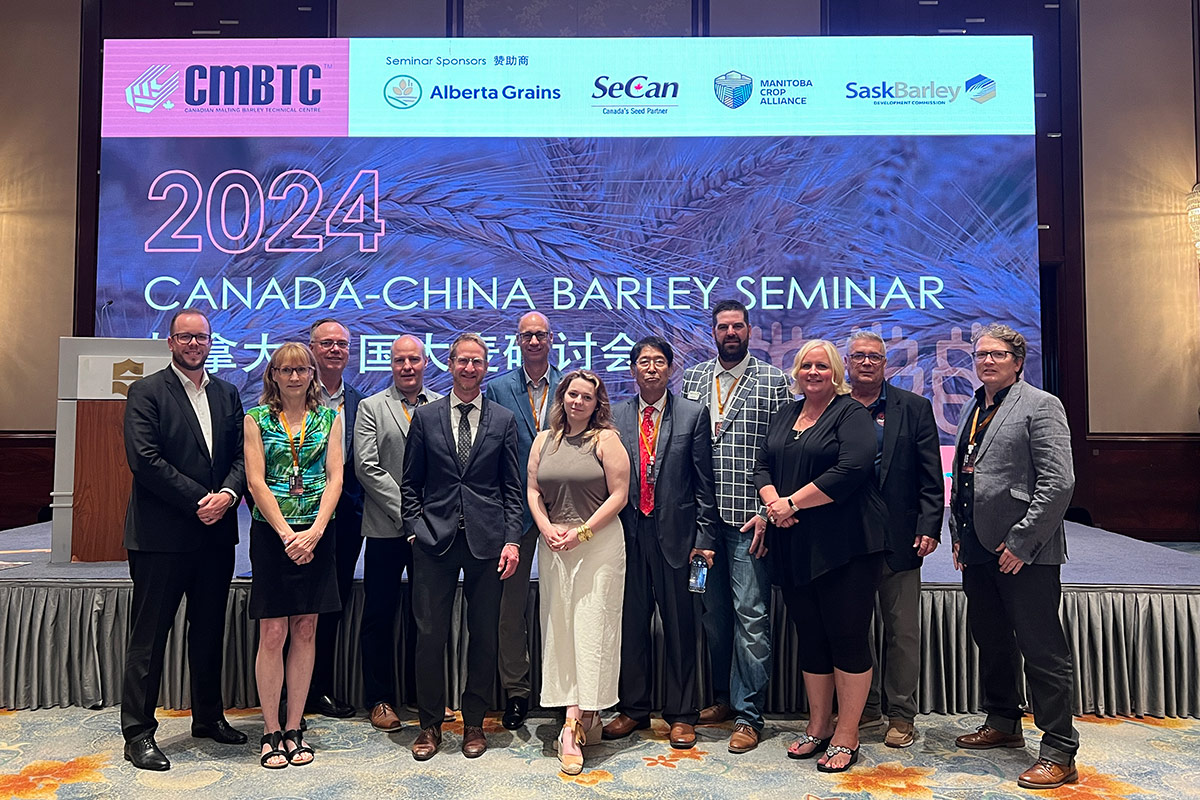
Grain farmer and MCA crop committee delegate Korey Peters was a farmer representative on the Asia trade and technical mission, visiting customers in Japan, Indonesia, the Philippines and China from Nov. 24 to Dec. 9.

“The experience was awesome and very eye opening,” says Peters. In each seminar, Peters used photos and videos to talk about the crop types he grows on his family farm and shared information about how the 2023 growing season went.

Photo Gallery

After his presentations, he was often asked questions related to soil fertility, managing wheat diseases and how he looks after the environment.

“Customers were very curious to hear firsthand what we do, how we grow things, and what works and what doesn’t,” he says. “I talked a lot about crop rotation and science-based solutions, and how we work with professionals like certified agronomists, for example, to help us.”

At all the seminars, Peters says customers were engaged and seemed eager to speak directly with a farmer. “They wanted to know about everything I did, but they also wanted to know about the grain and quality,” he says. “They were asking about breadcrumb structure, air pockets and how the bread was going to look.”

He adds the level of scientific detail blew his mind. “I just grow wheat, but it was interesting to hear these types of questions and discussions. It also reinforced to me the importance of having members from the whole value chain at these missions to answer all their questions and to build trust.”

Something that stood out to Peters was the relationships. “These companies want to put a face to the names of the people in the value chain. Some were on a first-name basis, or even exchanging hugs because they’ve met many times before. This showed me how important it is to our customers to have that personal connection.”

For Cereals Canada, the trade and technical missions are a way to build and maintain strong relationships, which is vital to growing the international demand for Canadian wheat. For Peters, it was a great experience, and he says he would go again in a heartbeat.

“It became very clear to me that Canada’s wheat is second to none. Every place we visited agreed that Canadian wheat is phenomenal, which makes me very proud of what we grow.”

For more information about the New Wheat Crop Report or the trade and technical missions, visit cerealscanada.ca.

Lorne Grieger, director of technical sales, Prairie Agricultural Machinery Institute

Research on the Farm – Wheat Seeding Rate Trial Summary

The Manitoba Crop Alliance (MCA) Research on the Farm (ROTF) program conducts scientific research with farmer members, using replicated strip trials on commercial fields. Farmer co-operators use their own equipment and management practices to conduct this research. Research projects are developed to investigate current and pressing agronomic questions and provide site-specific answers. More information about the ROTF program and all trial results can be found here.

As wheat genetics have improved, testing current seeding rate practices for new spring wheat varieties was necessary to understand if targeted plant stands are being optimized for yield and grain quality. The purpose of the spring wheat seeding rate trial was to quantify the agronomic and economic impacts of reducing and increasing farmers’ target plant stands compared to their normal target plant stand. This was done by increasing and decreasing seeding rates. Seeding rates ranged from 20 – 45 lbs/ac higher and lower than the farmers’ normal seeding rate (Table 1). This trial has been conducted for four growing seasons (2020 – 2023) and has 26 site-years of data. Trial sites covered numerous soil types, management practices and climatic conditions, as sites were located across agro-Manitoba.

Figure 1. Summary of spring wheat yield by seeding rate for all trial sites from 2020 – 2023. Note: Letters indicate significant differences between treatments.

Over the past four growing seasons, significant differences in plant-stand density were observed at 50 per cent of trial sites. In all cases, where a significant difference in plant-stand density was observed, the highest seeding rate had the highest plant-stand density. Although significant differences in plant-stand density were observed between treatments at 50 per cent of sites, there were only three sites where significant yield differences were observed. In each instance where a significant yield difference was observed, the low seeding rate treatment always out yielded the high seeding rate treatment (Figure 1).

Results from this trial indicate that producers have a good idea of the optimal seeding rate for their farm. Our results also suggest that during dry conditions, increasing your seeding rate does not necessarily lead to increased yield. Although, it should be noted that this data does not directly measure other variables that are impacted by seeding rates, such as crop uniformity and days to maturity. No statistical analyses were conducted on grain quality parameters.

Table 1. Economic analysis of all trial sites from 2020-2023.

Note: Seed costs are based on Manitoba Agriculture 2023 Cost of Production Guidelines ($34/ac or $17/bu). Wheat prices based on a No. 1 grade, hard red spring wheat price of $9.52/bu. Net profit calculated based on seeding costs only.

In terms of profitability, in this ROTF trial, it typically did not pencil out economically to use the high seeding rate, as there were no significant yield increases when the high seeding rate was used.

Tone Ag Consulting carries out MCA’s ROTF trials in all six of our crop-types. They assist the farmer with plot planting and harvesting, then capture key information throughout the growing season. This includes soil sampling in the spring, followed by growth stage notes and precipitation data during the growing season.

Top