Should I bale my wheat straw, or is it worth more left in the field?

By Ashley Ammeter, Whole Farm Specialist, Manitoba Crop Alliance
To give the classic agronomist response: it depends.
Straw has value whether it’s baled or left in the field. How that value is best captured varies from farm to farm and even from field to field. The answer depends on your soil type, moisture conditions, cropping system and long-term management goals.
If you farm clay soils with high organic matter, excess straw may cause management challenges. Heavy crop residues can require additional tillage, delay soil warming and drying in the spring, and interfere with seeding. In these situations, baling straw may be a practical management tool.
On the other hand, on lighter-textured, drought- or erosion-prone soils or those with lower organic matter, the benefits of retaining straw may outweigh any potential income from baling.
Some components of the value of straw are relatively easy to quantify. Straw contains nutrients that are removed from the field when baled and may need to be replaced through fertilizer. Other benefits, such as supplying organic matter, are much harder to put a dollar value on.
Straw contains valuable nutrients
The nutrient content of straw can vary depending on crop type, growing conditions and soil fertility levels. Potassium (K) content can be particularly variable, since the K found in crop residue is highly soluble and will leach from crop residue if there is rainfall before baling.
Typical straw nutrient contents are shown below:
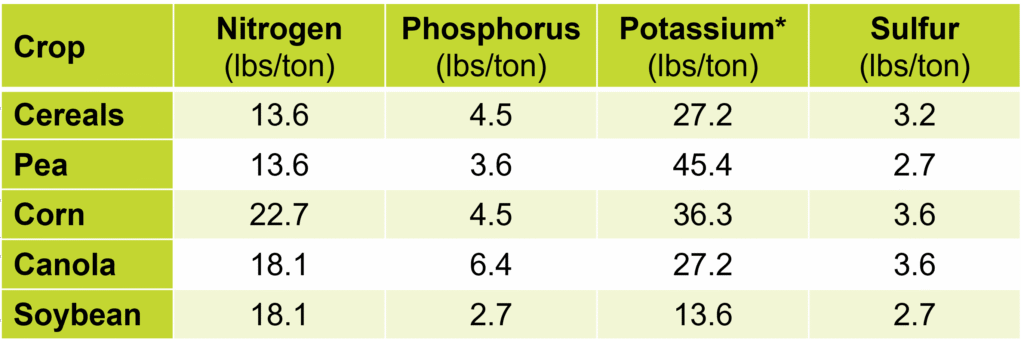
*Note that potassium is often naturally abundant in clay soils, so potassium removal is not always considered a significant concern in clay soils. Source: Manitoba Agriculture Straw Cost Calculator.
Manitoba Agriculture’s Straw Cost Calculator can help determine the value of straw based on the cost of nutrients removed. While the actual nutrient content of straw can vary considerably, calculating an approximate replacement value for the nutrients removed can be a useful starting point.
The value of organic matter
The nutrient value of straw is relatively easy to calculate. The value of the organic matter in straw is much harder to quantify, but may be even more important in the long run.
Soil organic matter is a critical component of soil health that influences many soil properties and plays an important role in crop productivity:
- Soil moisture regulation: Increased organic matter can improve water infiltration under excess moisture conditions and improve water holding capacity under drought conditions.
- Soil structure and aggregation: Soil organic matter plays an important role in the formation of stable soil aggregates (soil particles that are bound together). A well-aggregated soil improves water infiltration, root growth and can better resist erosion and compaction.
- Herbicide breakdown: Soils with low organic matter can have an increased risk of herbicide carryover, particularly under dry conditions. Organic matter provides sites for herbicides to bind to, preventing them from impacting sensitive crops. In addition, soils with high organic matter often have increased microbial activity, speeding up herbicide breakdown.
What does long-term research tell us about straw removal?
Long-term research from Indian Head, SK, suggests that the impact of straw removal depends on how much residue is removed, how often straw removal occurs and the overall management system.
In a study by Lafond et al. (2009), straw was removed two years out of three in a fallow-wheat-wheat rotation over a 50 year period. Depending on the harvest system used, baling removed 26 to 40 per cent of the total aboveground crop residues (other than grain). Despite repeated straw removal, researchers saw no reduction in soil organic carbon and soil organic nitrogen.
They concluded that in medium- and heavy-textured soils, crop residue can be harvested without negatively impacting long-term productivity, provided that less than 40 per cent of residue is removed, that removal happens no more than two years out of three, and that the practice is combined with adequate fertilization and no-till management.
The bottom line
Straw is a valuable resource. It contains nutrients, contributes organic matter and helps protect soils from erosion. At the same time, straw can create management challenges and may have market value.
If you decide to bale straw:
- Maintain sufficient crop residue and stubble to protect the soil from erosion, and reduce tillage after harvest to preserve residue cover. The Manitoba Agriculture Soil Management Guide recommends maintaining at least 35 per cent crop residue cover after seeding for most soils, and at least 65 per cent cover on soils that are susceptible to wind erosion.
- Avoid removing straw so frequently that soil organic matter levels decrease.
- Fertilize crops adequately to replace nutrients removed in the straw and use soil testing to guide fertility decisions.
- Be especially cautious on low organic matter, drought-prone and erosion-prone soils.
Additional resources
- Manitoba Crop Alliance – Straw Management in Western Canada Wheat and Barley Cropping Systems
- Manitoba Agriculture – Straw Cost Calculator
- Prairie Nutrient Removal Calculator