
I’ve noticed a lot of wild oat escapes in some of my fields this year; what can I do to prevent it from getting worse next year?


By Ashley Ammeter, Whole Farm Specialist, Manitoba Crop Alliance
Despite our best efforts, sometimes even the best laid weed control plans go wrong!
The first thing to remember is that not all weed escapes are created equal. In some cases, weeds can survive because of application timing issues, challenging weather conditions or late flushes that emerge after spraying. However, when weeds aren’t controlled by herbicide applications, herbicide resistance should also be on your radar.
A recent survey in Manitoba found that in fields with uncontrolled wild oats, 100 per cent of populations were resistant to Group 1 products, 82 per cent were resistant to Group 2 products, and 82 per cent were resistant to both Group 1 and 2 herbicides. Those numbers show how important it is to take a closer look at wild oat weed escapes.
Start with scouting
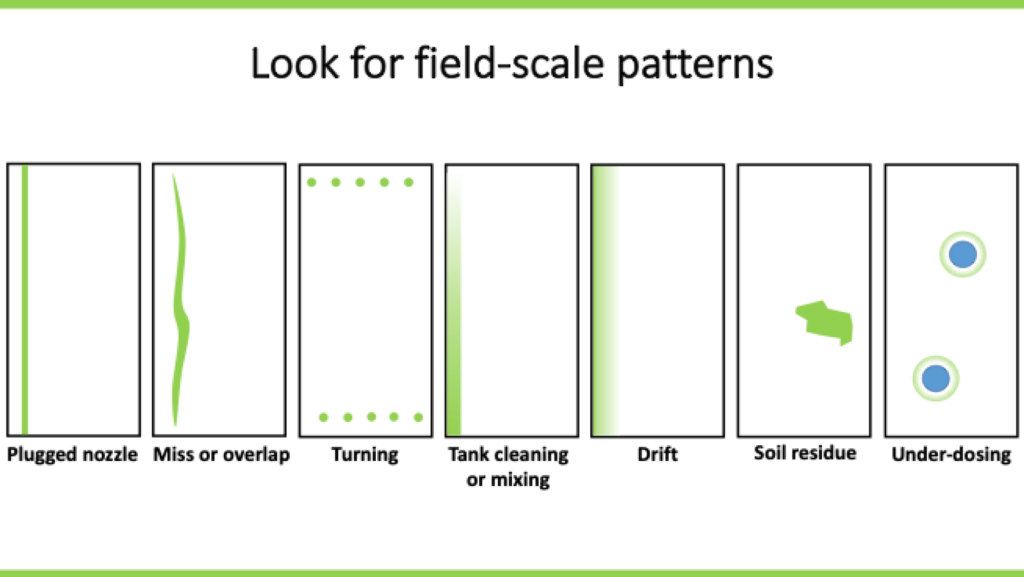
Examples of field-scale weed distribution patterns that may help diagnosing weed escapes. Image from: Dr. Charles Geddes and Alberta Grains.
Identifying why your herbicide failed to control wild oats is the first step toward finding a solution. Start by scouting the field to narrow down the cause. Consider factors such as application timing, weather conditions, late flushes after spraying and the size of the weeds when you sprayed. Look out for distribution patterns in the field that might suggest application issues, such as plugged nozzles, missed areas or poor coverage. If you’re able to rule out these causes, its time to consider herbicide resistance.
For more information on narrowing down potential causes of weed escapes, see our resource on scouting after herbicide applications.
Herbicide resistance testing
If you suspect herbicide resistance, the next step is to collect samples to send for testing. Currently, most herbicide resistance tests require samples of mature seeds from the suspected weed patch. While some species may not have mature seed until after harvest, wild oats will likely have mature seed before your crop is harvested. Keep a close eye on your wild oat patches so you can collect seeds before harvest.
The Resistant Wild Oat Action Committee has information on how to collect samples, where to send them for testing and how to interpret the results.
Managing weed escapes this season
Even if you’re waiting on herbicide resistance test results, there are still steps you can take this season to manage the long-term impacts of surviving wild oats.
Before seed set, consider mowing patches to prevent the seed maturing and returning to the soil seedbank. If you plan to submit a sample for resistance testing, leave a small patch so you can collect mature seed.
At harvest, combines can spread wild oat seeds up to 145 m. Rather than chopping and spreading straw and chaff in heavy wild oat patches, consider dropping and baling the straw. This can help contain the patch and minimize spread.
Build a long-term strategy
Whether or not you have herbicide-resistant wild oats, using an integrated weed management strategy gives you the best chance of success in your fight against weeds.
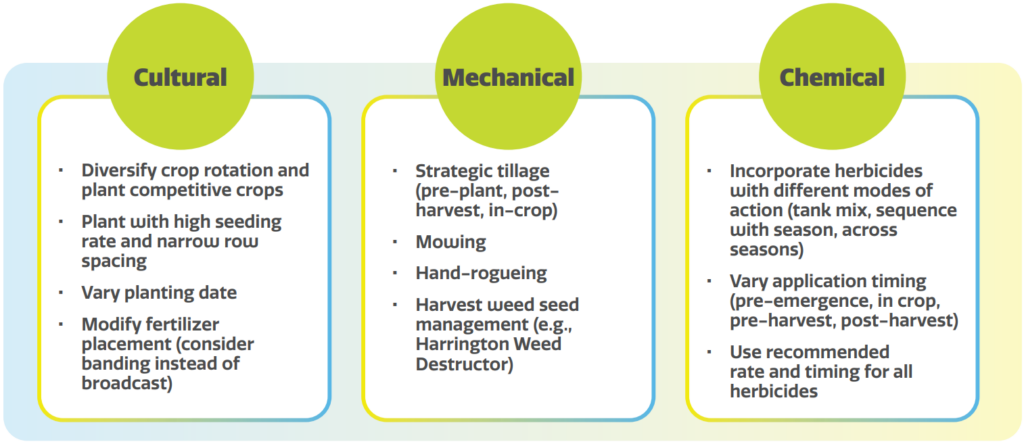
Integrated weed management incorporates cultural, mechanical and chemical control practices to manage weeds. These are just some of the possibilities!
Combining multiple strategies can significantly improve your success in managing wild oats:
- Use herbicides with different modes of action such as pyroxasulfone, fall-applied granular herbicides or other effective modes of action.
- Diversify crop rotations. Winter cereals can be more competitive, later-seeded spring crops allow more time for wild oat control prior to seeding, and forages are harvested before wild oat seeds shatter and return to the soil.
- Consider targeted tillage in the fall to promote fatal fall germination of wild oats, or in the spring to stimulate early germination of wild oats that can be controlled prior to seeding.
- Improve crop competitiveness through practices such as higher seeding rates, narrower row spacing, careful placement of fertilizers to feed the crop not the weeds or choosing taller varieties.
With weed escapes, its not only the surviving plants that matter; it’s also the thousands of seeds they contribute to next year’s weed problems! Taking the time to identify why those wild oats survived allows you to build a management plan that uses “many tiny hammers” to keep the weeds at a disadvantage and protect the effectiveness of herbicides into the future.