Production Resources

Root Rots in Cereals

Although not the most prominent cereal diseases, seedling blight and root rot diseases do impact yield in small grains. These diseases are typically discussed in a “complex,” therefore multiple pathogens are infecting the plant simultaneously. This article will go over how to identify and manage the most common seedling diseases impacting small grains in Manitoba.

2026-27 Malting Barley Recommended Varieties

THE CANADIAN MALTING BARLEY TECHNICAL CENTRE (CMBTC) RECOMMENDED LIST provides producers with an indication of which malting barley varieties have the greatest potential for selection and marketing. Each variety on the recommended list has been tested at the CMBTC and all exhibit good malting characteristics. All varieties on the list are registered with the Canadian Food Inspection Agency (CFIA).

Control of Perennial Weeds

Unlike annual weeds that complete their life cycle within one year, perennial weeds live for multiple years, becoming dormant in the winter and re-growing again in the spring. While spring application of herbicides can control top growth of perennial weeds, late summer and into the fall is the ideal time to control perennial weeds.

Managing lodged cereal crops

Lodging is one of the most common issues across the Prairies. Growers can use tools such as PGRs or select varieties with good lodging ratings to reduce lodging incidents, however, with the wet conditions and storms, lodging may still occur in some fields. Lodging causes delayed dry down, higher pre-harvest sprouting risks, reduced combining speed and higher disease risks such as FHB. This creates a challenging harvest situation.  

Flax Preharvest FAQs

What is the staging for a preharvest or desiccation in flax?

Flax is considered physiologically mature when 75% of the bolls (in the field or on a plant) are brown and the boll segments have begun to separate. This is a visual rating that corresponds to a grain moisture content of around 30% and is known as the 75% boll turn or 75% brown boll stage.
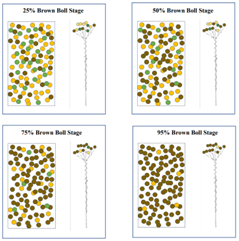
Flax Maturity Ratings Sask Flax

Figure 1: Flax Maturity Ratings. Credit: SaskFlax

What is the difference between a preharvest aid and a desiccant?

Two types of chemicals are available to assist with flax harvest management: pre-harvest herbicides (sometimes called harvest-aids) and desiccants.

  • Pre-harvest herbicides are non-selective systemic herbicides that provide late season perennial weed control and may improve the harvestability of the crop by reducing the amount of green material in the field.
  • Desiccants are non-selective herbicides that rapidly dry down the crop and weeds to allow for an earlier harvest.
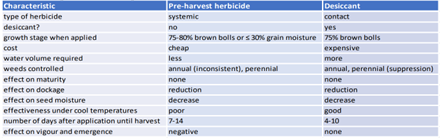
Comparison between pre harvest herbicide and desiccant characteristics Sask Flax

Figure 2: Comparison between preharvest herbicide and desiccant characteristics. Credit: SaskFlax

How quickly can you expect results from a preharvest aid or desiccant on flax?

Research conducted by Indian Head Agricultural Research Foundation (IHARF) in 2021 and 2022 shows a visual difference in three treatments: untreated, glyhposate and diquat at registered amounts.  The untreated check does not appear visually different 21 days after application (21 DAA) of the other treatments. Glyphosate and diquat applications look similar after 21 days, though progression of dry-down appears differently throughout the three weeks between the two treatments. Diquat shows significant dry-down effects just 4 DAA and improves throughout the following weeks, while glyphosate seems to take 14 – 21 days to appear ready for harvest.

Change in appearance of CDC Glas (Indian Head, 2021) after treatment with glyphosate and diquat.

The situation shown above is an example of one scenario and the result of great drying conditions, environmentally. 

Can we use glyphosate as a preharvest aid?

Preharvest glyphosate applications will alter the crop, assisting with stalk dry-down and harvestability, however it is commonly expected that the effects of glyphosate applied alone on flax dry-down can be slow and inconsistent, depending on environmental conditions. This all being said, at this time, it is not a recommendation of Manitoba Crop Alliance to apply glyphosate as a preharvest aid due to inconsistent results with maximum residue limit (MRL) testing. If a producer must use glyphosate, it is strongly recommended to speak with their grain buyer to determine if a glyphosate application to their flax will be a marketing concern.

What are the current registered preharvest aids and desiccants for flax in Manitoba?
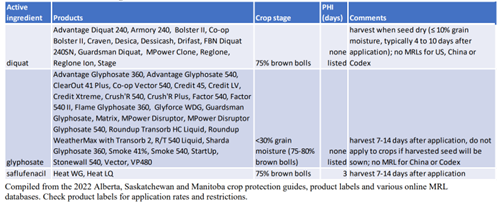
Preharvest chemicals registered for use on flax Sask Flax

Figure 3: Preharvest chemicals registered for use on flax. Credit: SaskFlax

References:

SaskFlax: Preparing for Harvest, July 2018. https://www.saskflax.com/quadrant/media/Pdfs/Flax%20on%20the%20Farm/180724_July_Flax_on_the_Farm_Final.pdf

Indian Head Agricultural Research Foundation: Pre-harvest Weed Control and Desiccation Options for Flax, 2019. https://iharf.ca/wp-content/uploads/2021/04/Pre-harvest-weed-control-and-desiccation-options-for-flax.pdf

SaskFlax: Flax Markets and Maximum Residue Limits, April 2022. https://www.saskflax.com/quadrant/media/Pdfs/Flax%20on%20the%20Farm/2022/220425%20MRL%20Information-April.pdf

Identifying the parts of a wheat head

Identifying the structure and function of wheat head parts is important for making management decisions, describing insect and diseases issues, communicating with others in the industry, and reviewing agronomic material. Agronomic information is more accessible than ever, but the level of detail and terminology differ among sources. This document provides background information on the plant parts of a wheat head and their function.

Scouting After Herbicide Applications

Your weed management plan shouldn’t end after you’ve sprayed! Scouting after a post-emergence herbicide application is an important step in ensuring adequate weed control and identifying potential problems early.

Spring Tips for Flax Farming

Research has shown that flax performs poorly specifically after canola and/or mustard, and not only because of disease issues. The poorer performance of flax on canola stubble is attributed to mycorrhizae fungi which do not associate strongly with canola and decrease in presence during the canola crop’s growing season.

Top