
Section Title
Pre-Harvest Control of Perennial Weeds
- Whole Farm
Unlike annual weeds that complete their life cycle within one year, perennial weeds live for multiple years, becoming dormant in the winter and re-growing again in the spring. Perennial weeds that spread only by seed are called simple perennials (examples include dandelions and foxtail barley). Others, known as creeping perennials, spread by creeping roots, above-ground stems (stolons) or below ground stems (rhizomes) (examples include perennial sow-thistle, quackgrass and Canada thistle). Creeping perennials may also spread by seed.
Common perennial weeds in Manitoba include:
- Broad-leaved Plantain
- Canada Thistle
- Common Milkweed
- Curled Dock
- Dandelion
- Foxtail Barley
- Perennial Sow-thistle
- Quackgrass
Perennials have extensive root systems that store energy reserves and allow them to re-grow from below the soil. This means that to effectively control perennial weeds, you must kill the entire root system. Often, this requires a multi-year, integrated weed management strategy.
While spring application of herbicides can control top growth of perennial weeds, late summer and into the fall is the ideal time to control perennial weeds. As temperatures start to cool, perennials prepare for winter by transferring energy reserves to their root system. Herbicides applied at this time will also move down into the root system, providing better control.
For many perennial species, the best approach is often a pre-harvest herbicide application. If you are considering post-harvest herbicides, be aware that for taller perennial weeds, much of the weed biomass will have been cut off during harvest. To ensure success, weeds must be allowed to regrow enough leaves prior to herbicide application. Also consider that herbicides can only be taken up when weeds are actively growing. Perennial weeds can often withstand a light frost, but it is important to assess frost damage. For glyphosate, ensure that at least 60% of the above-ground tissue is still living.
Pre-Harvest Herbicides
When applying any pre-harvest herbicide, it is essential to check with your grain buyer to ensure that there are no concerns with the product you are choosing. To learn more about maximum residue limits (MRLs) and market risks that may be present for certain products and crop types, visit the Keep it Clean website.
When choosing a product for pre-harvest application, there are several product types to be aware of:
- Harvest aids and desiccants help speed the dry down of crops and weedy material. These type of products are contact herbicides, which means they kill only the tissues that come in contact with the spray, and do not move throughout the plant. These products control only the top growth of weeds. Coverage is essential to maintain efficacy of these products, so high water volumes are encouraged.
- Pre-harvest weed control products are intended to provide control or suppression of weeds, including perennials. These can enhance crop dry down, but not as consistently or effectively as desiccants. Glyphosate is a popular choice. As a systemic herbicide, it moves throughout the plant and provides effective control.
Table 1: Herbicides for use as pre-harvest aids and desiccants in wheat and barley. Compiled from the Manitoba Guide to Field Crop Protection 2026 and product labels. Always check product labels for complete application information.
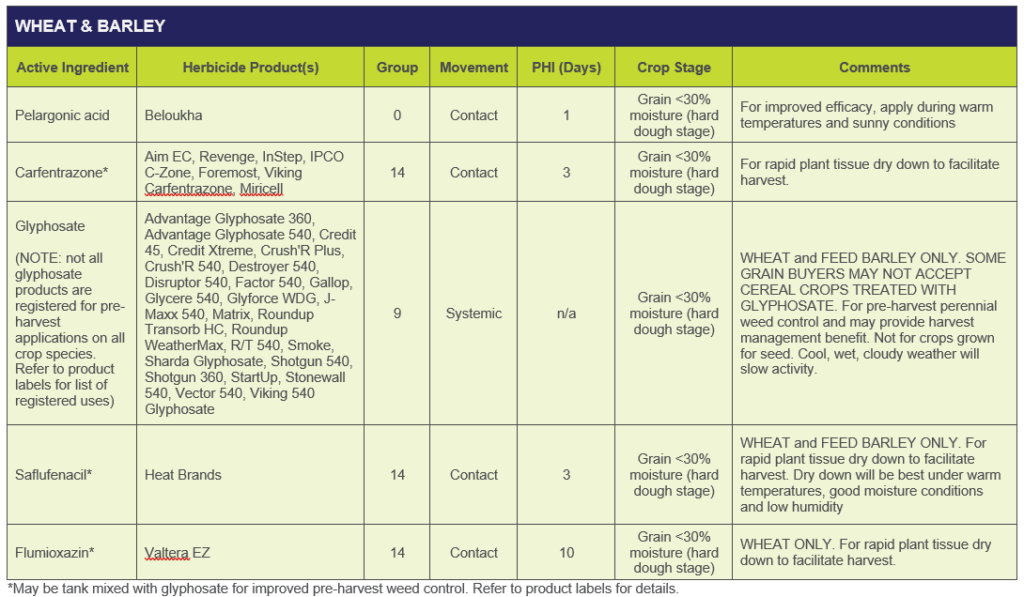
Table 2: Herbicides for use as pre-harvest aids and desiccants in sunflower. Compiled from the Manitoba Guide to Field Crop Protection 2026 and product labels. Always check product labels for complete application information.
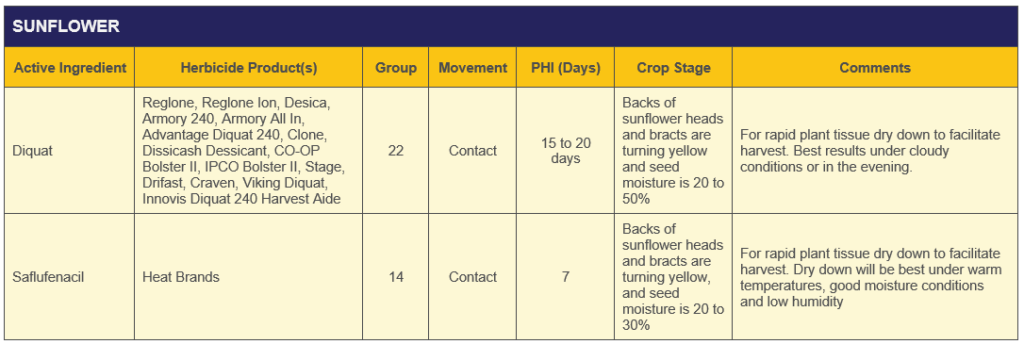
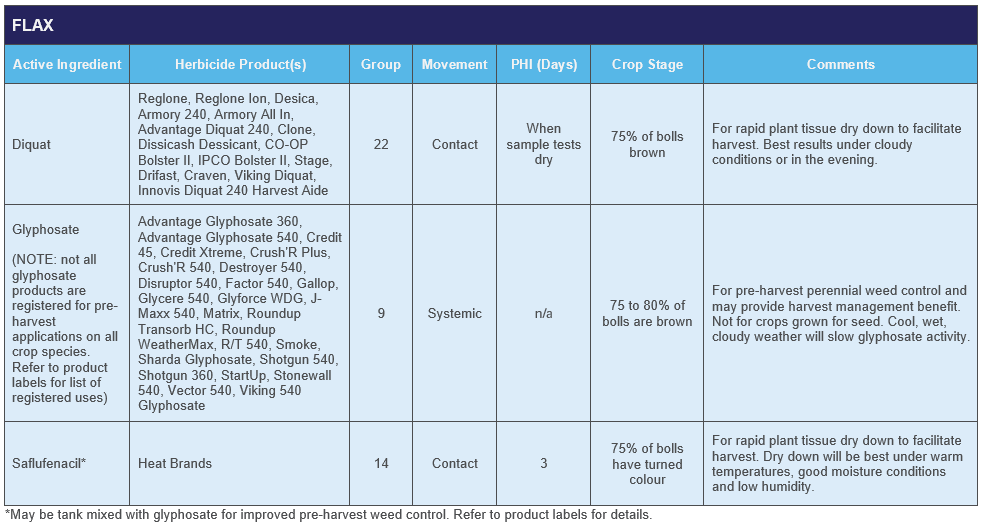
Table 3: Herbicides for use as pre-harvest aids and desiccants in flax. Compiled from the Manitoba Guide to Field Crop Protection 2026 and product labels. Always check product labels for complete application information.
More information on pre-harvest herbicide options is available here.
Integrated Weed Management
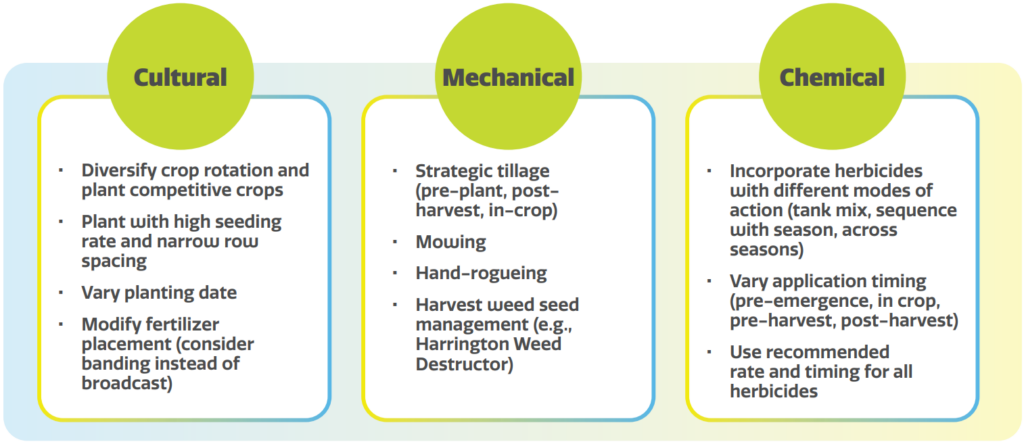
While herbicides are useful tools in the fight against perennials weeds, effective control often requires a multi-year, integrated weed management strategy. Along with herbicides, integrated weed management incorporates cultural and mechanical control practices to manage weeds.
Additional resources
Staging Cereals for Pre-Harvest Glyphosate Application
Guide to Field Crop Protection 2026
Manitoba Agriculture – Controlling Dandelion in the Fall
Manitoba Agriculture – Temperature and Quackgrass Control With Roundup


-
September 21, 2026
Kochia is a noxious weed with widespread resistance to herbicide Groups 2 and 9, along with emerging resistance to Group… Read More

-
July 3, 2025
Identifying the structure and function of wheat head parts is important for making management decisions, describing insect and diseases issues,… Read More

-
June 4, 2025
Your weed management plan shouldn’t end after you’ve sprayed! Scouting after a post-emergence herbicide application is an important step in… Read More



-
June 7, 2024
Armyworms (Mythimna unipuncta), sometimes called true armyworm, are a pest species that impact winter wheat, spring wheat, fall rye, barley,… Read More

-
May 17, 2024
Manitoba farmers are well aware of the destructive abilities of wireworms. They feed below ground on many different crop types,… Read More

-
April 29, 2024
Early season weed control can be key to optimizing yield and giving your crop a good head start. Even small… Read More


-
April 8, 2024
Hybrid selection in sunflower can be difficult. Seed companies provide an abundance of information on specific traits, but all this… Read More


-
April 8, 2024
Hybrid selection in corn can be difficult. Seed companies provide an abundance of information on specific traits, but all this… Read More

-
April 8, 2024
This is Part 3 in a three-part series on managing extremes of moisture. Part 1 focuses on soil properties and… Read More