
Section Title
Root Rots in Cereals
- Wheat
Although not the most prominent cereal diseases, seedling blight and root rot diseases do impact yield in small grains. These diseases are typically discussed in a “complex,” therefore multiple pathogens are infecting the plant simultaneously. This article will go over how to identify and manage the most common seedling diseases impacting small grains in Manitoba. Information for this article was gathered from the Diseases of Field Crop in Canada, 4th Edition and Crop Protection Network.
General Symptoms
- Pre-emergence seedling death
- Post emergence seedling death
- Poor germination
- Stunted plants
- Non-uniform plant stand
- Late season plant death
- Poorly developed root system
- Necrotic root and crown tissue
Major Seedling Diseases
Pythium or Browning Root Rot (Pythium species)
General information: Pythium species are ubiquitous, living in the soil or on crop residue. Pythium is predominantly a soil-borne disease, with the pathogen surviving for many years in soil. Pythium root rot is generally a seedling disease, which reduces plant establishment and plant stands, delays maturity and decreases yield.
Pythium thrives under cool and wet soil conditions, where there is little soil oxygen. Cereal crops grown in low phosphorus and organic matter soils are more susceptible to Pythium infection. Generally, barley is more susceptible to pythium infection than wheat.
Symptoms: Affected plants are typically found in patches, especially in low lying areas with saturated soils. Pythium root rot causes damping off or sudden death of germinating plants. Symptoms typically first appear at the seedling stage, with severely affected plants being stunted and leaves becoming yellow and chlorotic. Eventually lower leaves can become brown and if pulled, the root ends can have brown lesions and likely have the outer layer missing (Figure 1). In some cases the root systems will be dead. Infected plants can also fail to produce a developed head or tillers.
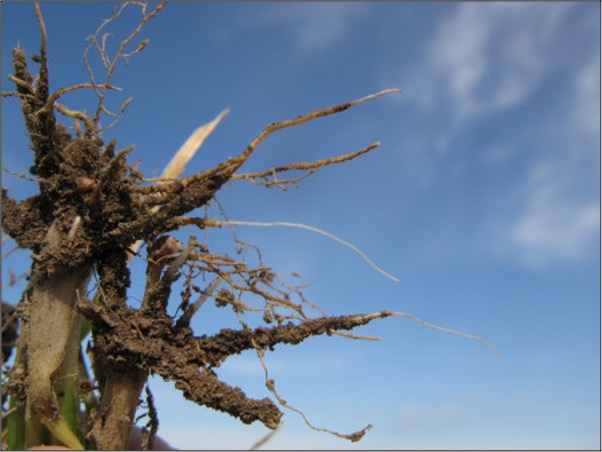
Figure 1. Damaged root end caused by Pythium pathogen. Photo Credit: Crop Protection Network (M.Burrows).
Control: Proper soil drainage to improve aeration and reduce soil saturation is the most important way to reduce Pythium infection, using high quality seeds with good germination and vigour and ensuring adequate soil phosphorus level are met. A seed treatment with activity on Pythium species may also reduce disease severity.
Seedling Blight, Common Root Rot, Crown and Foot Rot (Cochlibolus sativus and Fusarium species)
General information: The seedling blight and common root rot complex is composed of many pathogens with Cochlibolus sativus (C. sativus) being a primary cause of the disease. Fusarium species, such as F. graminearum, F. pseudograminearum, F. culmorum, and F. avenaceum are also a part of the seedling blight and root rot complex. The C. sativus pathogen also causes spot blotch, a foliar disease affecting wheat and barley, while most of the Fusarium species involved in the complex cause fusarium head blight.
Sativus spores survive in the soil or on seeds for years as resting spores. The pathogen can also be found on crop residue. Fusarium pathogens reside in soil, on seeds, or crop residue in various spore structures. The pathogens can infect wheat and barley root systems throughout the growing season. Common root rot and seedling blight favours stressed environments, specifically dry and warm soil conditions. Yield decreases of up to 10 per cent and 6-7 per cent are seen annually in barley and wheat respectively on the Canadian Prairies.
Symptoms: Infected plants are usually found sporadically through the field, rather than in large patches like Pythium or Take-all. Infected seedlings can be killed pre or post germination, leading to field areas with poor germination and non-uniform plant stands. Brown lesions on the coleoptile, sub-crown internode, crown and the lower leaf sheaths, leading to necrosis or death of that tissue (Figure 2) is common. Infections can reduce root system size and constrict nutrient/water uptake. The slow contraction of nutrient and water flow due to compromised root systems is often what causes the most plant damage.
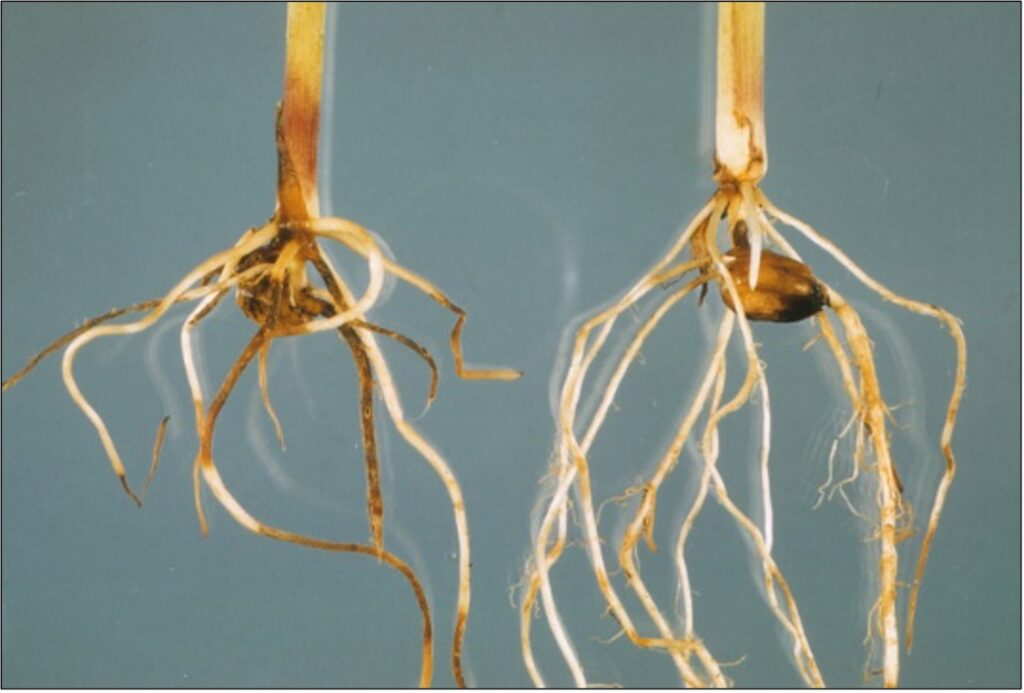
Figure 2. Fusarium root rot in wheat. Photo Credit: Allison Robertson.
Above-ground symptoms are not always visible until severe damage or plant death. When good growing conditions (e.g., adequate moisture) exist, symptoms are not always visible, as the remaining healthy root tissue can acquire needed nutrients and water.
Later season symptoms (Figure 3) include premature ripening especially in severely infected plants, with plants having sterile heads or heads with shrivelled kernels. Green colour of these plants can be lost, and the stems and heads can be bleached. Plants can be easily pulled from the ground and can be conspicuous compared to healthy green plants. The bottom of the stem may have honey brown colouration or brown lesions (Figure 3).
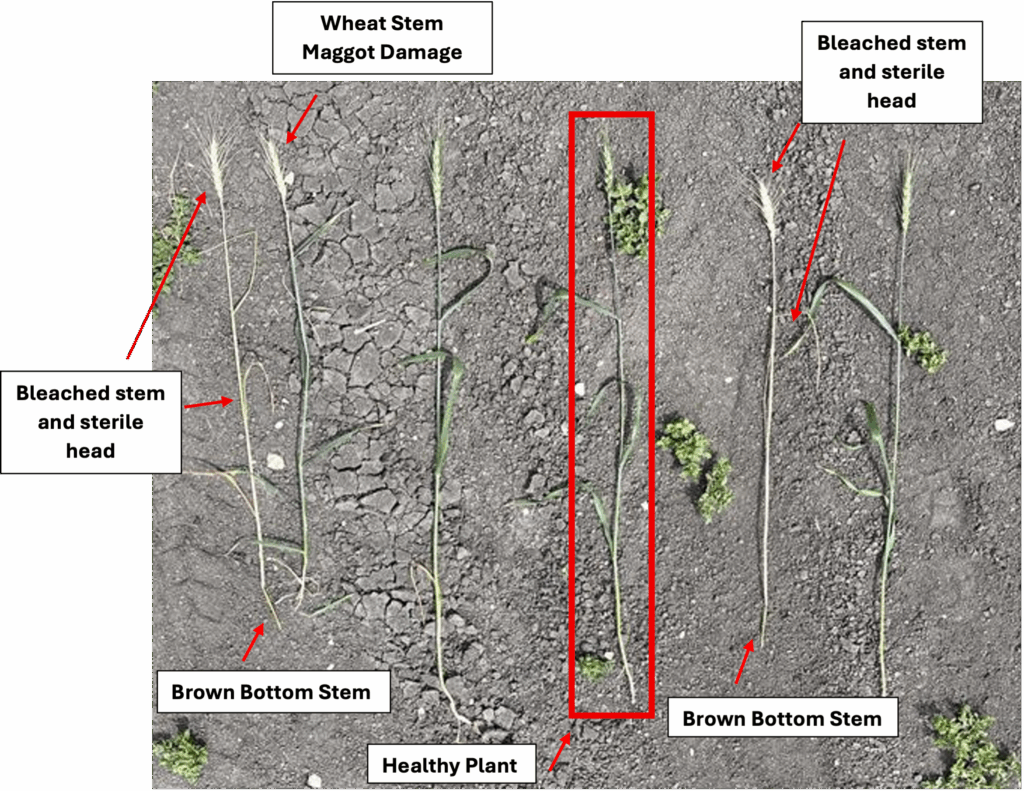
Figure 3. Symptoms of common root rot or crown and foot rot on mature wheat plants, compared to healthy plants. Photo Credit: Andrew Hector.
Control: The main control methods for common root rot and fusarium root and crown rot are using healthy, disease-free seeds, with high germination levels. Fungicide seed treatments with activity on Fusarium species and C. sativus can provide some early season protection but won’t provide protect against late season infections. Refer to the local guide to crop protection for seed treatment options. It is recommended to not plant seed that has more than five per cent F. graminearum or over 10 per cent of any Fusarium species (Saskatchewan Agriculture, 2025).
Proper seeding depth and fertility to promote vigorous growth can also reduce disease pressure. Including non-susceptible hosts crops (e.g., flax and canola) between wheat and barley can reduce inoculum load of C. sativus, but Fusarium species are ubiquitous, with multiple hosts. Therefore, crop rotations won’t reduce the inoculum load of Fusarium species. Wheat and barley varieties vary in resistance levels, select a variety a variety with improved resistance when possible and needed.
Take-all (Gaeumannomyces graminis)
General information: The main inoculum source for Take-all is infected crop residue. Fugal structures initially infect plant roots, with root-to-root transmission occurring, spreading the disease. Conditions favouring disease development include high soil moisture levels, mild soil temperatures (12-20 °C), alkaline and compacted soils, and nutrient deficient soils.
Symptoms: Take-all’s most prominent symptom is the shiny black discolouration along the lower stem and fungal structures under the leaf sheath (Figure 4). The plant root system and crown can look completely rotted. Take-all, like other seedling diseases can cause stunted plants, poor plant stands, and reduced tillering.
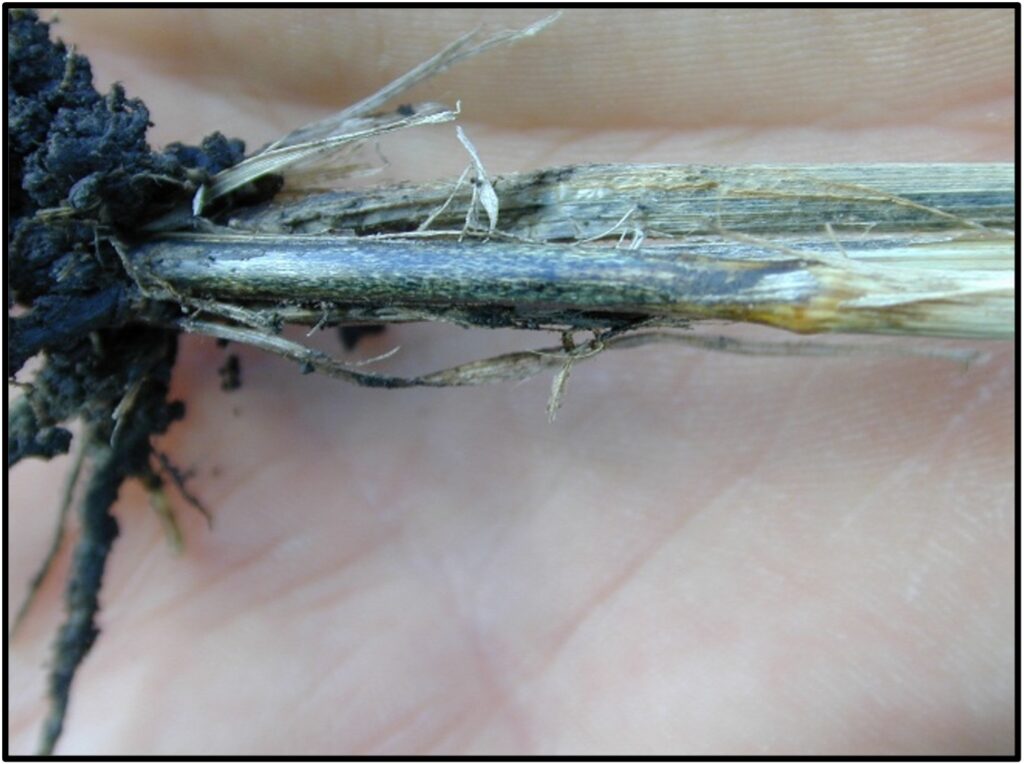
Figure 4. Shiny black fungal growth on the bottom of the stem, a prominent Take-all symptom in wheat. Photo Credit: Dr. Kelly Turkington.
Late season symptoms include premature bleaching on stem material and white heads. The white heads empty, or kernels may be small and shrivelled. Infected plants are easily pulled from the soil and are conspicuous within the green and immature crop. Infected plants are typically found in patches.
Control: The main control of Take-all is having a crop rotation that has non-crop hosts (i.e., canola, flax, corn and oats). Furthermore, ensuring appropriate soil potassium and phosphorus levels are met to promote vigorous root growth. Currently fungicide seed treatments in the Manitoba Guide to Crop protection are only rated for suppression of Take-all and won’t provide season long protection (Kwak and Weller, 2013). Seed treatment fungicide options can be found in the Manitoba Guide to Field Crop Protection.
Additional References
- Kwak YS, Weller DM. Take-all of Wheat and Natural Disease Suppression: A Review. Plant Pathol J. 2013. 29(2):125-35.

-
April 7, 2026
Fungal leaf diseases can be major yield robbers in wheat crops across Manitoba. Leaf diseases reduce plant health and photosynthetic… Read More

-
December 3, 2025
THE CANADIAN MALTING BARLEY TECHNICAL CENTRE (CMBTC) RECOMMENDED LIST provides producers with an indication of which malting barley varieties have… Read More

-
September 8, 2025
Lodging is one of the most common issues across the Prairies. Growers can use tools such as PGRs or select… Read More
-
July 3, 2025
Identifying the structure and function of wheat head parts is important for making management decisions, describing insect and diseases issues,… Read More

-
July 2, 2025
Learn to diagnose common smut, common rust, Goss's wilt and more. Read More

-
July 2, 2025
Learn to diagnose Anthracnose stalk rot, Fusarium stalk rot, Gibberella ear rot and more. Read More
-
April 25, 2025
Do you know where your wheat yield comes from? Understanding wheat yield components and how management choices influence each component… Read More

-
November 8, 2024
Rapid visco analysis (RVA) is the assessment used to determine the degree of pre-germination in barley grain. This measurement is… Read More

-
October 21, 2024
This document is designed as a guide for use in proactively scouting wheat fields to detect pests at or before… Read More