
Evaluating Wheat Seeding Speed Through the Research on the Farm Program

Faster speeds let you cover more acres per hour, but does this come at the expense of poor emergence or lower yield? How does it impact fuel use?
As a part of our Research on the Farm program, Manitoba Crop Alliance is addressing these questions by running a new trial to look at the impacts of seeding speed in spring wheat. Initial fuel use data from several trials has already been received. At most sites three seedings speeds were used: 4.5 mph, 6 mph, and 7.5 mph. Fuel use was tracked based on readouts from the tractor. Some preliminary results are already coming in. Higher speeds considerably reduce the time needed to seed a field as expected, but fuel use also appears to decrease slightly with higher speeds (Table 1).
Table 1. Averages from six on-farm trials. Fuel costs assume diesel = $1.75/L.
| Seeding speed | Time needed to seed 160 acres | Diesel use per 160 acres | Fuel costs per 160 acres |
| 4.5 mph | 5.41 h | 79.09 gal | $524.34 |
| 6 mph | 4.13 h | 74.74 gal | $495.55 |
| 7.5 mph | 3.3 h | 72.49 gal | $480.64 |
Fuel usage was highly variable between trials ranging from 47 to 106 gal/160 acres, but the trend of higher speeds lowering fuel use was largely consistent (Figure 1).
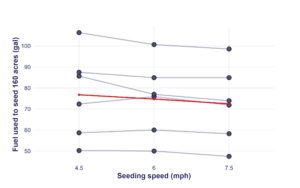
Figure 1. Fuel use at three seeding speeds across six on-farm trials. Grey lines represent individual trial sites and the red line shows the average at each speed.
Later in the growing season, plant stands, stand uniformity, and yield will be collected to assess if higher seeding speeds have any negative impact. Look out for updates on this project later this year.