
Section Title
Herbicides aren’t the only option for kochia control
- Whole Farm
Manitoba Crop Alliance co-funded a recently completed project led by Dr. Charles Geddes.
Highlights
- Higher seeding rates and narrower row spacing can reduce kochia biomass by up to 80 per cent.
- Swapping spring wheat for winter wheat can reduce kochia biomass by 64 per cent and density by 74 per cent.
- Planting crops with early harvest times can interrupt kochia growth cycles and reduce seed production.
- Pre- and post-harvest herbicide applications can help mitigate kochia regrowth and seed production following an early harvest.
- Consider seeding perennial forages in areas with dense kochia patches, especially areas with salinity and moisture issues.
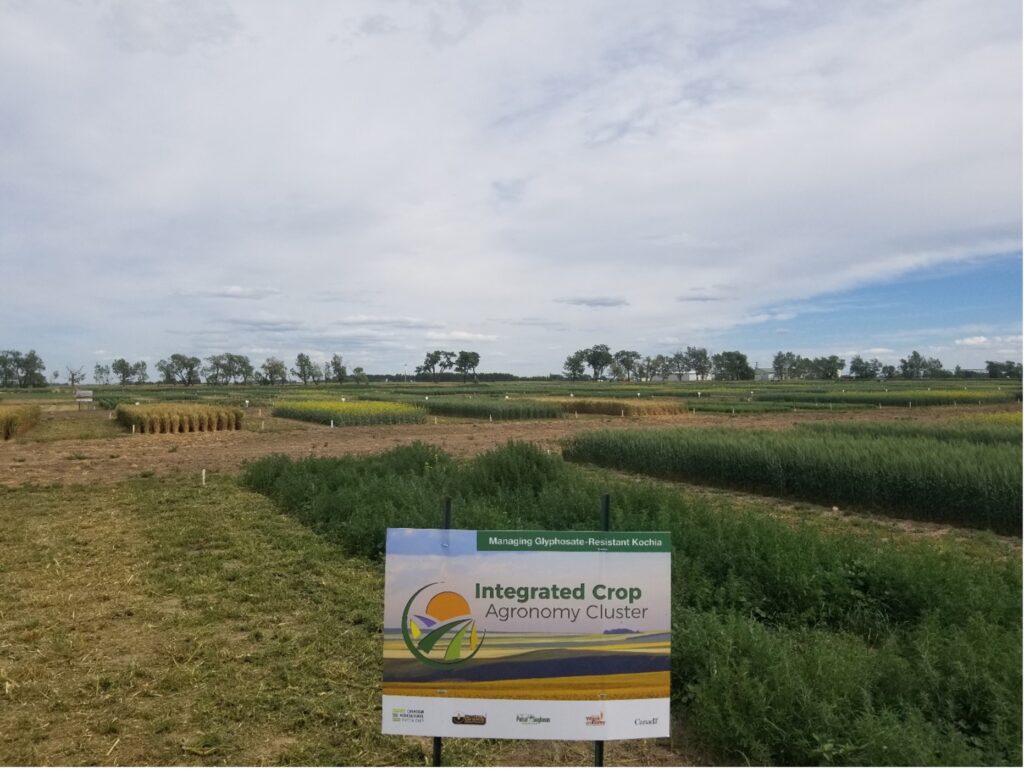
Photo courtesy of Charles Geddes
Background
Kochia is a noxious weed with widespread resistance to herbicide Groups 2 and 9, along with emerging resistance to Group 4 in Manitoba. Additionally, kochia has recently been observed to have developed resistance to Group 14 products in Saskatchewan and North Dakota. The loss of these modes of action has limited options for in-season control of the weed. However, kochia can still be effectively controlled using an integrated weed management approach.
The unique biology of kochia offers both challenges and opportunities for its suppression. Kochia is a prolific seed producer, with a single plant capable of producing 14,000 to 30,000 seeds1,2. These seeds are short-lived, persisting in the soil for only about two years3. This short seed longevity means that new traits, such as herbicide resistance, can rapidly become the dominant trait in a field. However, it also means that several years of careful management can drastically reduce the kochia soil seed bank. Kochia plants can easily spread. Upon maturity, kochia plants break off at the base of the stem and act as tumbleweeds, distributing seeds across multiple fields.
What the researchers did
The study included three main experiments. First, a four-year rotation study was established in Lethbridge, AB, and Scott, SK. Eight crop rotations were included in the experiment, featuring spring wheat, winter wheat, canola, lentil and alfalfa/grass. Second, trials were established in Lethbridge and Winnipeg to assess the effects of row spacing and seeding rate. Finally, trials were established at multiple locations, including Carman and Winnipeg, to assess the effects of harvest date and pre- and post-harvest herbicide applications on kochia regrowth and seed production.
What they found and what it means for farmers
Establish a competitive crop using higher seeding rates and narrower row spacings
Narrower row spacing and doubled seeding rates resulted in an 80 per cent reduction in kochia biomass. Although the row spacing treatments were not representative of those commonly used by Manitoba farmers (18 inches for the wide-row treatment and nine inches for the narrow-row treatment), these results highlight the importance of establishing a competitive crop for kochia control.
Winter annuals and perennials have the edge on spring seeded crops
Growing winter annuals, such as winter wheat, can also help suppress kochia. Winter annuals have a head start in the spring and are more competitive against the weed. Additionally, winter wheat matures before kochia seeds become viable and the early harvest cuts down existing plants, helping to suppress seed production. In the rotations tested, replacing spring wheat with winter wheat resulted in reductions in kochia biomass of approximately 70 per cent and reductions in the number of kochia plants (plant density) by 60 per cent (Figure 1).
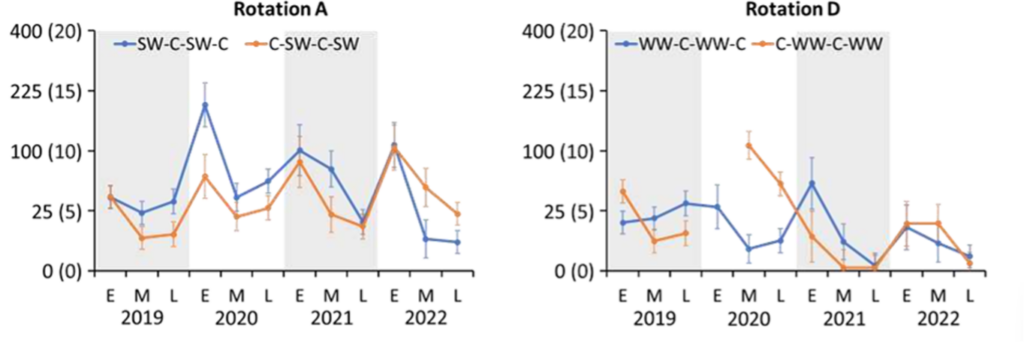
Figure 1. Kochia plant densities across four years in a spring wheat/canola rotation and in a winter wheat/canola rotation.
Seeding problematic areas into perennial forages is another potential avenue for kochia control. Repeated forage cuttings throughout the growing season limit kochia’s ability to set seed and shade out emerging plants, resulting in reduced kochia plant densities over time. However, during the establishment year, in-field kochia densities can increase rapidly. At the end of the four-year study, kochia plant densities had declined by 97 per cent (Figure 2), but kochia seeds remained abundant in the soil.
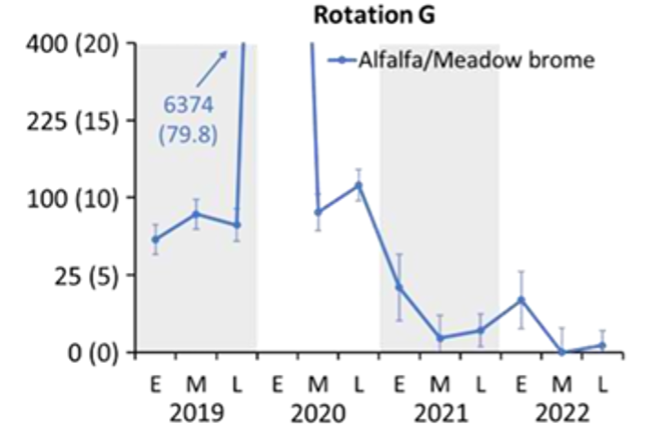
Figure 2. Kochia plant densities across four years in a stand of alfalfa and meadow brome.
Early maturing crops can mature before Kochia develops viable seeds. But watch for regrowth
The importance of kochia regrowth depends on harvest timing. In the study, early harvests (e.g., late July to early August) cut down kochia before seeds on growing plants became viable. However, early harvests create an opportunity for kochia regrowth and subsequent seed production. In contrast, harvest timings around mid- to late August (approximately 2083 GDD in this study) balanced minimizing initial kochia seed production while also limiting regrowth potential. For early harvest timings, pre-harvest and post-harvest herbicide applications, along with mowing dense kochia patches in mid-August, provide additional opportunities to manage kochia regrowth and prevent seed production.
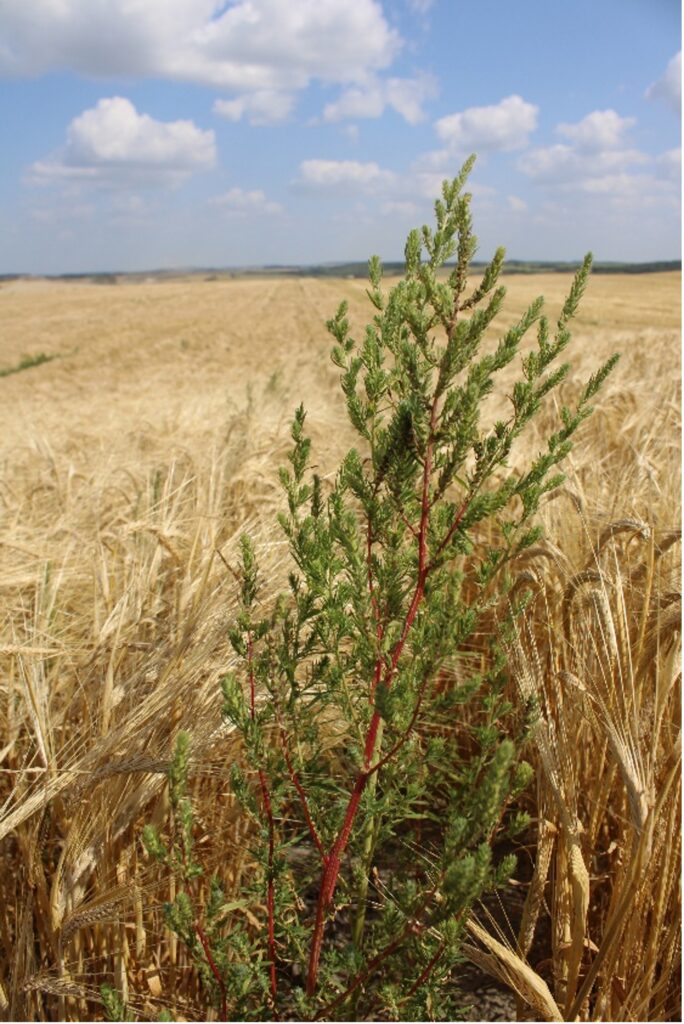
Kochia growing in a barley field at harvest.
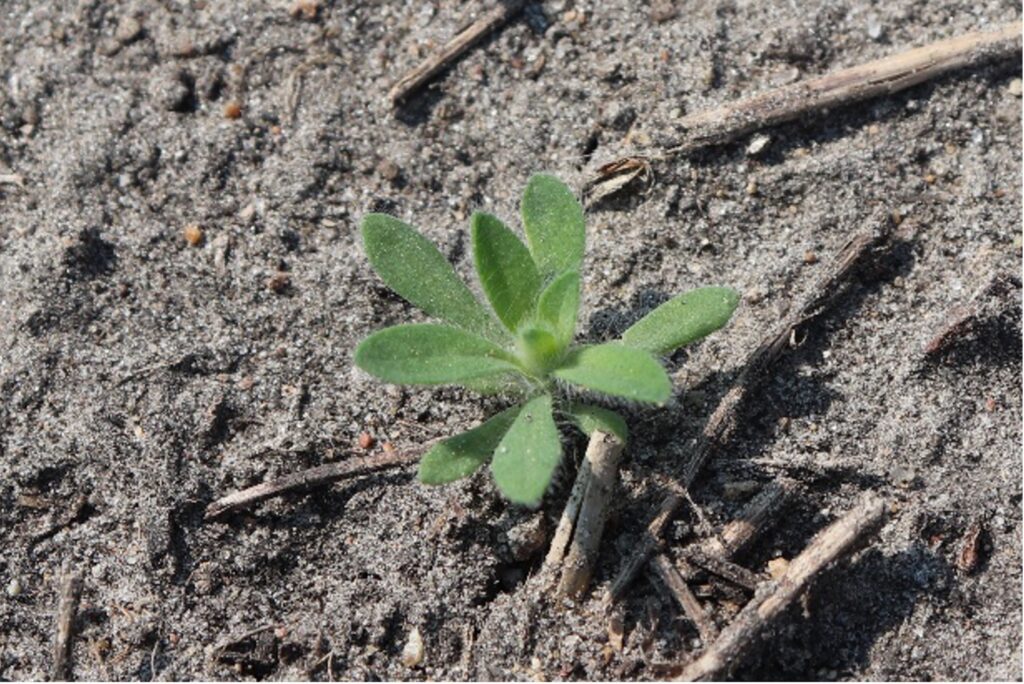
Kochia seedling.
Additional management practices to control Kochia
- Mitigate saline areas that allow kochia to grow without crop competition.
- Spray early before crops emerge to control early flushes of the weed.
- Scout fields early and often.
- Rotate and mix herbicides; whenever possible use at least two effective modes of action following recommended timings and rates.
- Consider using harvest weed seed control equipment; MCA is exploring the use of this equipment on two Research on the Farm trials.
Additional resources
- Managing Herbicide-Resistant Kochia - Manage Resistance Now
- Wheat School: Why kochia is so hard to kill and so prone to herbicide resistance
References
- Friesen, L. F., Beckie, H. J., Warwick, S. I., & Van Acker, R. C. (2009). The biology of Canadian weeds. 138. Kochia scoparia (L.) Schrad. Canadian Journal of Plant Science, 89(1), 141–167. https://doi.org/10.4141/CJPS08057
- Beckie, H. J., Blackshaw, R. E., Hall, L. M., & Johnson, E. N. (2016). Pollen- and seed-mediated gene flow in kochia (Kochia scoparia). Weed Science, 64(4), 624–633. https://doi.org/10.1614/WS-D-16-00038.1
- Beckie, H. J., Blackshaw, R. E., Leeson, J. Y., Stahlman, P. W., Gaines, T. A., & Johnson, E. N. (2018). Seedbank persistence, germination and early growth of glyphosate-resistant Kochia scoparia. Weed Research, 58, 177–187.


-
November 24, 2025
Unlike annual weeds that complete their life cycle within one year, perennial weeds live for multiple years, becoming dormant in… Read More

-
June 4, 2025
Your weed management plan shouldn’t end after you’ve sprayed! Scouting after a post-emergence herbicide application is an important step in… Read More

-
May 17, 2024
Manitoba farmers are well aware of the destructive abilities of wireworms. They feed below ground on many different crop types,… Read More

-
April 29, 2024
Early season weed control can be key to optimizing yield and giving your crop a good head start. Even small… Read More


-
April 8, 2024
Hybrid selection in sunflower can be difficult. Seed companies provide an abundance of information on specific traits, but all this… Read More


-
April 8, 2024
Hybrid selection in corn can be difficult. Seed companies provide an abundance of information on specific traits, but all this… Read More

-
April 8, 2024
This is Part 3 in a three-part series on managing extremes of moisture. Part 1 focuses on soil properties and… Read More
-
April 8, 2024
This is Part 2 of a three-part series on managing extremes of moisture. Part 1 focuses on soil properties and… Read More
-
April 8, 2024
This is Part 1 of a three-part series on managing extremes of moisture. Part 2 focuses on crop selection, pests… Read More