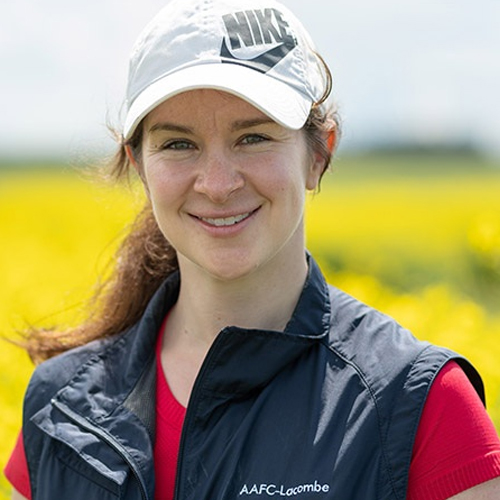
Breanne Tidemann, weed scientist, Agriculture and Agri-Food Canada

Follow @breannetidemann on Twitter!
Breanne Tidemann is a weed scientist in weed science and field agronomy with Agriculture and Agri-Food Canada (AAFC) based in Lacombe, AB. While her original ambition was to be a dentist, partway through her degree she realized she did not enjoy working with teeth all that much. Instead, she spent a summer working with AAFC where she fell in love with agriculture research. She moved on to complete her master’s degree and PhD at the University of Alberta. Tidemann is currently on maternity leave, although you will still catch her online and in the field occasionally, and lives in Blackfalds, AB, with her husband and two little boys.
Where did you work before AAFC?
I started working with AAFC partway through finishing my PhD. I worked previously as a summer student for Dow AgroSciences and for Cargill as a crop scout, as well as my original summer in agriculture research with AAFC as a student.
What got you interested in this area of work?
During my summer position with AAFC I really became interested in weed science. I was working on the weed management crew at the Scott Research Farm. As I was working through the scientific method of asking questions and learning how things work, I realized the work we were doing like trying new herbicides was something my dad could use on the farm, or a specific weed was becoming problematic and we were looking for new ways of managing it. So, it was really that application of science that drew me in.
Tell us a bit about what you’re working on at AAFC?
Our program is focused on integrated weed management strategies and my research is focused around alternative weed management strategies in conventional cropping systems. We are trying to discover additional strategies to help farmers reduce reliance on herbicides and manage the selection and evolution of resistant weeds. For example, I’m doing a bit of work on harvest weed seed control (a strategy used in Australia) to discover its potential fit in Western Canada. I also collaborate closely with Charles Geddes and Shaun Sharpe on weed biology work.
Developing decision support tools for effective herbicide use in the face of herbicide resistance is quite a unique project in my program. It stemmed from a conference presentation I was giving at an agronomy update in Alberta a couple years ago. I was presenting on using effective tank mixes and multiple modes of action and discussing how sometimes our understanding (or the marketing) of effective modes of action makes us think that we’re doing the right thing when in fact we may not be. For example, we’ve got two actives in the tank as per marketing guidelines, but the actives might not both have activity, or perhaps we’ve got resistance to one or we’re not using the correct mix rate. All of these types of situations can easily occur and prevent farmers from getting the full benefits from the products. At the end of my presentation a colleague in the audience asked me if some type of decision support tool exists to help farmers work through some of this information. That was my “Aha!” moment and this project stemmed from there.
The project began in April last year (2021) when Christine Cock was hired as a term technician. She is currently building the database, collecting herbicide labels and their actives, including which weeds they are effective against. The goal of the project is to create a tool farmers can go into and say, “I’ve planted this crop, I want to spray this product, what other products could I add that would give me another effective mode of action? ”We’ve developed a prototype of the application and are testing to ensure the coding and crop/herbicide selections are working correctly. For now, the focus is on building the database so we can include selection in all the crops grown in Western Canada and all the weeds found here. The project is funded by Manitoba Crop Alliance, Alberta Wheat Commission and Saskatchewan Wheat Development Commission.
What can you say about the value of farmers providing funding and support to your organization?
Funding from farmers tells me that the research we are doing is something they can incorporate on their farm, and that we are working on issues that are important to them. The goal of all of our research is to help farmers.
How does that farmer funding and support directly benefit farmers?
Hopefully, we’re doing work that is useful to them and are providing results they can use on their farm. In this case, particularly, we hope to be able to hand farmers a tool that they can actively use when they are making herbicide decisions on their farms to help manage resistant weeds and prevent further resistance selection.
How do you spend your time outside of work?
I love to read! I am a very avid reader. I also crochet a little bit here and there and I play the violin.
How do you celebrate agriculture?
Teaching my boys about agriculture is certainly one way. We live in town now, but my oldest son (4 years old) sure knows what a combine does and what tractors are! I love my job and I love what I do, that’s why I still work while I am on maternity leave. It’s more of a day-to-day lifestyle than a big celebration. I certainly buy canola oil and Canadian-made products at the grocery store and try to ignore the non-GMO certified labels.
What gets you most excited about your work?
The potential to ask questions to everyone, not just the experts but to farmers and my peers. There’s always something new to look at or something interesting to stumble across in research. I think my technicians sometimes dread when I come out to the field to help them because I tend to squirrel off into seeing something off topic or get distracted by a weed. There is just so much to learn, and for me, it’s so much fun.
Follow @breannetidemann on Twitter!
Late Season Planting

The reality of seeding or planting any crop into June is that yield penalties will occur. This could be due to reduced bushel weight, small seed size, and low quality grain as a result of early fall frost or poor environmental conditions leading up to maturity.
Planting corn or sunflowers beyond May 30th is still a possibility in 2022, but hybrid selection is of utmost importance, since we have already missed out on 250 crop heat units or more, depending on location. Sunflowers require 115 – 130 days to mature in Manitoba, with the varieties we currently have available. So, a sunflower crop that is planted on June 1st, will mature by September 24th, at the earliest.
Sunflowers are a great option in a wet year, if you can get them planted. They are one of the top water-users that we grow in Manitoba, only behind corn and roughly tied with soybeans. They are very well adapted to dry growing seasons as well because they will search much further for water sources than other crops.
The following tables are taken directly from a NDSU Extension article, “Replanting or Late Planting Crops”: https://www.ndsu.edu/agriculture/ag-hub/publications/replanting-or-late-planting-crops. Note that the majority of North Dakota accumulates several more crop heat units than Manitoba, even at our most southern locations, but these tables do depict a good indication of what a farmer is looking at for yield loss when planting into June.

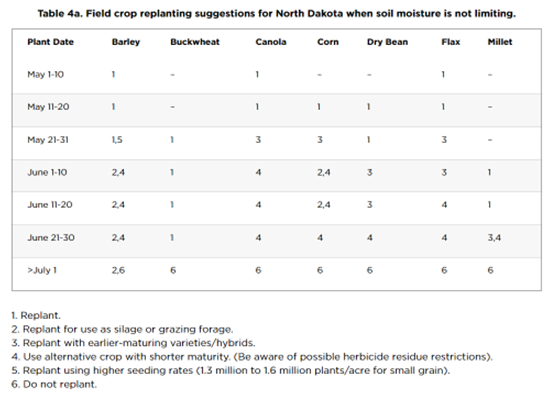
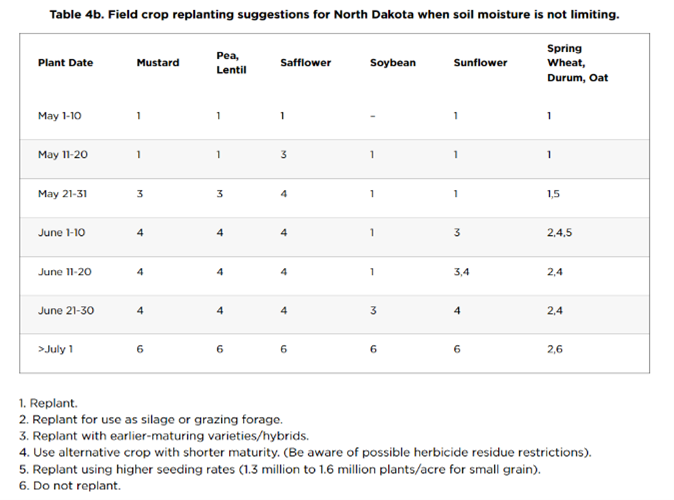
The data provided here is very cautious and simply states that anything grown after May has very little chance of being economical, which isn’t completely true, but it does encourage the fact that a farmer does have to be wary of what is being seeded after that point. The risks involved are obvious and great care must be taken in order to get any late seeded or planted crop to germinate as quickly as possible and off to a healthy start. It is not unheard of to have a crop emerge within just a few short days of planting when soils are warm and have good moisture, and the quicker that crop gets growing, the more water it will start using. Take great care in placing seed accurately in the soil, control weeds and fertilize accordingly to mitigate any early season stresses.
Curtis Pozniak, professor and director, University of Saskatchewan


Follow @CurtisPozniak and @CDC_USask on Twitter!
Professor of wheat breeding and genetics at the University of Saskatchewan (USask) and director of the Crop Development Centre (CDC), Curtis Pozniak grew up on a farm in Saskatchewan and lives in Saskatoon with his wife Maureen and two sons Marcus and Jonathon. Curtis has an undergraduate degree in plant science and environmental science and a PhD from USask where he is now a professor.
Where did you work before USask?
I’ve been a professor at USask since 2003. After I completed my graduate degree in 2002, I moved into a faculty breeding position in the CDC and in 2020 I became the director for a five-year term.
What got you interested in this area of work?
I was born and raised in Saskatchewan and I’ve always been interested in agriculture. I came to university to become an agronomist, so I could go back to work on the farm where I grew up, but I got hooked on genetics and plant breeding and decided to stay. I met some really interesting professors and I think it was the mentorship from a number of professors and people that really piqued my interest and supported me along the way. In a way, it’s a bit of a Cinderella story to be able to work at the university I trained at, in the province where I grew up, in an industry that is important to me and my family.
Tell us a bit about what you’re working on at USask.
As plant breeders, we focus on a number of traits when we are improving varieties for western Canadian farmers. Its important to have disease resistance, for example, to ensure the variety has yield stability, so disease pathogens don’t infect the plants and ultimately the yield. We focus on the five priority-one diseases in Western Canada: Fusarium head blight (FHB), leaf rust, stem rust, stripe rust and common bunt. We are working on a couple of projects that focus on some of these key priority diseases, funded partially by Manitoba Crop Alliance (MCA).
FHB is one of the biggest challenges for disease resistance breeding in Western Canada. Durum wheat, which is what I focus on, is possibly the most susceptible of the wheat classes that we grow in Western Canada. Although there is very little genetic resistance to FHB in durum wheat, there is some that tends to be controlled by what we call minor genes. Essentially, minor genes don’t have a large effect on their own, but when combined one at a time, you get this slow build up of resistance. The objective of the Multi-pronged FHB management strategy in Western Canada through insights into pathogen virulence mechanisms project is to identify those genes and how they work and bring them together in this additive way to collectively improve FHB resistance in durum wheat. That project is interesting because we are focusing on both the plant and the pathogen. When you think about diseases, the interaction between the plant (the host) and the pathogen is either a resistance response or a susceptibility response. We are identifying the genes that cause resistance in the plant, but we are also trying to understand the pathogen and what the pathogen is doing to infect the plant. We hope that if we bring those two pieces together, we will have a complete picture of how the host and the pathogen interact with one another so we can make plants more resistant.
Maximizing durable disease resistance in wheat is another interesting project where we are identifying novel resistance genes that haven’t yet been deployed in plant breeding. Through this project, we are collecting and screening some of wheat’s wild relatives (wheat species that still grow in the wild) with the diseases that are important for our environment. We identify those that are resistant and perform very detailed genetic studies to identify the underlying genes that are causing that resistance. Next, we bring those resistant genes into commercial varieties that farmers want to grow.
What can you say about the value of farmers providing funding and support to your organization?
Support from farmers is critical to our success. It’s an excellent example of a win-win relationship, where farmers are funding research that is important to their farms and, in turn, our breeding programs are tackling the problems with the biggest impact on farms. It’s an intimate relationship where there is two-way communication on the research priorities we can focus on, and then deliver on in the form of improved varieties for western Canadian farmers. In my program and certainly in the CDC, funding from farmers keeps us grounded in working on the priorities of farmers and in tackling those big problems that are immediate for them.
How does that farmer funding and support directly benefit farmers?
Ultimately, in the form of new varieties – new, high-yielding varieties that are resistant to diseases and are marketable with the end-use quality profile that demands a premium in the international markets. We’ve done a number of studies at the university that have shown in our CDC programs for every dollar invested by growers they are getting a $12 return. It’s an excellent example of the benefit that farmers are getting through new varieties.
How do you spend your time outside of work?
I’m a singer and guitar player in a rock and roll band in Saskatoon. I’ve been a musician my whole life, playing concerts, cabarets, gigs and parties since I was about 10 years old. Once a week, the band gets together and we play songs – I really enjoy that. It helps me turn off from work and do something completely different that is artistic and fun. It’s sort of my adrenaline rush. Summer is looking busy, so that’s good!
What is the best part about your job?
The diversity of what I get to do. In my own research program, I focus on developing new varieties for western Canadian farmers. I focus on durum wheat, as well as Canadian Prairie Spring Red wheat, but I also have a strong genetics and genomics research program that focuses on developing molecular tools that then flow in and assist the plant breeding program. And in my role as the director of the CDC, I get to engage with the industry, industry partners and our stakeholders from across the value chain. I get to work with some great scientists every day, it’s a very diverse place. That’s what I really like about my job, the diversity and connecting that basic research to varieties that are ultimately grown in farmers’ fields.
How do you celebrate agriculture?
I live ag! Celebrating ag is seeing the varieties that the CDC and my collaborating breeders develop grow on our farm. That is the celebration – to see the fruits of our research growing in a farmer’s field.
What is the best piece of advice you’ve received?
Don’t take the easy road, think outside the box. When I was in my PhD, I wanted everything to be perfect and it never really was. Then I realized it was because I was anticipating the outcome instead of seeing where the path takes me. Always keep an eye to the future.
Follow @CurtisPozniak and @CDC_USask on Twitter!


Charles Geddes, research scientist, weed ecology and cropping systems, Agriculture and Agri-Food Canada


Follow @charlesmgeddes on Twitter!
Charles Geddes is a research scientist in weed ecology and cropping systems at Agriculture and Agri-Food Canada’s (AAFC) Lethbridge Research and Development Centre. Charles grew up on a farm in southern Manitoba and moved to Winnipeg after high school, where he earned his bachelor of science in agroecology and his Ph.D. in plant science at the University of Manitoba. He currently lives in Lethbridge with his wife, Crystal, and their two kids, Olivia and Adam.
What is the best part about your job?
To me, one of the most important things about this job is that I can contribute to some adoption of applied solutions at the farm level. In my position, I have the ability to design research projects that can have a direct impact on the farm. I think that is really important and one of the biggest benefits of the job.
What got you interested in this area of work?
My initial interest came from my days on the family farm. Around the start of university, during the summer I was farming with my dad and we took over a field that was rented for several years previous. We didn’t have a good history on that field and it turned out to be infested with wild oats that had multiple resistance, and it was just a devastating crop year. I like to think that experience is what made me dedicate my career toward helping farmers manage herbicide-resistant weeds.
Tell us a bit about what you’re working on at AAFC Lethbridge.
The big focus of our research program at AAFC is herbicide resistance. The program takes an approach where we are focused on the discovery of new herbicide-resistant weed biotypes that exist on the Prairies. We monitor for those biotypes across the Prairies to determine the impact of that herbicide resistance, and we develop integrated management strategies specifically targeting those biotypes.
The “Next generation of prairie herbicide-resistant weed surveys and surveillance” project leads the herbicide resistance surveillance for Alberta, Saskatchewan and Manitoba. In this project, we survey 800 fields across the Prairies over the course of four years and look at the status of herbicide resistance in essentially all field crops across the Prairies and many of the weeds that are present in crops after post-emergence herbicide application. The “Glyphosate resistance kochia survey” is a post-harvest survey looking at the status of herbicide resistance in kochia, specifically, with the difference being the timing of the survey because kochia seed isn’t viable when the previous survey takes place. These projects are a monitoring component, looking at the status of herbicide resistance across the Prairies and how it’s changing over time. Then we try and link the status of resistance to grower management practices using a management questionnaire.
The other two related projects are “Management of glyphosate-resistant kochia in western Canadian cropping systems,” co-funded through the Integrated Crop Agronomy Cluster, and “Understanding auxinic herbicide resistance in kochia and staying ahead of what’s next.” In general, we know that herbicide resistance in kochia is a growing issue across the southern Canadian Prairies. These projects are specifically trying to develop new and integrated management strategies targeting herbicide resistant kochia. Anything from looking at further understanding resistance in kochia, to looking for types of resistance that aren’t out there to our knowledge but are on our radar – as we think they might be selected for next in kochia – and also looking at integrated management in the field.
We are looking at things like:
- How crop rotation diversity impacts the management of herbicide resistant kochia through alternating crop life cycles
- Swapping out summer annuals in a crop rotation for winter annuals like winter wheat, or perennials
- How row spacing and seeding rates affect the ability of crops to compete with kochia
- Developing management strategies based on the biology of kochia
What can you say about the value of farmers providing funding and support to your organization?
Farmer-based and farmer-led funding makes up the majority of our research program and is extremely important to us. Almost all our work is funded by farmers and grower groups. When we go through these different proposal and review processes, I really appreciate that a lot of the boards that are making decisions are made up of farmers who are dealing with some of these issues. I like to think that my link back to the family farm and a bit of applied experience in farming helps me relate to some of those issues and communicate what we’re trying to do in a way that makes sense at the farm level.
How does that farmer funding and support directly benefit farmers?
Several of our projects that are farmer funded tend to be more applied in nature, so the results tend to be directly applicable on the farm. Basically, the money that farmers are investing in research is trying to come up with new tools or strategies to manage these herbicide-resistant weeds we are dealing with on the Prairies. With that, I think they can see a more immediate return on investment.
How do you spend your time outside of work?
In the summertime we really like to go camping, and there are a lot of excellent camping spots in southern Alberta. I also like to play music. I play the violin and guitar – both electric and acoustic, although I don’t get to play as often as I’d like to!
And what are you excited about for the future of agriculture?
I think the future in agriculture is bright and I’m really fortunate to work in this discipline. I think we are also aware of challenges that are coming down the road, specifically related to our research. We know herbicide resistance is an issue that’s growing, and it’s going to be at the forefront of a lot of our agronomic decisions moving forward and in the future. I’m excited to have a contribution to some of those decisions.
What is your favourite food/meal to cook?
I really like turkey dinner. As for cooking, although this probably isn’t considered cooking, I like to brew beer completely from natural ingredients. What I mean by that is I like to go from grain brewing all the way to beer, rather than using home-brew kits. I actually have a hop variety experiment going on in my back yard. We’re growing nine different varieties of hops and that’s what I am using in the brewing process.
Follow @charlesmgeddes on Twitter!
Rob Graf, winter wheat breeder, Agriculture and Agri-Food Canada


Follow @grafwheat on Twitter!
Rob Graf is a winter wheat breeder with Agriculture and Agri-Food Canada (AAFC) at the Lethbridge Research and Development Centre. Rob completed his bachelor of science in agriculture at the University of Saskatchewan (USask), specializing in agronomy, and earned his PhD under the supervision of Gordon Rowland at the USask Crop Development Centre. Rob began his career in 1987 as a wheat breeder with the Saskatchewan Wheat Pool and was there for 12 years. During that time, he was part of a team that developed three Canada Western Red Spring (CWRS) wheat varieties, including McKenzie and Prodigy. In 1999, Rob joined AAFC as a winter wheat breeder. He currently lives in Lethbridge with his wife, Linda, and is looking towards retirement in October.
Tell us a bit about what you’ve worked on at AAFC throughout your career.
Our mandate is to develop improved winter wheat varieties for Western Canada. In the AAFC breeding program, we’ve concentrated on varieties for the Canada Western Red Winter (CWRW) milling class and, to a lesser extent, feed varieties for the Canada Western Special Purpose class. In a general sense, the objectives of the breeding program are to improve agronomics, disease resistance and end-use quality. The agronomic issues we focus on are increased yields, improved winter hardiness (both prime considerations), increased lodging resistance (strong straw in a range of height options), a range in maturity and good test weight.
As for disease resistance, in Western Canada there are five priority-one diseases that must be addressed for variety registration. These include the rusts (stem, leaf and stripe), Fusarium head blight (FHB) and common bunt. Disease resistance was one of the objectives I felt really needed to be concentrated on. In 1999, disease resistance was only starting to be deployed in the winter wheat varieties being registered. Farmers had to make the choice to grow a variety with leaf and stem rust resistance (important for Manitoba), or a variety with bunt resistance (particularly important in southern Alberta). At that time, FHB wasn’t on the radar for winter wheat, but it was a major issue in spring wheat. That’s one of the reasons why winter wheat acres in Manitoba exploded in the 2000s (the escape from FHB and orange wheat blossom midge) along with the variety CDC Falcon, which had short, strong straw, early maturity and high yields; farmers liked it. Today, we have varieties that have good resistance to all five priority-one diseases and are also working on resistance to other diseases and pests. It took about 20 years, but we’ve been able to get there through some really excellent collaborations with nurseries and testing sites across Western Canada.
A key element to developing varieties that work well in Manitoba was a collaboration with Anita Brûlé-Babel at the University of Manitoba. Her team planted a large leaf-and-stem-rust screening nursery for us that I rated and made selections from every year. We don’t normally see leaf and stem rust in Alberta, so that made a huge difference for Manitoba farmers. The other critical aspect of our collaboration was the provision of an FHB screening nursery. Without that, we couldn’t have made the advances that we did. For example, Emerson, which is still a popular variety in Manitoba, was identified as an FHB-resistant line in those nurseries. Without that nursery, we wouldn’t have known. It’s collaborations like these that are so crucial to the success of any breeding program.
Quality is the third pillar of our breeding program. When I started, the major improvements CWRW needed included increased protein concentration, gluten strength and flour water absorption. Over time, we’ve gradually increased protein concentration and gluten strength, and we’re finally starting to make progress on flour water absorption. My hope is that over the next few years, we will see a substantial increase in winter wheat flour water absorption.
Upon my retirement, Harwinder Sidhu will be taking over the winter wheat breeding program. I’ve been mentoring him for the last year, getting him up to speed on the program, and I think he’ll do an excellent job. He is a recent PhD graduate from the University of Guelph, where his PhD project was focused on genomic selection for FHB resistance in winter wheat.
What got you interested in this area of work?
I grew up on a farm near Humboldt, SK. I remember when my dad changed varieties from Neepawa to Napayo and then Sinton. It was intriguing to me that Napayo had awns (most varieties at the time were awnless), as I thought only barley was awned. A couple of years later, we grew Sinton, which was interesting because it had better leaf rust resistance, which I could actually see in the field. I also remember a wet harvest period in the mid-1970s when Sinton sprouted in the swath and Napayo didn’t. It was those genetic differences in the varieties that got me intrigued, and I guess the rest is history.
What is the best part about your job?
There are a lot of things! I really enjoy seeing the genetic variability when we cross various parents. I also like the interaction with farmers and the industry to hear what their problems and concerns are, and then trying to come up with breeding solutions to address them. When I’m able to deliver a variety that addresses at least some of those concerns, and it becomes accepted and farmers like the variety, it’s a great feeling.
What can you say about the value of farmers providing funding and support to your organization?
The funding farmers provide to breeding programs is absolutely vital to their success. When an industry group approaches AAFC with issues they need to have addressed and are willing to invest, it means a lot. Governments have many priorities for funding, and that goes for farmers as well. The funds received for breeding and pathology programs, and some of the more basic research, are absolutely vital to the successes that we’ve had and to the continued success and prosperity of the industry and Canada.
How does that farmer funding and support directly benefit farmers?
The funding support has hugely impacted the number and size of populations that I can handle as a breeder. Breeding is a numbers game. You need large numbers to find those rare segregants that bring together all of the traits that are needed by the industry. It allows us to handle a lot more material, gives us the ability to put trials at important locations, and it supports disease screening nurseries and quality analysis. From a Manitoba perspective, that has been crucial in developing varieties with resistance to FHB, stem rust and leaf rust.
What is one of your major accomplishments over your career?
Within the winter wheat program, one of the major wins was the registration of Emerson. Essentially, we moved from most winter wheat varieties being quite susceptible to FHB, to the first wheat in Canada that was rated resistant. That was certainly a bit of good luck, but as breeders we need to be able to set things up to identify those advances.
What opportunities lie ahead for winter wheat breeding?
Winter wheat has a bright future. From the standpoint of climate change over the medium term, it’s likely that our winters will get milder. Winter wheat provides the opportunity to use early spring moisture that farmers are waiting to dry off prior to spring seeding. Why not use that moisture to build yield? With the possibility of hotter summers, because the crop matures earlier, it may also be able to escape some of the heat stress we get in late July and August. It certainly has an excellent opportunity to fit into our environment, perhaps somewhat better than it has in the past. Not to say that it doesn’t fit now, but I think as time goes on, farmers will see it as a more attractive option. Or at least I sure hope so!
What are you looking forward to most about retirement?
There is a number of things. I am looking forward to taking a break, visiting more with family and friends, and my wife and I enjoy camping and plan to do more of that together. Our granddaughter just turned one, so we look forward to spending more time with her, as well. We’d also like to do some travelling in Canada and the United States, and longer term in Europe and other places.
Who or what inspires you?
There are a lot of people who inspire me! My colleagues and all of the important work that they are doing inspires me every day. Young people and their optimism for the future also inspires me.
What is the best piece of advice you’ve received?
There are a couple of things, both from my dad. “Pray and live like you’ll die tomorrow; work like you’ll live forever.” The other was, “If you see something that needs doing, don’t wait for someone else to do it.” Those are gems of wisdom I can’t argue with.
Follow @grafwheat on Twitter!
To meet other researchers involved in winter wheat breeding and agronomy, check out our profiles on Curt McCartney and Brian Beres!
Highly coveted certification assists consumers in identifying environmentally friendly products
By Ellen Pruden, Cereals Canada
Sustainability labels on food packaging can be found in the grocery stores on everything from coffee to chocolate and even on wine. Food and beverage packages that contain Canadian wheat have not seen an ecolabel applied to their products until now with the Habitat-Friendly Winter Wheat Ecolabel. The Habitat-Friendly Winter Wheat Ecolabel program is a solution that benefits Canadian wildlife habitats, the environment and the economy.
Research by Ducks Unlimited shows that winter wheat provides ground cover in the spring to help reduce soil erosion and offers nesting habitat for wildlife, especially waterfowl and songbirds in Western Canada.
While bread and flour are obvious products that could be certified, any food or beverage brands that use western winter wheat are eligible. For example, Beam Suntory, a world leader in premium spirits, received certification for its newly launched Northern Keep Vodka, a premium craft vodka that is committed to sustainability and land protection.
“We’re thrilled to announce that Northern Keep Vodka is one of the first brands in Canada to be accredited as a certified Habitat-Friendly Winter Wheat product. This highly coveted certification assists consumers in identifying environmentally friendly products that provide critical habitats for ducks, birds and other Canadian wildlife,” says Danielle Milette, senior brand manager of Northern Keep Vodka.
Northern Keep Vodka believes in preserving Canada’s natural resources and has partnered with the Nature Conservancy of Canada to protect ecologically significant parts of the country. “Sustainability and protection of the lands that have gifted us the bounty of grains needed to create this premium vodka are at the core of everything Northern Keep Vodka does,” Milette says.
Consumers will start to see the branded ecolabel on Northern Keep Vodka product promotions in local liquor stores this spring.
“As the Habitat-Friendly Winter Wheat program grows with more companies, choosing products with the ecolabel helps supports Canadian farmers while making a positive impact on the environment,” says Doug Martin, winter wheat farmer from East Selkirk, MB. “By working together from field to product, we are showcasing one part of Canadian agriculture’s sustainability story.”
Manitoba Crop Alliance has partnered with Cereals Canada to develop this ecolabel in co-operation with the Alberta Wheat and Barley Commissions, Saskatchewan Winter Cereals Development Commission and Ducks Unlimited Canada. The ecolabel highlights the ecological benefits of winter wheat to consumers and creates new marketing opportunities that increase demand for winter wheat.
The Habitat-Friendly Winter Wheat Ecolabel program promotes western Canadian winter wheat, while also sharing the environmental benefits that are inherent in this crop. “It is an innovative approach to market development that taps into growing consumer demand for sustainable products,” says Daniel Ramage, director of market access and trade policy at Cereals Canada. It also represents an opportunity to communicate agriculture’s positive contributions to the environment.
Farmers can participate in the program by growing western Canadian winter wheat and delivering it to a certified processor or end user. Grain handlers, mills and food manufacturers can become certified through an application and audit to confirm they can appropriately document grain segregation and track flour blending to meet the required 30 per cent minimum percentage of winter wheat for certified flour.
Along with Northern Keep Vodka, another company using the ecolabel is Les Moulins de Soulanges, a specialty flour manufacturer based in Quebec’s Montérégie region. They are sourcing Manitoba winter wheat to sell certified habitat-friendly winter wheat flour to bakers across North America. Both companies found a fit with the Habitat-Friendly Winter Wheat program that puts sustainability at the forefront.
“We want to see this program expand. We are always looking for more companies to get certified and to use the ecolabel, and more farmers to grow winter wheat,” says Ramage. “We are excited about new partners joining the program and look forward to announcing the addition of another participating brand later this spring.”
Learn more about the Habitat-Friendly Winter Wheat Ecolabel program at habitatwheat.ca
Learn more about the Northern Keep Vodka and their sustainability efforts at northernkeep.ca

East Selkirk, MB, winter wheat farmer and MCA wheat and barley committee delegate Doug Martin