Allan Feurtado, Team Lead, National Research Council Canada
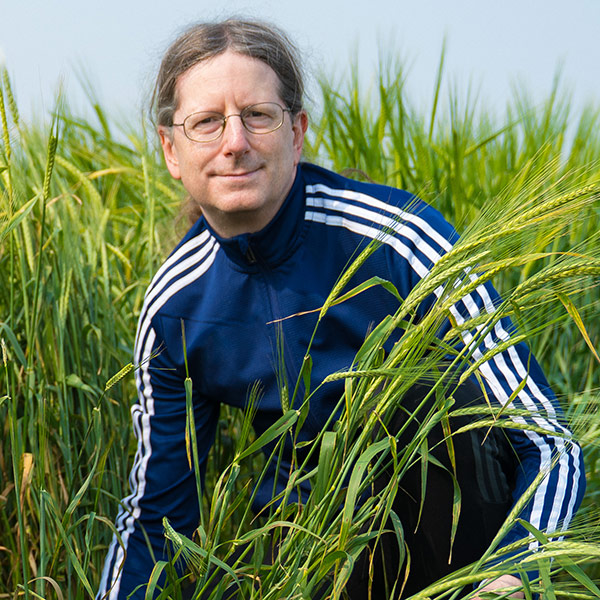
Allan Feurtado is the Team Lead of Integrated Omics and Climate Resilience at the National Research Council Canada (NRC). Growing up in Ontario, he developed an interest in plants and crops that led him to study at Queen’s University, the University of Guelph and then Simon Fraser University. His research focused on seed dormancy and germination, which eventually brought him to the Prairies and his current role at the NRC.
Where did you work before the NRC?
I first came to the NRC in Saskatoon as a PhD student through Simon Fraser University in Burnaby, BC. What was originally meant to be a one-year visit, to work with specialists in plant hormone research, turned into the place where I completed my PhD. After my PhD, I stayed at the NRC in a postdoctoral research associate role, working on seed maturation and germination. Over time, I became interested in abiotic stress, because of the parallels with events in seed development and maturation. This eventually led to my current position as team lead and research officer with the NRC’s Aquatic and Crop Resource Development Research Centre.
What got you interested in your current area of work?
My interest in plant roots stemmed from our discovery that the root system plays a significant role in wheat lodging resistance in our Prairie environments. Root biology had always interested me and its connection to lodging issues faced by farmers renewed my interest to develop a project centred on root system architecture – the shape and spatial arrangement of root systems. The second priority was figuring out the best way to look at roots. That’s where my interest in photography and imaging came in. I started thinking about how we could best use imaging technology and analysis to gain better insight into the root system diversity of our crops, and that’s also when I teamed up with root researcher Leon Kochian at the University of Saskatchewan.
Tell us a bit about what you’re working on at the NRC.
One of the current projects I’m working on is “Root of the Problem 2.0: Solidifying barley lodging,” which is a continuation of earlier work where we looked at various stem and root traits to determine which were impacting lodging resistance. The work is being done in collaboration with barley breeder Aaron Beattie at the University of Saskatchewan. Through the first “Root of the Problem” project, we conducted field trials in a small set of barley cultivars with varying lodging tendencies to confirm and validate the major traits contributing to lodging resistance in barley. We found that, in addition to plant height, wider root angles help anchor the crop and improve lodging resistance.
Since it is quite labour intensive to study roots in the field, we also wanted to use our indoor root imaging techniques to see if we could develop an efficient method that could be used to initially screen for lodging resistance. We found that root angles measured shortly after germination using hydroponic pouches were also associated with lodging resistance in the field.
Those findings led to Root of the Problem 2.0, which began in summer 2024 as a four-year project. Our goal is to further validate our findings and build an AI / machine learning model that breeders could use to select for lodging resistance using indoor root imaging. We’re also evaluating a larger collection of barley, around 250 genotypes, to better understand the genetics of root traits and develop root-based markers that will be very useful for barley breeders. We are continuing to collaborate with Aaron Beattie on the work and have added Ana Badea at AAFC Brandon to collect additional lodging data that will be important for building our models.
What can you say about the value of farmers providing funding and support to your organization?
It’s critical. At the NRC, part of our research is supported through external funding, so being able to work on projects that are directly relevant to industry and collaborate with breeders is incredibly important. Results coming out of our projects are applicable across the Prairies and involve funders from both crop organizations and government partners.
Support from farmers and the industry is essential for the research we want to do, especially bringing together the collaborations needed to elevate our research discoveries and outputs. Another important piece is science communication. It’s valuable that organizations like Manitoba Crop Alliance are interested in sharing our research with farmers and helping connect the science to the people who will ultimately benefit.
How does that farmer funding and support directly benefit farmers?
It has been important for me to build connections with crop development teams and breeders, and to work closely with them so the knowledge we are generating goes directly into breeding programs and helps develop the next generation of crops. Our goal is to give breeders tools to select barley with improved lodging resistance, which will ultimately help farmers reduce losses and improve crop productivity.
How do you spend your time outside of work?
My main hobby is photography, which relates back to my interest in image-based analysis of plants and our root imaging technologies. I’ve always enjoyed taking pictures, especially landscapes, nature, wildlife and places around Saskatchewan and Western Canada.
What is the best part about your job?
A couple of things come to mind. What really excites me is the science itself and the knowledge we can generate. Over the last decade, it has been exciting to see where that knowledge can go and the impact it can have through collaborations with plant breeders and other industry experts. The other part is working with collaborators and co-supervising students. I enjoy mentoring students, transferring knowledge and helping develop our next generation of potential scientists. It has been incredibly rewarding.
What is a good piece of advice you’ve received that has stuck with you?
Recently, I had a conversation with a new colleague about science being a team effort. We talked about surrounding yourself with people who bring diverse perspectives and expertise and about how critical this is to advancing research for Canada.
I’ve really seen the importance of that over the last five years through engaging with crop development teams, breeders, computer scientists, data engineers and AI/machine-learning experts. I see myself working at the intersection of crop biology and technology, where collaboration is essential.
It’s all part of surrounding yourself with an array of expertise and bringing different perspectives together to elevate what you are able to accomplish. That is advice I’ve received from several people over my career.