Corn Starter Phosphorous-Eastern

Background & Info

Research from Johnston et al. (2006) determined that 25% of fields are rated low to very low in soil P and cannot supply adequate phosphorus for a corn crop. Starter P is typically applied generously as a result of this data.

This project looks at the yield benefit vs. yield draw of starter P applied on high-P testing soils

Corn has high phosphorus requirements for plant development, beginning at germination. It is a favourable practice to seed-place a portion of the phosphorus blend, resulting in vigorous seedling growth and development. The remainder of the blend can be placed in a band near the seed row, though some grain corn farmers have adopted a split application process in-crop.

Starter phosphorus increases early-season biomass and plant height when measured at V4 and V7, respectively (Rogalsky, 2016). In the same research, silking date was 2–7 days earlier in starter-P treatments than untreated checks.

Result

In 2025, two sites (CRNSP03 and CRNSP07) remained unharvested at the time of publication, which leaves 16 site years of data to build a conclusion from. Three in 16, or 19 per cent, of site years showed yield results of statistical significance. These three sites consistently exhibited a yield bump in the same treatment across four replicates. However, 2024-CRNSP02 had a yield improvement in the additional phosphorus treatment and the reverse was demonstrated in
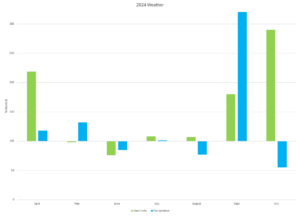
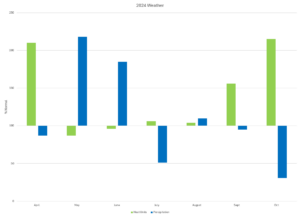
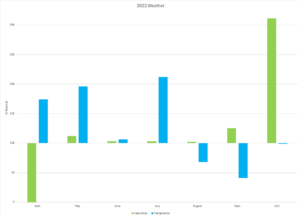
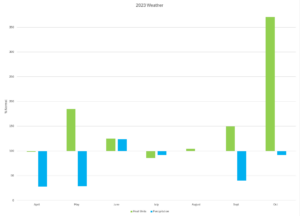
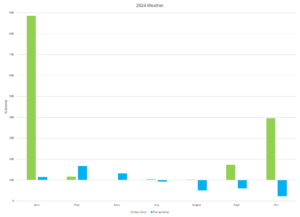
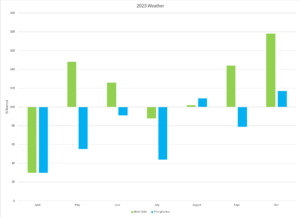
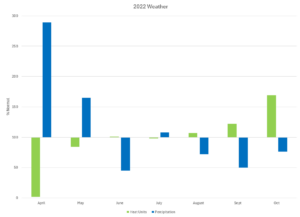
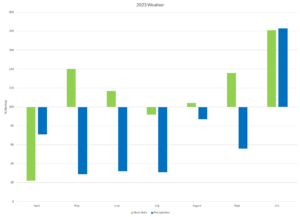
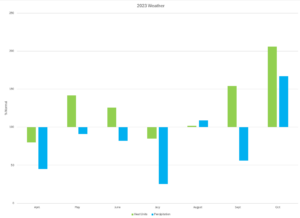
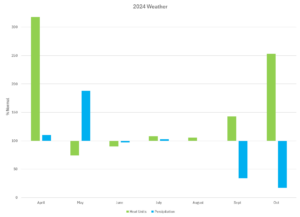
both 2025-CRNSP04 and 09. There was more precipitation in spring 2024 than in 2025, so that could be a factor in the yield increase with the added phosphorus treatment and soil-P mobility, especially in a lower soil-P scenario. There are many factors that cannot provide an exact explanation to each circumstance. More data is needed to come to a conclusion.

Loading


Weather Info

Corn Starter Phosphorous- Central

Background & Info

Research from Johnston et al. (2006) determined that 25% of fields are rated low to very low in soil P and cannot supply adequate phosphorus for a corn crop. Starter P is typically applied generously as a result of this data.

This project looks at the yield benefit vs. yield draw of starter P applied on high-P testing soils

Corn has high phosphorus requirements for plant development, beginning at germination. It is a favourable practice to seed-place a portion of the phosphorus blend, resulting in vigorous seedling growth and development. The remainder of the blend can be placed in a band near the seed row, though some grain corn farmers have adopted a split application process in-crop.

Starter phosphorus increases early-season biomass and plant height when measured at V4 and V7, respectively (Rogalsky, 2016). In the same research, silking date was 2–7 days earlier in starter-P treatments than untreated checks.

Result

In 2025, two sites (CRNSP03 and CRNSP07) remained unharvested at the time of publication, which leaves 16 site years of data to build a conclusion from. Three in 16, or 19 per cent, of site years showed yield results of statistical significance. These three sites consistently exhibited a yield bump in the same treatment across four replicates. However, 2024-CRNSP02 had a yield improvement in the additional phosphorus treatment and the reverse was demonstrated in
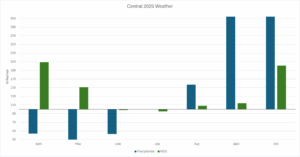
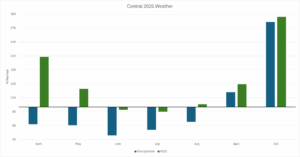
both 2025-CRNSP04 and 09. There was more precipitation in spring 2024 than in 2025, so that could be a factor in the yield increase with the added phosphorus treatment and soil-P mobility, especially in a lower soil-P scenario. There are many factors that cannot provide an exact explanation to each circumstance. More data is needed to come to a conclusion.

Loading


Weather Info

Corn Starter Phosphorous-All

Background & Info

Research from Johnston et al. (2006) determined that 25% of fields are rated low to very low in soil P and cannot supply adequate phosphorus for a corn crop. Starter P is typically applied generously as a result of this data.

This project looks at the yield benefit vs. yield draw of starter P applied on high-P testing soils

Trial fields received starter phosphorus amounts ranging from 20-45 lb/ac of P2O5, as per their respective spring soil analyses

Corn has high phosphorus requirements for plant development, beginning at germination. It is a favourable practice to seed-place a portion of the phosphorus blend, resulting in vigorous seedling growth and development. The remainder of the blend can be placed in a band near the seed row, though some grain corn farmers have adopted a split application process in-crop.

Starter phosphorus increases early-season biomass and plant height when measured at V4 and V7, respectively (Rogalsky, 2016). In the same research, silking date was 2–7 days earlier in starter-P treatments than untreated checks.

Result

In 2025, two sites (CRNSP03 and CRNSP07) remained unharvested at the time of publication, which leaves 16 site years of data to build a conclusion from. Three in 16, or 19 per cent, of site years showed yield results of statistical significance. These three sites consistently exhibited a yield bump in the same treatment across four replicates. However, 2024-CRNSP02 had a yield improvement in the additional phosphorus treatment and the reverse was demonstrated in
both 2025-CRNSP04 and 09. There was more precipitation in spring 2024 than in 2025, so that could be a factor in the yield increase with the added phosphorus treatment and soil-P mobility, especially in a lower soil-P scenario. There are many factors that cannot provide an exact explanation to each circumstance. More data is needed to come to a conclusion.

Loading


Flax Seeding Rate – Interlake

Result

Zero sites have had statistically significant yields between treatments. ​Plant counts were significantly different at 3 of the sites, however this did not result in subsequent increases in yield.

Additional Considerations: Lower seeding rate and plant populations can reduce crop competitiveness to field pest. Uniformity of crop maturity will be more variable with lower seeding rates, reducing crop protection product efficiencies.

Loading


Weather Info

Flax Seeding Rate – Western

Result

This site did not have had statistically significant yields between treatments. ​Plant counts were significantly different at the site, however this did not result in subsequent increases in yield.

Additional Considerations: Lower seeding rate and plant populations can reduce crop competitiveness to field pest. Uniformity of crop maturity will be more variable with lower seeding rates, reducing crop protection product efficiencies.

Loading


Weather Info

Flax Seeding Rate – Central

Result

Zero sites have had statistically significant yields between treatments. ​Plant counts were significantly different at two of the sites, however this did not result in subsequent increases in yield.

Additional Considerations: Lower seeding rate and plant populations can reduce crop competitiveness to field pest. Uniformity of crop maturity will be more variable with lower seeding rates, reducing crop protection product efficiencies.

Loading


Weather Info

Flax Seeding Rate – Eastern

Result

Zero sites have had statistically significant yields between treatments. ​Plant counts were significantly different at two of the sites, however this did not result in subsequent increases in yield.

Additional Considerations: Lower seeding rate and plant populations can reduce crop competitiveness to field pest. Uniformity of crop maturity will be more variable with lower seeding rates, reducing crop protection product efficiencies.

Loading


Weather Info

Flax Seeding Rate – Parkland

Result

Zero sites have had statistically significant yields between treatments. ​Plant counts were significantly different at all sites, however this did not result in subsequent increases in yield.

Additional Considerations: Lower seeding rate and plant populations can reduce crop competitiveness to field pest. Uniformity of crop maturity will be more variable with lower seeding rates, reducing crop protection product efficiencies.

Loading


Weather Info

Flax Seeding Rate- All

Result

After three years of conducting the flax seeding rate trial, zero sites have had statistically significant yields between treatments. ​Plant counts were recorded in every treatment and site and there were 10 out of 17 site years that did see differences in plant stand between seeding rates.

Quality analysis (oil % and protein %) was run on the four 2024 sites. All treatments at each site were consistent, with no affect on quality by plant population.

Additional Considerations: Lower seeding rate and plant populations can reduce crop competitiveness to field pest. Uniformity of crop maturity will be more variable with lower seeding rates, reducing crop protection product efficiencies.

Loading


Early Wheat Seeding-All

Background Information

  • Recent research from Collier et al. (2021) explored seeding spring wheat by soil temperature, rather than by calendar date.
  • They investigated if early seeded wheat can make better use of early season moisture and miss extreme summer heat during flowering and grain filling. However, early seeding comes with risk, such as frost, poor emergence and slow growth.
  • Results showed that initiating seeding into soil with temperatures between 2-6 °C resulted in no negative effects on wheat yield or protein, when compared to seeding at 8°C.
  • The Collier et al (2021) study did not include research sites located in Manitoba. Current MASC data suggests that seeding early is important to maximize yield.

 Results

No significant yield or protein differences were found between planting dates at these trial sites. Therefore, during the trial years, at these sites planting early did not impact wheat grain yield or protein levels

Loading


Top