
Making Every Pound Count: Nutrient Management in Corn

Fertility starts with the soil and the variables that make nutrients available to a growing crop.
Know Your Soil Texture
- Clay – very fine, soils with >50% clay
- Silt – rock & mineral particles that are larger than clay and smaller than sand. Soils with >87% silt
- Sand – very coarse, soils with >70% sand
- Loam – a balanced mixture of clay, silt and sand (approximately 20-40-40)
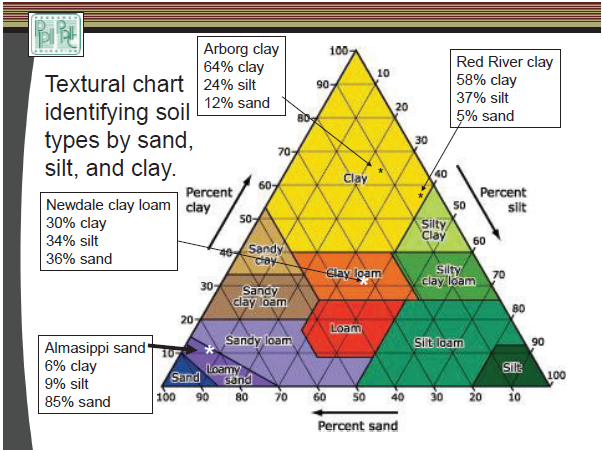
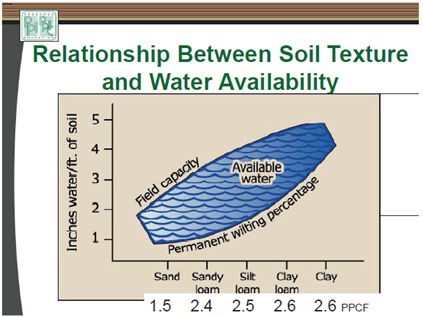
Soil texture determines a soil’s water holding capacity. Sand has low capacity to hold water and low water content at permanent wilting point (~10-15% v/v). Clay loam has a higher capacity to hold water, therefore has a higher water content at permanent wilting point (~15-20% v/v).
Nutrient Balance
Nutrient balance is vital to soil fertility and crop production. Nitrogen is most commonly the first and most limiting nutrient for non-legume crops, but without an adequate fertility blend with other nutrients, nitrogen use efficiency is not “maxed out” and suffers.
A poorly fertilized corn crop uses just a little less soil water over the season than an adequately fertilized crop, and yet fewer bushels of corn are produced per inch of water used. The properly fertilized crop is able to be much more efficient in water usage to produce more grain per inch of water used.
Nutrient Uptake
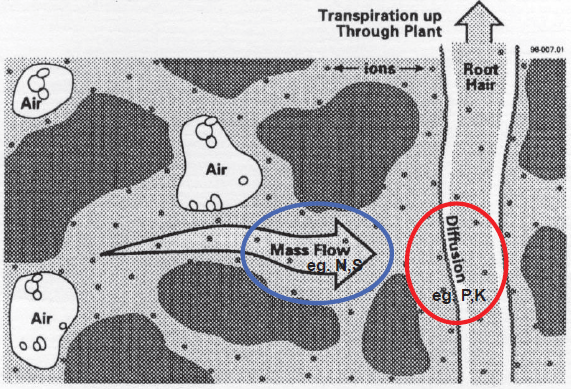
Nutrient movement in the soil and uptake by plant roots is important to understand because it dictates where fertilizer placement best facilitates root uptake. Nitrogen and sulfur are very mobile in the soil and move via mass flow. This essentially means that they move with the soil water. As a plant transpires water, the roots are required to draw in more nutrient-rich soil water and they do this by creating tension that draws the soil water to the roots. The rate of transpiration is related to environmental conditions, so poor soil moisture or cold temperatures, for example, will decrease the rate of transpiration, therefore decrease uptake of soil water (and nutrients) via mass flow. Phosphorus and potassium move in the soil via diffusion, meaning that with the help of soil moisture, the nutrients move from areas of high P or K concentration to areas of lower P or K concentration. As the nutrients are absorbed by plant roots and moved up into the plant, the roots become an area of low concentration, thereby drawing nutrients towards the roots from a higher concentration zone.
Nitrogen
Exact nitrogen rates in corn are still hard to identify and perfect. Modern corn hybrids have improved in nitrogen use efficiency, but more than that is required to optimize nitrogen uptake. We have already discussed how nutrient balance in the soil optimizes nutrient uptake, but soil conditions and the environment above and below the ground play major roles in this as well.
In 2016-17, John Heard, former Manitoba Agriculture Soil Fertility Specialist, performed a nitrogen use and uptake project in corn to identify whether nitrogen recommendations needed to be updated. Following this project, Dr. Don Flaten’s graduate student, Lanny Gardiner, then began his Master’s research, in 2018, on a similar study, “Optimum Nitrogen Fertilizer Management Strategies for Modern Corn Hybrids in Manitoba”. The two studies complemented each other with similar findings, which were the following:
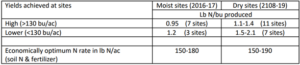
Nitrogen requirement to achieve the economically optimum yield for higher and lower potential yields. John Heard, 2022 – Profitable Nitrogen Rates.
A site that has a “lower” potential yield would be one that could be considered to have poor productivity. This may include variables like drainage issues, salinity, soil productivity, or poor crop management choices like delayed seeding, compaction issues, or delayed weed control, for example.
Dry sites in 2018-19 needed more nitrogen to achieve similar yields because dry soils have less mineralization of soil organic matter and decreased mass flow movement of nitrate-N to the plant root.
Phosphorus
Phosphorus is required for plant growth and seed development, therefore should be placed at least in a sideband for availability in early growth. It is not very mobile in the soil and will not get leached in spring conditions like we know nitrogen will in high moisture.
The general recommendation for phosphorus requirements in corn is +0.6 lbs of P per bushel of yield. Uptake is equivalent to 0.6 lbs P/bu and removal is 0.36 lbs P/bu, so it is very important to consider what your preferred level of phosphorus in the soil is following a corn crop.
Applying phosphorus at planting is the best practice for availability. The safest placement is in a 2×2 band but proceed with caution if applying P in a sideband with other nutrients. P is used throughout the season and some farmers choose to apply additional P in-crop, which can be a good practice but not studied thoroughly in Manitoba to come to an economical conclusion.
Potassium
Corn requires 1.28 lbs K per bushel, but will only remove 0.21 lbs K/bu. In a 150 bushel crop, uptake will be about 192 lbs of potassium and removal will be 32 lbs of potassium because so much of the nutrient stays in the vegetative tissues. Manitoba soils are generally high in potassium, but it is important to monitor and fertilize to maintain K supply in the soil.
To support a corn crop, ensure there is greater than 200 ppm of K in the soil. When levels start appearing in the 100’s, farmers may see benefits from adding K at this time. Livestock farmers may find a significant benefit from applying manure in this situation.
If potassium becomes deficient, the plant will pull the nutrient from older leaves to feed the younger leaves, developing grain, etc., just like nitrogen, and that is when deficiency symptoms appear.
Sulfur
Sulfur is not needed in high quantities like our other three macros, but it is required for corn development and chlorophyll production, therefore photosynthesis.
Corn does not necessarily respond to additional sulfur fertilizer, unless soils are already deficient, whereby a yield response will occur with fertilization. Farmers should be aware of sulfur levels in the soil and be prepared to apply sulfur when levels decline. Sulphate sources are typically available to the crop immediately, so timing of application can be flexible. If deficiency symptoms appear (interveinal striping), rescue applications can be effectively made.
Additional Resources on Corn Fertilization:
- Spring Nitrogen Application Options – Manitoba Crop Alliance
- Profitable Nitrogen Rates for Corn – Manitoba Agriculture
- Corn – Soil, Nutrition and Fertilizers – Manitoba Agriculture
- Nitrogen for Manitoba Corn: Rates and Splits – Manitoba Agriculture