Emergency Use Registration: Avian Control For Use as Blackbird Deterrent in Sunflower

Manitoba Agriculture, Manitoba Crop Alliance and Avian Enterprises® are pleased to announce that Avian Control® Bird Repellent has been approved for use to deter blackbird feeding in sunflowers in Canada.

The need for a product used to deter blackbirds from feeding on sunflower crops has been identified as a need in Manitoba due to the significant losses recorded by farmers. Sunflower seeds are particularly vulnerable to predation by blackbirds due to the high nutritional value and easy accessibility.
After nesting, blackbirds form large flocks and begin feeding in grain fields nearby. Feeding begins in sunflowers soon after petal drop and most of the damage occurs during the following three weeks. Peak concentrations of blackbirds occur in mid-September, coinciding with the crop reaching physiological maturity.

Farmers have alternative options to applying a deterrent, like Avian Control ®. Alternate practices include planting far away from roosting areas, like cattail marshes and woodlots, or planting at the same time as neighbours to spread feeding damage over more acres during seed maturity. Insect and weed control will reduce the pre-season food source for blackbirds before the crop reaches a susceptible stage for feeding. Delaying cultivation or harrowing of crop stubble in neighbouring fields increases alternate feeding area for hungry birdlife. Desiccation to advance harvest and getting the crop harvested as soon as possible also reduces exposure.

Another effective management practice is to control cattail production areas, which reduces nesting sites for blackbirds. Managing cattails does take a significant amount of time and should be a collective project for local farmers to deter blackbirds from roosting in a large geographic area, to be effective. Scare methods, like bangers or sound devices, to frighten birds away from the area have achieved different levels of success, but birds tend to start tolerating certain tactics after a period and return to host crops.

How does Avian Control work?

The active ingredient in Avian Control is methyl anthranilate. This active irritates a bird’s trigeminal nerves, which are sensitive to smell and taste, and causes a temporary, non-harmful, but unpleasant sensation to the affected bird’s eyes, beak and throat. The first birds to visit the treated field associate this discomfort with that location and communicate this information to the rest of their flock, instructing them not to feed there.

Methyl anthranilate is a food-grade additive, naturally derived from Concord grapes. It is a non-toxic, non-lethal and humane repellent, recognized as safe for humans and other animals. Due to the nature of this product, it does breakdown on surfaces much quicker than pesticides and will likely need to be applied more than once for continued efficacy.

Crop Specific Instructions for Avian Control

  • Apply Avian Control to ripening sunflowers before damage by blackbirds begins to occur
  • Do not apply when crop is wet or rain is expected
  • Repeat treatment at 6 – 8 day intervals if significant crop damage from blackbirds begins to occur
  • Avian Control may be applied up to the day of harvest
  • Use with non-ionic surfactant at 0.06 – 0.25% v/v
  • DO NOT exceed 5 applications per year

For full Avian Control label on sunflowers, click here.

Please contact Avian Enterprises for more information on Avian Control and product orders:

Jon Stone
President, Avian Enterprises
1 (888) 707-4355
https://aviancontrolinc.com/products/avian-control/ 
Sunflower Survey 2025

In partnership with National Sunflower Association, every other year Manitoba Crop Alliance and Agriculture and Agri-Food Canada participate in a Sunflower Survey. The collaboration includes several states in the U.S. where sunflowers are grown, so participation in Manitoba is beneficial to the dataset. 

Some of the factors included in the survey are:

  • Field analysis: population, head size, seed fill, yield calculations
  • Weed pressure: weed prevalence
  • Insect Pressure: insect incidence and damage severity
  • Disease Pressure: disease incidence and severity
  • Blackbird Presence: percent blackbird damage estimate
  • Other Limiting Factors: environmental, uneven growth, herbicide damage, plant spacing, and more.

Sunflower diseases make up the bulk of the survey since, agronomically, they are the greatest concern to the crop. The requirements are to assess ten diseases in incidence (number of plants) and severity (% damage to affected plants) of sunflower rust, specifically. 

MCA is funding the participation of AAFC’s oilseed and Pulse Crop Pathologist, Dr. Ahmed Abdelmagid, on this project. Dr. Abdelmagid participates in the field survey and also analyzes stalk disease samples from each field to determine various strains present in Manitoba sunflowers.

This survey is important in a “minor” crop for Manitoba in order to help farmers understand the specific pressures they are working against. Together with AAFC and Manitoba Agriculture, we can use the survey data to create extension for farmers and agronomists that will strengthen the crop’s success on the Prairies. Paired with the U.S. data, we are able to make fair comparisons and and identify Manitoba’s successes and areas that need improvement. This leads to more directed research projects in the future and extension work with farmers on specific topics.

The 2025 Sunflower Survey will begin in late August. MCA is looking for several sunflower fields across the province to include. Please contact Morgan Cott at morgan@mbcropalliance.ca or 204-750-2489 if you or someone you know would like to be contact this summer to be involved in the survey. This tends to be a quick visit to collect data on all points mentioned above and the farmer will be kept informed throughout the short process.

Lambda-cyhalothrin update – March 2025

Lambda-cyhalothrin insecticide – a fast-acting stomach and contact insecticide that provides control of several foliar pest in various crops. It is a synthetic pyrethroid and group 3A insecticide.

In April 2021, the PMRA published and announced that lambda-cyhalothrin and all associated end-use products underwent a re-evaluation decision. As is well-known, the final decision at the time was to cease all sales of lambda-cyhalothrin products in Canada. Another re-evaluation in 2023 determined that the insecticide could only be used on crops not being used, in any form, for human or animal feed consumption.

Health Canada’s PMRA made the most recent update on February 3, 2025, which appears to be a generous re-evaluation of lambda-cyhalothrin to reinstate certain feed uses of the product. Several livestock feed uses have been re-instated, which are generally grain, meal and by products. Feed uses not re-instated are several silages, stover, forage, hay and straw products, plus some others. The full list can be found in the latest publication here.

Unfortunately for confection sunflower farmers, lambda-cyhalothrin has not been re-instated for the control of lygus bugs. Products for direct human consumption do not appear to have potential for reinstatement on the insecticide’s label. Oilseed sunflowers are not affected as readily by lygus bug damage because their impact to the oil content of the seed is not as detrimental as quality is to confection sunflowers.

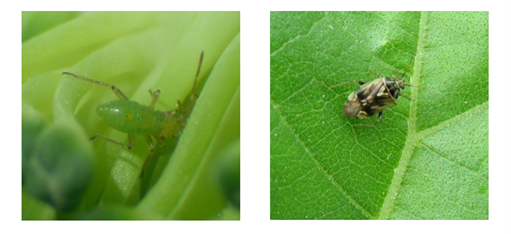
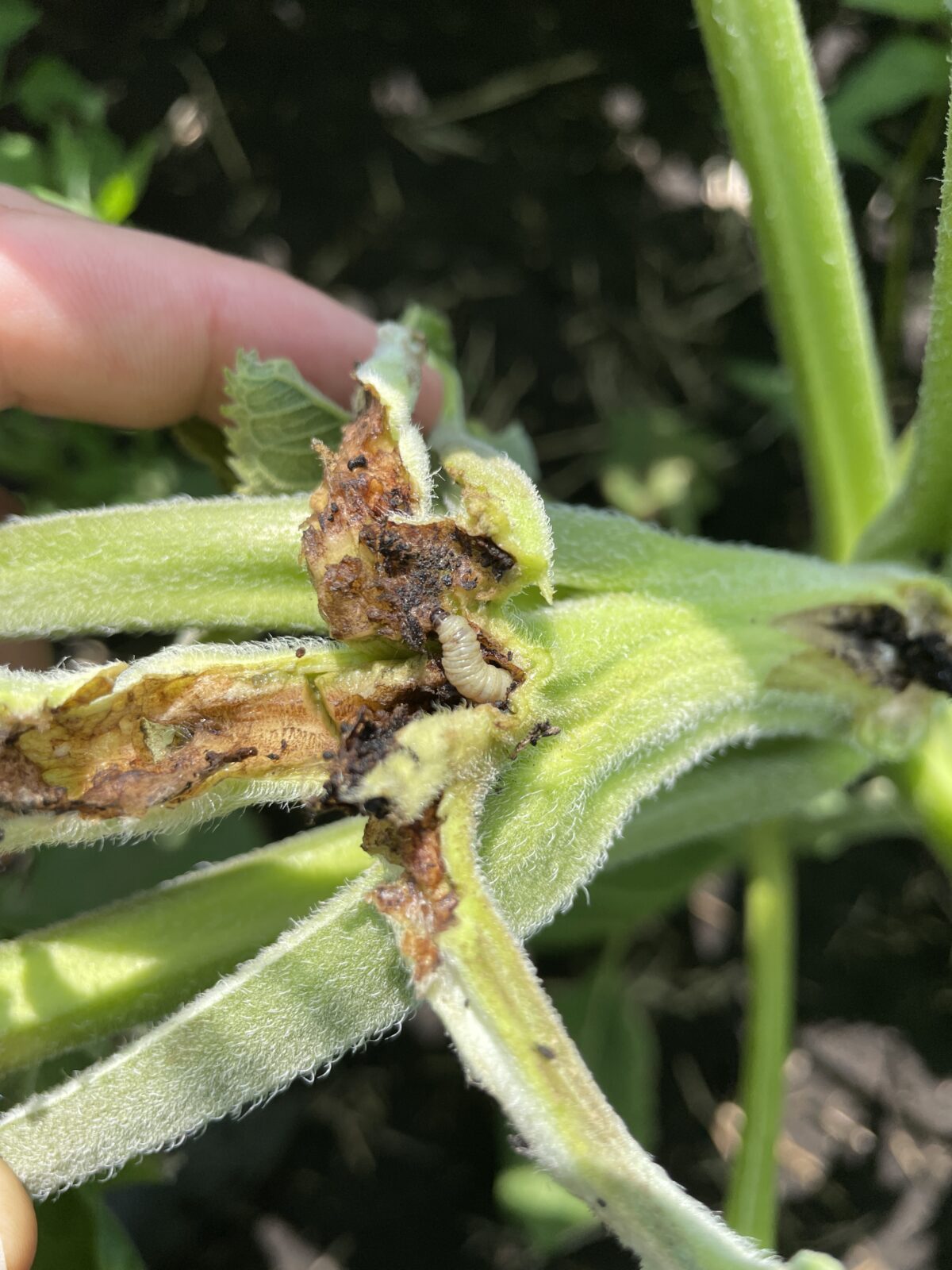
Lygus nymph and adult.

Manitoba Crop Alliance has worked together with Manitoba Agriculture and FMC Canada in 2023 and 2024 to ensure confection farmers have Carbine (R) insecticide available for use on confection sunflowers to control lygus bug. This occurred via a 12-month Emergency Use Registration. The current EUR is valid until July 2025, so the three groups are working on another 12-month EUR and FMC Canada is making efforts toward a permanent registration of the product via the PMRA.

Carbine (R) Insecticide is a group 29 insecticide that is an “ideal partner in integrated pest management (IPM) – has minimal impact on beneficial insects and pollinators when applied according to the label,” and “has no known cross-resistance to other active ingredients,”  according to FMC Canada.

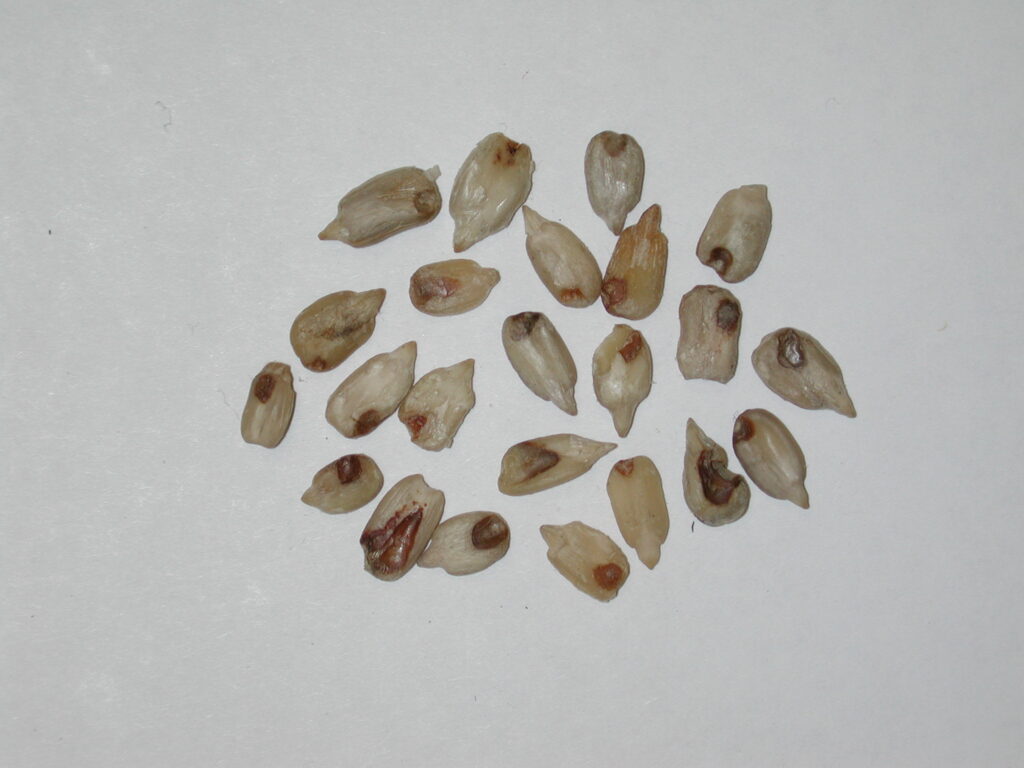
Additional Information: Lygus bugs are a major pest of sunflowers because they can cause kernel brown spot, which is a small brown to black spot on the blunt end of the seed. The industry standard allows for a maximum of 0.5% kernel brown spot in confection sunflowers marketed for human consumption. The economic threshold for lygus but in confection sunflowers is one bug per 9 sunflower heads. Each adult lygus bug is capable of damaging as many as 35 seeds per head.

Control of lygus bug is very limited and insecticides (lambda-cyhalothrin) are the most effective option in sunflowers. Cultural options are even more limited. When planning sunflower acres, it is recommended to avoid planting near adjacent canola fields since they are both favourable host crops to lygus bug. Canola does have limited insecticide options available for lygus bug, so in canola-lygus infestation and insecticide application scenarios, those neighbouring lygus bugs will attempt to move out and find another host crop, like sunflowers.

Some environmental and biological control factors from Manitoba Agriculture include:

  • Weather: Heavy rainfall may reduce levels of early-instar nymphs of lygus bugs. A study in alfalfa found heavy rainfall reduced first generation nymphs of Lygus lineolaris by 50%.
  • Biological Control: Nymphs of Lygus bugs may be killed by parasitic wasps in the genus Peristenus (Hymenoptera: Braconidae); with parasitism being common in weedy alfalfa stands or uncultivated weedy sites but very low in canola. Damsel bugs, assassin bugs, lacewing larvae, big-eyed bugs and crab spiders can prey on lygus bugs. Protecting these natural enemies by avoiding unnecessary insecticide applications may also help to reduce the impact of lygus bugs.

Holcus Spot

What is holcus spot?

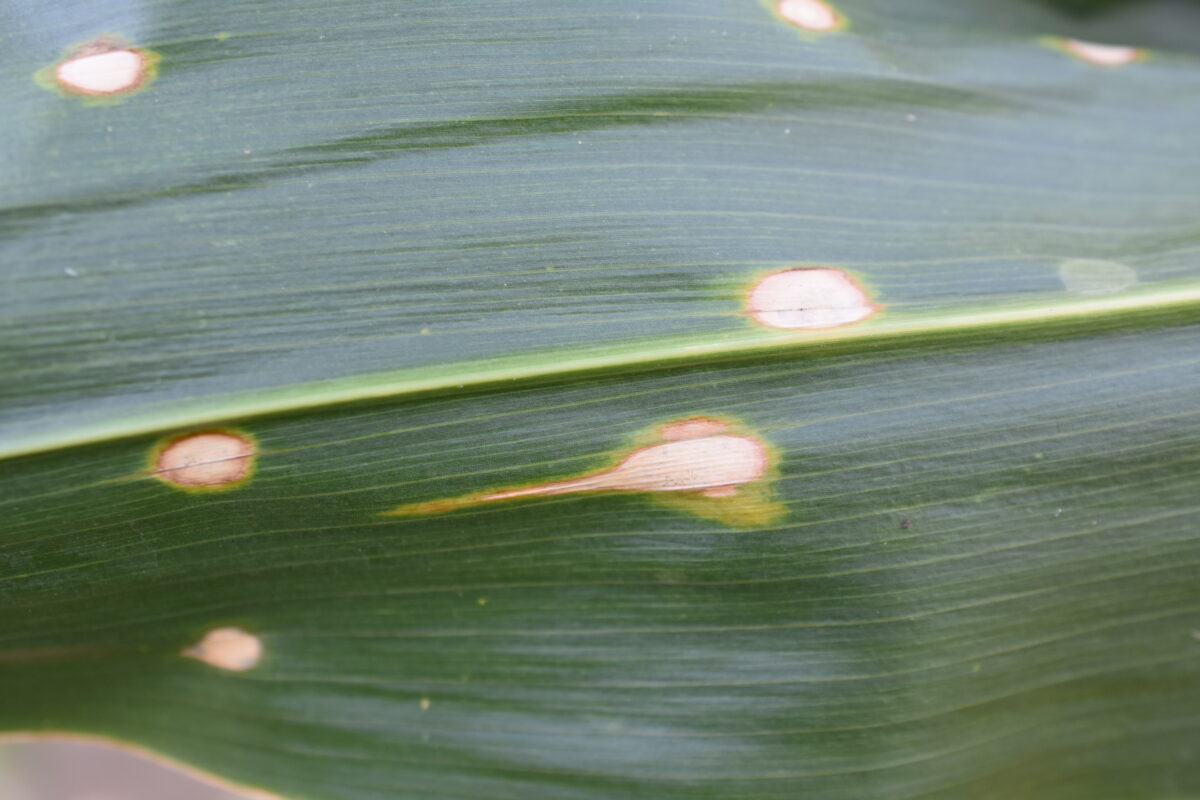
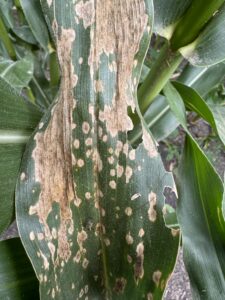
Holcus spot on corn leaf

Holcus spot on corn leaf

A bacterial leaf disease affecting mainly corn crops, though it can overwinter in both monocot and dicot species. Holcus spot begins as a water-soaked spot on lower leaves and develops into small (1/4 to 1/8 “ in diameter), circular to elliptical, white to tan lesions. Lesions commonly develop a brown margin and sometimes a light halo is visible around the lesions. In severe infections, holcus spot can cause significant lesions on plant leaves, though it is more common to have minor spotting, covering less than 5% of a single leaf’s surface.

Conditions for Development

Holcus infections follow typical Manitoba spring conditions. This includes high winds and heavy rains, followed by extended moisture and warm summer temperatures (24C – 30C). The bacteria is interesting because it infects the leaf via wounding, but it doesn’t need a wound for development. The pathogen also does not spread from an infected leaf to a healthy leaf, as in many other leaf diseases. 

Disease Management

The holcus spot pathogen lives and overwinters on crop residues. Best management practices to gain control of the pathogen are crop rotation and tillage. As a bacterial pathogen, fungicides will have no effect on the disease.

Fortunately, holcus spot affects a very small area of each infected leaf and photosynthesis of the green leaf material is still very effective. This is a concern in more disruptive leaf diseases or killing frosts that affect large areas of each leaf and photosynthesis is allocated to a small area or none at all. As a result of the small area affected, yield is not penalized and holcus spot is more of an aesthetic disease than a concern for farmers. 

Don’t get confused…

Holcus spot infections are relatively uncommon. It is easy to see them and be unsure of what it means because lesions are most often minute and don’t draw attention. 

In the rare occasion that the disease does grab attention, lesions can be confused with drift of a contact herbicide, like diquat (image below), or fertilizer burn. Key tips to determine if it could be fertilizer injury would be to ask the farmer or applicator if anything was applied recently or in the sprayer tank. If there is a possibility of herbicide drift, there will be a clear pattern in the area that would have gotten “hit”. The lesions would likely be worst along the outer rows and lessen the further into the field you look.  Early in the season, injury would not grow with the plant and new leaves would be injury-free. 

Diquat drift on corn leaf

Diquat drift on corn leaf

The Impact of Mid-Season Excess Moisture

It is well-known that spring weather in Manitoba is unpredictable. Farmers endure drought conditions one season and excess moisture the next, never knowing for sure what is ahead. These dubious conditions make crop planning particularly difficult because no one knows what extremes of moisture crops may or may not have to grow through that season.

Generally, crops should endure excess moisture fairly well in early summer, when they are actively growing vegetatively, and environmental conditions are usually conducive to evaporation. The growth curve is quite steep during this time, especially in the large-sized crops like corn and sunflower and their water uptake is generous if conditions are good. Flax is not going to be a crop that tolerates “wet feet,” and it will be evident if it is in standing water for extended periods.

Corn

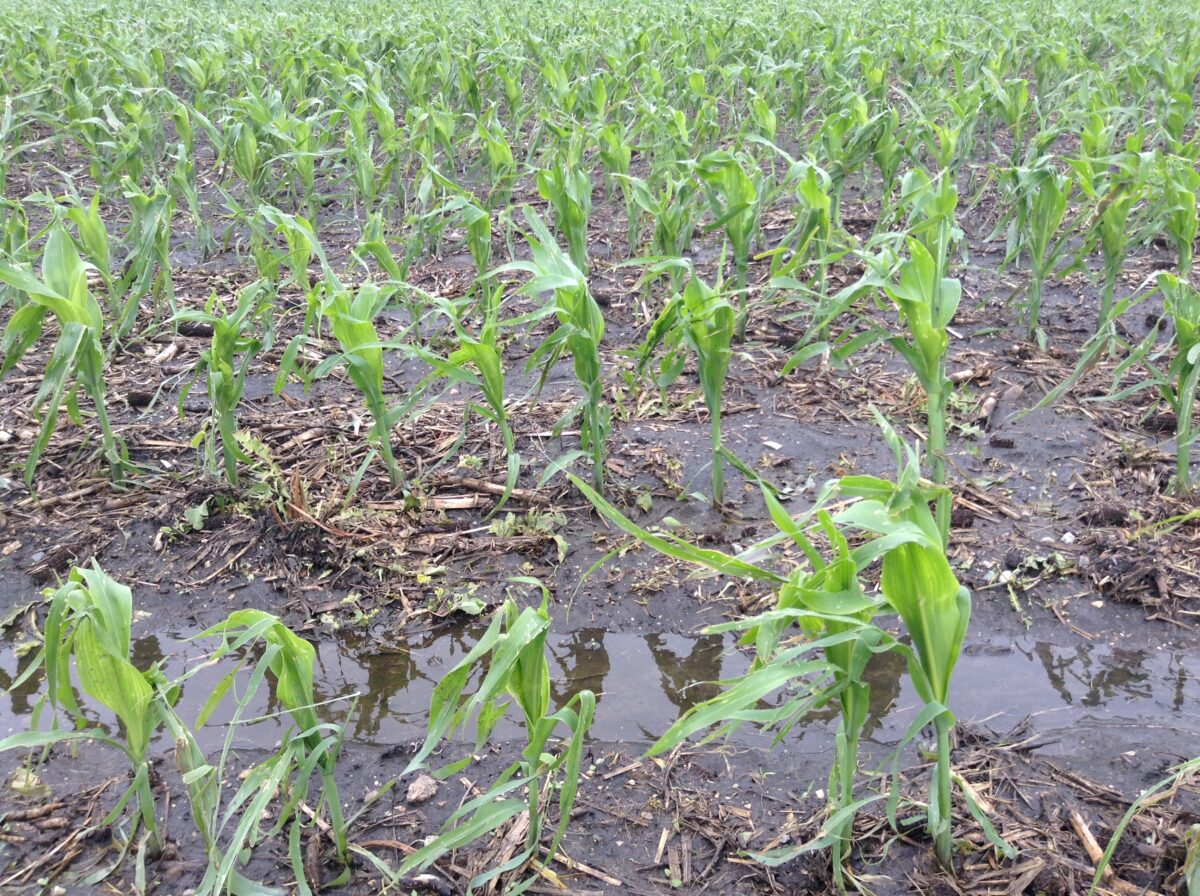
Corn that is past V6 staging has the growing point above ground, so flooding at this stage isn’t quite as detrimental as it would be at earlier stages. Remember that where there is standing water, there is no oxygen exchange and living cells cannot survive without it for very long. Ideally, conditions do not get too hot (crop stress) and evaporation and/or water drainage can happen quickly. Depending on how many times the flooded areas have been flooded this season, this influences the ability of the crop to “bounce back.” Root death is possible in this scenario and warm, dry soils will be required to generate new root growth. New root growth is possible in corn in these situations, but the new growth will extend horizontally, which leads to a few implications with nutrient uptake and plant stability.

In younger plants, V5 or smaller, being waterlogged for four days would be a maximum time span to survive and recover. It is harder to determine what that is for larger plants that are growing much more quickly, especially if there have been multiple heavy precipitation events that have left fields saturated and/or puddled. It is also exceedingly difficult to determine what nitrogen losses may be, and even more so when top-dress applications have occurred recently. At this stage and in the days ahead, it would be very important to keep an eye out for nitrogen deficiency symptoms. Corn nitrogen uptake is about 60 per cent of total uptake from the V8 to silking stages, so losing access to nitrogen via leaching or denitrification could seriously impact yield.

Sunflower

Sunflowers are growing rapidly in July and moving quickly into the reproductive stages. At this time, the crop can be using up to 1/3 inch of water each day. It is hard to believe that with this excessive water use that the crop wouldn’t manage saturated soils very well, but the roots do still need to breathe. Photosynthesis also slows down while stomata remain open in wet conditions, which slows plant development. In flooded conditions, sunflowers may have a tolerance for about three-plus days in an anaerobic environment. During those conditions and following, crop recovery is better with cloudy and cool-warm weather rather than hot and sunny weather.

Sunflowers are also very susceptible to stalk diseases during this vegetative growth, including sclerotinia basal rot. Sclerotinia infections can occur anytime between early vegetative stages through to seed fill and generally need precipitation to spread their spores. It is an important consideration for farmers and agronomists and recommended to know the high risk of disease that the crop carries in wet environments.

Flax

Flax has the lowest tolerance to flooding of the three specified crops. It is a small, shallow-rooted crop that does not adapt well to extreme conditions, nor does it have a need for high amounts of water to grow. If it remains in standing water for longer than three days, flax will become stunted, yellow and there will be a high risk of yield loss.

Flax requires the bulk of its water during flowering and seed fill, at roughly 0.28 inches/day. It is also known that dirty (weedy) flax fields use water much less efficiently than clean flax fields. The one benefit to flax in wet fields is that it is not as susceptible to stem diseases as most other Manitoba oilseeds, therefore wet conditions are not a matter of concern with regards to yield or quality loss due to disease.

Top