
Preventing and Monitoring for Insects in Stored Grain

By John Gavloski, Extension Entomologist at Manitoba Agriculture
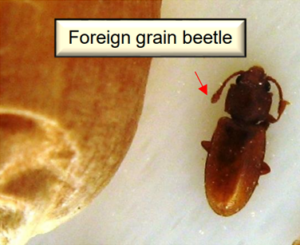
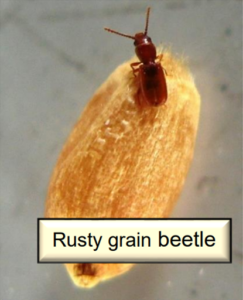
Grain beetles can be an issue in high infestation years, so it is important to review management strategies. The first step is knowing what species of beetle is present and whether it is a species that feeds on the grain itself, or more on fungus growing on the grain or in the bin. Without magnification, it can be difficult to determine the difference between rusty grain beetles, one of the more common beetles feeding directly on many stored grains, and foreign grain beetle, which is primarily a fungus feeder.
Note the club-shaped antennae on the foreign grain beetle in the photo. If placed in a glass jar, foreign grain beetles will climb up the sides, while rusty grain beetles cannot.
Preventing insects being introduced into or establishing in grain bins.
A few steps to reduce stored grain insects establishing in grain bins include:
- Clean in and around storage facilities.
- Inspect grain storage facilities for signs of deterioration, leaks or holes.
- Clean equipment used to move grain. Combines, grain wagons, truck beds,
augers and other equipment used to move grain should be cleaned of grain
residue before being used. - Dry and cool grain (ideally below 15°C) as quickly as possible after harvest.
Controlling insects found in stored grain.
Knowing the species you are dealing with is important when determining the most effective and economical means of control. If it is a fungus feeder such as foreign grain beetle, practices that result in grain drying may be all that is needed.
For insects that feed directly on the grain, if the grain is being kept over the winter, lowering the grain temperature through aeration or moving the grain can kill stored gain insects.
Grain vacs, if used at a slow enough speed (such as 200 bushels per hour), can kill stored grain insects. Removing too large a volume of grain at a time results in the grain protecting the insects and reduces kill. Insect killing efficiency is greatly increased when a 90° angle is made in the grain vac pipe. The grain should be dry for this method to work well.
Depending on the crop being stored and insect pest, chemical control options can include fumigants (such as phostoxin or fumitoxin), diatomaceous earth (Protect-It, Insecto), or malathion. There are things that should be considered before using any of these chemical control options, however.
Fumigants such as phostoxin and fumitoxin are restricted to applicators with a valid stored agricultural products license. These products can not be used when the grain temperature is below 5°C, as the tablets release the gas too slowly.
Diatomaceous earth damages the cuticle of the insect, reducing the insect’s ability to retain moisture. The insect eventually dies from dehydration. It can take weeks for diatomaceous earth to control insects in grain bins, assuming the grain is dry.
Important note: Some commodities, such as canola, flax and sunflowers, should not be stored in facilities recently treated with malathion.
For more information:
Prevention and Management of Insects and Mites in Farm-Stored Grain, Manitoba Agriculture