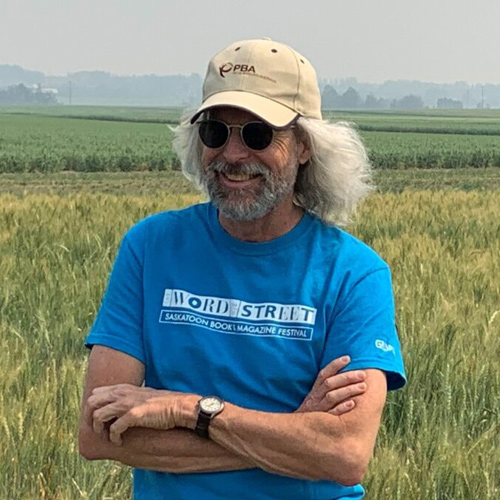
Brent McCallum, Plant Pathologist at AAFC Morden

Specializing in wheat leaf rust disease, Brent McCallum is a Plant Pathologist at the Morden Research and Development Centre (Morden RDC) for Agriculture and Agri-Food Canada (AAFC). McCallum earned his Bachelor Degree in Agriculture at the University of Manitoba (UM) before completing his Masters Degree in the Department of Plant Science at UM. Next, he earned his PhD focusing on bean rust, wheat stem rust and the genetics of rust and rust resistance at the University of Minnesota. McCallum spends half his time living in Morden for work and half his time living in Winnipeg with his family.

Where did you work before AAFC Morden?

After my PhD I returned to Canada to continue my research at UM focusing on a disease of lentils. One year later I moved over to AAFC in a postdoc position where my research was focused on fusarium head blight (FHB) in barley until I got my current position in rust pathology.

What got you interested in this area of work?

I was really interested in genetics but I had the practical interest in farming and farm production from growing up with parents who farmed. The two areas kind of went together because you can apply genetics directly through plant breeding or genetic analysis of pathogen populations. It seemed like an area where I could combine my two strong interests. I really find it enjoyable because I get to see the varieties we work on with breeders go through the registration process and eventually see them in production in the fields.

Tell us a bit about what you’re working on at Morden RDC.

Our research is focused on developing genetic resistance to leaf rust and other wheat diseases like FHB. We work with plant breeders and geneticists to incorporate this resistance into Canadian wheat cultivars. We do surveillance within Manitoba to figure out where the diseases are and how severe they are. Sometimes we access farmers fields but we also take advantage of the Manitoba Crop Variety Evaluation Trials (MCVET). This collaboration is great because MCVET doesn’t apply fungicides so we are able to find all of the diseases in each area and the levels of each.

We do an annual survey where we collect pathogens throughout areas of western Canada (areas we can access) and we have collaborators that send us samples from all over the country. We then do a detailed analysis of the pathogens variance profile so we can see which genes are effective/ineffective against the pathogen and compare those results with previous years to see how the pathogens have acted over time.

In addition, we do a lot of screening for disease resistance cultivars that are in development. We screen all the wheat lines being proposed for registration for their level of resistance and publish our ratings in the provincial seed guides. We screen diseases like wheat leaf rust, fusarium, stem rust and stripe rust so farmers can get a good idea how the crop lines will perform in their fields.

What can you say about the value of farmers providing funding and support to your organization?

Farmer funding and support is really important because farmers are the ones who have a grasp on what is valuable to them and what is going to pay off in their production practices. They are the ones who find new or emerging problems so we value any feedback that goes into the research we can do to help reduce the disease or problems they are facing. I also think most of the farmers are very patient and understand the research they invest in won’t produce results for one to two years.

How does that farmer funding and support directly benefit farmers?

It’s a good feedback loop – they can direct us to the important issues and they can also help us apply the solutions. There is no point developing disease resistant varieties if nobody is going to grow them. The cultivars have to be in good backgrounds, high yielding, high quality germplasms so producers will grow them without taking a big hit by growing something that’s resistant to wheat midge, fusarium, or leaf rust. They can grow high quality varieties or adapt a new management technique or something that works for them. Its more the fact that they have valuable input on what problems to tackle, but then also in supplying the funding to tackle those problems and the implementation of solutions. They are really critical in all three of those phases.

I (with additional collaborators) just finished an interesting article titled, We stand on guard for thee: A brief history of pest surveillance on the Canadian Prairies, with an interesting message; we’re all specialists, for example I work on one disease on one crop. Farmers are generalists, they have to work with multiple problems on multiple crops. Fertility, insects, diseases, weeds, resistance, whatever the case may be. This paper helped us think more broadly because we looked at how all pest surveillance across western Canada has developed over time. Click here for more information or to read the review article.

How do you spend your time outside of work?

I enjoy being active and being outside. I like to curl and play hockey in the winter and I enjoy outdoor activities like cycling and golf in the summer.

What gets you excited about the work you do?

Agriculture is a very diverse field and you get to meet a lot of good people. The people are my favourite thing. The group I work with is a very dedicated group of individuals. They are very skilled, highly trained, hard workers who are conscientious and really good to get along with. In addition, we collaborate with so many good people across agriculture Canada, the universities, industry and private industry.

What is the best piece of advice you’ve received?

Try to understand the basics of things. Some things can seem quite confusing on the surface until you drill down and get to the root of the situation. Try to understand it step by step. That’s kind of what your graduate training teaches you to do. Not to skim long the surface, but to try to get a deep understanding of what is going on.

Effects of Drought Stress on Corn

The Prairies’ forecast for summer 2025 appears to be hot and dry. We know this is not ideal for corn growth, especially reproductive growth.

In recent years, we have dealt with drought stress in corn a lot. Fortunately, it has been overcome by timely rains and not had an impact province-wide. 2025 outlook is still unclear, but the heat doesn’t appear to be letting up and reproductive stages of corn are just around the corner. 

So, what happens to the plant when there isn’t enough moisture? Most visibly, corn leaves begin to curl and make the plant resemble pineapple leaves or onion greens. This occurs because the leaves are protecting themselves from excessive moisture loss or transpiration. Believe it or not, the more readily a plant curls its leaves up, the more beneficial it is to that plant. This transpiration increases as leaf area increases and it is the mechanism that water moves from the soil, through the plant and into the atmosphere. If leaf rolling is resulting from true drought stress and occurs for 12+ hours a day, grain yield is likely to decrease, even prior to reproductive staging.

Come July, the crop will be at a detrimental stage for water requirements. At the end of June to the beginning of July, corn is growing vegetatively extremely quickly. By July 10 – 15, “normal” staging could be tasseling (VT) or silking (R1), but that varies, depending on emergence and environment. Both of these stages have a very high demand for soil moisture to support development.

Potential ear size is already determined by the time silks emerge from the ear shoots. In fact, potential kernel row number is set by the 12-leaf collar stage (about chest-high corn.) Potential kernel number per row is determined over a longer time period, from about the 12-leaf collar stage to about 1 week prior to silk emergence” (https://www.agry.purdue.edu/ext/corn/pubs/corn-07.htm).

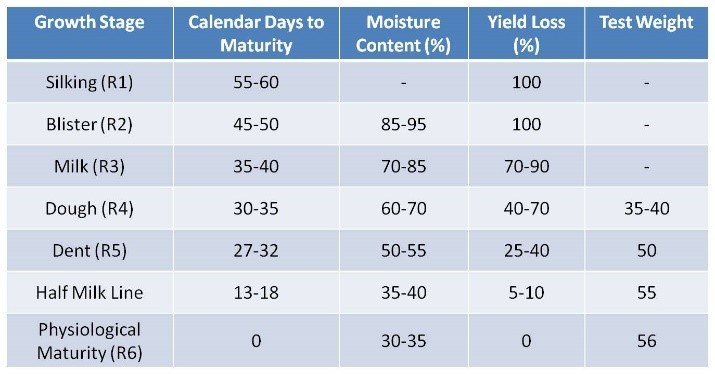
We know that row number is heavily predetermined through genetics, but kernels per row is not and has a strong sensitivity to environmental stresses. Below is a table identifying the potential yield reduction from drought stresses (with 4 consecutive days of leaf wilting) throughout the growing season.

Corn July 14 21 table crop

Severe drought stress has the greatest impact during silk elongation, which often results in poor pollination. Silks on the base of the ear begin to elongate first, followed by those from the center and then the tip of the ear. So, when plant water is in low supply, the silks elongate slowly and may not even elongate beyond the husk. If the silk isn’t outside the husk during pollen shed, it will not pollinate those potential kernels. During these conditions, silks that do emerge have an increased chance of desiccating quickly, making them unable to receive pollen.

There is no gain made in worrying about what may happen over the next several weeks. What is promising is that corn has an amazing ability to recover from drought stress when it does receive rain. It is very unlikely that no pollination will occur whatsoever, but if dry conditions persist, it is likely that grain will not fill to its full potential. This is where rain events can really improve grain quality and the length of the crop’s life after it has been under severe stress.

Farming through a severe drought is something Manitobans haven’t had to do in decades and it is a steep learning curve. From excess winds to extreme heat to wildfires, all in May, there have been some stresses to endure already this season. Let’s hope for timely rains and a durable crop this year!

Santosh Kumar, Wheat Breeder at AAFC Brandon

Assessing Plant Stands

Ana Badea, Barley Breeder at AAFC Brandon

Growth Stage and Herbicide Application

Herbicide applications are well-underway in corn, including tank-mixes. Fields should always be scouted before any herbicide application for weeds present, precise crop staging and environmental conditions that could have an affect on efficacy.

Applying a herbicide at early growth stages provides greater crop safety, in most cases. The corn plant has a smaller surface area to be in contact with the herbicide, which means a smaller risk of damage. Herbicides with active ingredients like 2,4-D or dicamba can need to be applied to the crop as early as possible for this reason: the larger the crop, the greater the plant surface area and the greater the risk to the crop. It is very important to refer to all herbicide labels and contact appropriate companies with any questions prior to applications.

Refer to Manitoba Crop Alliance’s Vegetative Growth Stage ID factsheet for staging tips.

Also available is a Quick Herbicide Reference Guide for current pre-emergent and post-emergent herbicides on the market in Manitoba.

Quick Herb Ref Guide

Post-emergent herbicide application tips: (for full list, visit https://www.dekalbasgrowdeltap…)

  • ALWAYS READ AND FOLLOW LABEL DIRECTIONS.
  • Corn under stress may not have the ability to metabolize some herbicides quickly enough to avoid crop injury. Weeds under stress may not may not accept the herbicide to its full capacity.
  • Spray additives can increase the rate of herbicide uptake by the crop.
  • Herbicide residues from previous applications may remain in the spray tank causing contamination.
  • Post-emergent herbicide injury symptoms can include leaf chlorosis or necrosis, onion leafing, internode stacking, rat tailing, ear pinching, ear bottlenecking, brace root malformation, and green snap.

Reference: https://www.dekalbasgrowdeltap…

Top