Weed Control Strategies in Flax

Flax is a small, upright plant that does not branch out (tiller) extensively or produce much biomass. It develops a short, branched taproot that will extend up to 1 metre (39 inches) in depth and 30 cm (12 inches) across. As a result of the minimal ground cover that flax provides, it is a poor competitor with weeds that are more aggressive and they can thrive via access to sunshine, moisture and nutrients.

Weeds don’t only affect crop yield, they also contribute to losses via dockage in grain samples and shipments. Removal of weeds also improves quality factors like oil content and iodine levels.

To see best results for weed control in flax and to minimize losses most effectively, removal should occur prior to the crop reaching 6 inches in height. Weeds in the seedling stage are easiest to control and there is a decreased risk to injury of the crop at the early growing stages. Crop injury can also occur in herbicide applications with low water volume and/or in hot conditions.

Since flax is a reasonably weed-intolerant crop, it is best to take a long-term approach for weed control with both cultural and chemical controls, where applicable. In terms of chemical control, timely pre-emergent herbicide applications, preferably with residual control, are ideal to get the flax crop off to a strong start. Some farmers find that seeding the flax crop a little later gives them a window for pre-seed or pre-emergent applications on those hard-to-control weeds. Following emergence, keeping an eye on the crop staging and weed pressure is crucial so that herbicides can be applied at an appropriate time.

Flax has a good selection of herbicides for all application timings. Always refer to Manitoba’s Guide to Field Crop Protection for up to date options, or refer to MCA’s Quick Herbicide Reference Guide.

Important considerations when determining a herbicide program include:

Pre-emergent herbicides give the crop the best chance to thrive as early as germination, and to get ahead of weed populations. Minimizing competition at this very early stage is crucial for the crop.

Post-emergent herbicides are limited to Groups 1, 4 and 6, which is not uncommon for special crops and it is a hurdle when considering weed control, especially in the age of weed resistance. Specific planning needs to occur in previous crops for weed control and with fall-applied or pre-emergent herbicide use.

Pre-and post-harvest herbicides are a valuable resource for long-term weed control planning, in flax and all other crops. This is great opportunity to look at perennial weed populations and target control when they are preparing for seasonal dormancy.

For more information on growing flax on the Prairies, see Flax Production Resources on our website.

Manitoba Farmers Participate in 2023 NSA Sunflower Survey

In alternate years, the National Sunflower Association performs a sunflower survey in six states (ND, SD, MN, CO, KS and NE). The survey looks at several agronomic pests and pressures and the potential yield impacts in the given year. In 2023, Manitoba Crop Alliance (MCA) participated in the survey with the help of Ahmed Abdelmagid, research scientist for oilseed crops pathology at Agriculture and Agri-Food Canada’s (AAFC) Morden Research and Development Centre. Nine sunflower fields were surveyed in Manitoba, reflecting the approximately 85,000 total sunflower acres in 2023.

This project serves two purposes:

  1. Identifying factors that affected yield in the given year and which may be of increasing importance in the future, and
  2. Identifying potential research priorities.

Factors that were looked at specifically during the survey were the following:

  • Yield components – plant population, head diameter, seed size, % good seed, % centre seed set, bird damage
  • Agronomic information – crop type, row width, tillage practices
  • Weed Assessment
  • Diseases
  • Insect & bird damage

Fields were visited in mid- to late-September, once R9 was reached and each was surveyed at two different sites within the field. Of the nine Manitoba locations, six were oilseed production fields and the remaining three were confections, and all locations were distributed throughout southern Manitoba from Eastman to Westman areas.

The initial process in each sampling location was to do a plant count followed by another count including only “harvestable” plants (this would not include very small heads, heads with no seed, lodged plants). These harvestable plants were used in yield estimation against all the factors that lay ahead. Head diameter was measured in inches on five plants per location and centre seed set was measured (diameter of seed not set in the centre of each head). Next, seed samples were taken from three heads and stored in a paper bag to send for testing, but not before determining percentage good seed (% filled seed) and seed size.

A general assessment of the field was made at each sample location for yield limiting factors (birds, disease, insects, weeds, drought, uneven plant growth, hail, herbicide damage, lodging and plant spacing within the row) and the top two limiting factors were ranked. The most common limiting factor across the nine surveyed fields was disease (five fields) and the remaining four fields had greatest limiting factor being birds, drought, lodging or weed pressure. It was rare to find a second limiting factor in these fields, which had a positive impact on yield due to less pressure on the crop.

Bird damage was estimated in the percentage of seeds lost. Five fields had bird damage at the time of surveying, ranging from 0.5 – 4.5 per cent seed loss. Surveying is typically done around the same time blackbirds tend to begin feeding on sunflowers and one of these surveyed fields had a significant increase in bird damage by harvest.

Insect presence measurements accounted for sunflower midge, sunflower seed maggot, sunflower bud moth and long-horned beetle damage (not found in Manitoba). 25 heads at each field site were examined for the above insect damage, aside from long-horned beetle, which required stalk splitting to identify the larvae presence.

Sunflower midge damage. Photo credit: National Sunflower Association.
Sunflower seed maggot damage. Photo credit: NDSU.
Sunflower bud moth damage. Photo credit: NDSU.


Disease observations and samples were taken of the following, when present:

  • Root lodging
  • Midstalk lodging            
  • Ground level lodging    
  • Sclerotinia wilt (basal stem)
  • Sclerotinia mid-stalk rot
  • Sclerotinia head rot
  • Rhizopus head rot
  • Downy mildew
  • Phomopsis stem canker
  • Phoma black stem
  • Verticillium wilt/leaf mottle
  • Charcoal rot
  • Rust

Lodged plants were identified, on average, at the nine locations as follows:

  • Root lodging or percent root upheaval – 2 per cent
  • Ground level lodging – 1.5 per cent
  • Mid stalk lodging – <1 per cent

Sclerotinia infections were significant, but averaged across all nine locations, the per cent instances are quite insignificant:

  • Sclerotinia wilt (basal stem) – 4 per cent
  • Sclerotinia mid-stalk rot – 3 per cent
  • Sclerotinia head rot – 6 per cent

Other diseases were more significant in 2023 and this likely reflects most years, but stem rots tend to go more unnoticed unless lodging is a major issue. Rhizopus head rot was found in two locations, but samples are being tested for disease presence. Rhizopus is not a disease Manitoba sunflower farmers have had to deal with in the past, so further testing is being pursued to determine if this is a misdiagnosis or a real issue. Downy mildew and charcoal rot were not found in any of the sample sites. Verticillum wilt was found to be present on 2 per cent of surveyed plants and rust remained low with roughly 6 per cent infection area on leaves.

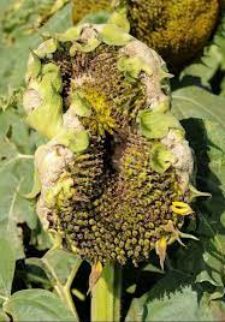
Phomopsis and phoma were the real diseases of concern in surveyed fields, which reflects the prior mention of disease being the most yield limiting factor in 56 per cent of surveyed locations. According to final yields, neither disease seemed to impact yield noticeably and lodging due to stalk disease did not occur. Phomopsis stem canker was found in 10 per cent and phoma black stem in 8 per cent of plants surveyed with diseased stalk samples being taken for further analysis. Phoma had very high incidence (80 per cent) across the entire survey in Manitoba and the six states, meaning 80 per cent of all plants sampled had phoma infections. Phomopsis was lower, at 34 per cent incidence in all samples, however this was noted to be an increase from past surveys. It is thought that Phomopsis stem canker prevalence increased due to any of the following factors:

  • Susceptible hybrid
  • Drought stress or other factors
  • No fungicide use
  • Wet weather closer to harvest

Weeds were generally not a concern in fields surveyed except for one that had lambs quarters and Canada thistle escapes and heavy pressure. It was this field that was identified as having weed presence being the primary contributor to any yield loss that was incurred.

MCA has applied for partial funding through the provincial government Sustainable Canadian Agricultural Partnership call for funding for the sunflower disease survey for 2024-27. During this time, they will be partnering with Agriculture and Agri-Food Canada to do disease verification of samples collected from the 2023 and 2025 season. This partnership allows further collaboration and cooperation with our NDSU partners to participate in their survey, bringing our members a larger dataset, with more information on disease tends.

Corn Establishment in Dry Soil Conditions

“Corn roots will not grow into dry soils.” – Dr. Joe Lauer, professor of plant and agroecosystems sciences, University of Wisconsin-Madison (retired)

When Manitoba experiences a dry cycle, a major concern is the ability of our crops to endure very dry and crusting soils. Spring drought is particularly concerning for crop germination and emergence. Without moisture, germination simply will not occur. With limited moisture, germination may begin and become halted if/when moisture runs out, resulting in an unproductive seed(ling).

According to Joel Ransom, North Dakota State University small grains & corn extension agronomist, “For most soils, 0.5 inches of rain (sandy soils require slightly less) is needed in order for moisture to move to a two-inch depth (the seed zone) in dry soils. Poor seed-soil contact can restrict the corn seed from extracting enough moisture from the soil to germinate. Crop residues that touch the seed can similarly impede the movement of water to the seed. Occasionally, fertilizers placed with the seed inhibit germination due to their salt effect being more pronounced in dry soils1.”

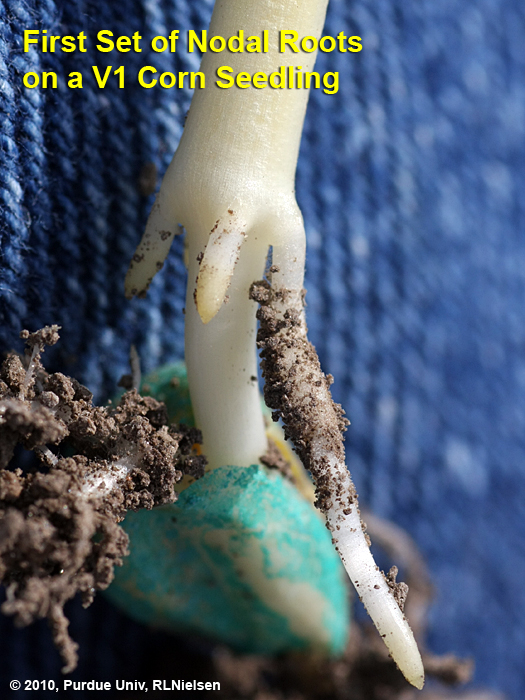
Of course, soil moisture is not just required for germination. It is required for all vegetative and reproductive growth. Nodal root development is occurring as the growing seedling reaches V1 staging and this requires ample moisture in the top two inches of soil. This new root development will be the primary means by which the plant acquires water and nutrients by the V3 stage1, so successful nodal roots are critical for further development. If soil is to remain dry around the crown (where nodal roots develop, about 0.75 inches below soil surface) for extended periods during early vegetative growth, these nodal roots will not develop. As corn plants grow larger, they become too heavy without the support of this root system and will flop over. This is where the terms floppy or rootless corn syndrome come from and these have frequently been found in areas of higher compaction or shallow seeding in recent years but will be a common symptom of dry growing seasons.

Figure 1: First set of nodal roots developing on a V1 Corn Seedling. Photo: Dr. Bob Neilsen, Purdue University.

Weather conditions in the entire month of May are impossible to predict. It is extremely rare to have so little soil moisture that the crop is unable to germinate or that the crop runs out of moisture during early development. It is rare that this should occur and to the best of our knowledge, it has not happened in Manitoba on a large scale.

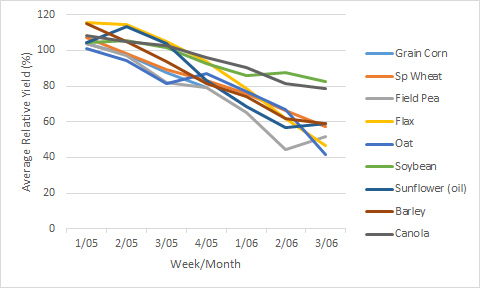
Should a crop failure occur in spring due to dry conditions and young seedlings die off via dehydration, a replanting scenario may be considered. Stand reduction does have to be very significant to justify replanting corn simply because of the delayed planting date. Manitoba Agricultural Services Corporation (MASC) historical data shows that there is an estimated yield loss of 5% per week delay in spring planting.

Figure 2: Average relative yield reported to MASC during each sowing week for the selected crops grown in Manitoba for the period of 2010-2019.

Replanting corn is a very expensive decision and most often is not economical unless stand loss is over 16,000 plants per acre. Even in that scenario, the farmer may still be looking at too significant a loss to make it worthwhile. Replanting grain corn should only ever be considered after careful economic analysis of costs against any potential gain2.

For more information on growing corn on the Prairies, see Corn Production Resources on our website.

References

  1. Ransom, Joel. “Dry Soils and Poor Corn Emergence.” NDSU Crop & Pest Report, NDSU, 1 June 2017, https://www.ndsu.edu/agriculture/ag-hub/ag-topics/crop-production/crop-pest-report.
  2. Manitoba Agriculture, Corn Seed Bed Preparation. https://www.manitoba.ca/agriculture/crops/crop-management/grain-corn/corn-seed-bed-preparation.html 

Seeding Flax to Provide the Best Start

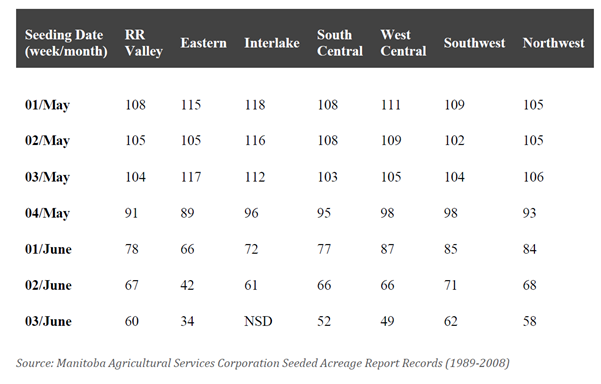
Typically, flax is seeded from May 1st to June 20th. It may be seeded the last out of all the crops as the bolls and seeds can stand and ripen in the fall without shelling while other crops like canola are being harvested. Prolonged exposure to fall weather, though, will reduce the quality of the harvested seed and make it ineligible for a food grade market. MASC data has shown that flax has good yield potential in the last week of May (Table 1), but yields decline in some areas as the calendar turns to June. MASC seeding deadline is June 20th for all of Manitoba.

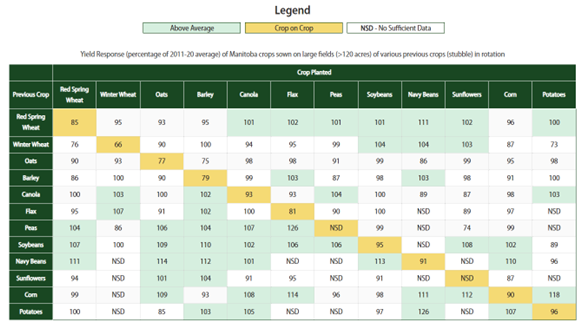
Table 2: Relative Stubble Yield Response (2011 – 2020). Source: Manitoba Agricultural Services Corporation.

Yield response data from MASC, recorded from 2011 – 2020 (10 year results), shows that flax responds best when seeded following a pea crop, with the next best response after corn (Table 2). It generally has the poorest yield response when seeded following any oilseed crop, for obvious reasons. Research has shown that flax performs poorly specifically after canola and/or mustard, and not only because of disease issues. The poorer performance of flax on canola stubble is attributed to mycorrhizae fungi which do not associate strongly with canola and decrease in presence during the canola crop’s growing season. When flax is grown on canola stubble, the mycorrhizae populations are lower, which leads to poorer early  season nutrient update, especially phosphorus, a relatively immobile nutrient in the soil that is crucial to early flax development.

Flax does well after cereals or corn. It also performs well after legume crops and alfalfa, but Rhizoctonia disease may be a problem. Flax does not do well after potatoes due to the loose seedbed and potentially Rhizoctonia in this rotation as well. According to MASC, the most common crop stubble that flax is seeded into is spring wheat in Manitoba and very few acres are seeded into pea stubble, so that flax-on-pea yield data in Table 2 could be seen as skewed. Crop rotation is extremely important when making all cropping decisions, but flax is a particularly sensitive plant to many outside factors and rotation should be paid considerably close attention to. It is recommended to have at least three years between flax crops on a field to control various soil-borne or stubble-borne diseases of flax, such as pasmo.

Table 2: Relative Stubble Yield Response (2011 – 2020). Source: Manitoba Agricultural Services Corporation.

For a successful flax crop, the greatest strategy is to enable the crop to emerge in a uniform and dense plant stand. This helps the crop with weed control throughout the season and allows for consistent physiological maturity down the road.

Tips for a productive flax plant stand:

  • Target 1 to 1.5 inch seeding depth to allow crop to emerge quickly
  • Do not overfertilize. Flax does not respond positively to increased rates of fertilizer. Excess nitrogen will cause prolonged maturity and potential lodging issues.
  • Target a higher seeding rate. Flax depends very heavily on adequate stand establishment and plant populations of 30 – 40 plants/ft2. Typical emergence for flax is 50% – 60% of seeding rate. Seeding rates on the high end of the recommended range should be used for ground prone to crusting when seeding late or under heavy weed pressure.
  • Do not seed flax on poorly drained soils or sandy soils because of poor water retention. Medium to heavy-textured soils are preferable. These soils may also crust in the spring, which can inhibit flax emergence.

For more information on growing flax on the Prairies, see Flax Production Resources on our website.
Preventing and Monitoring for Insects in Stored Grain

By John Gavloski, Extension Entomologist at Manitoba Agriculture

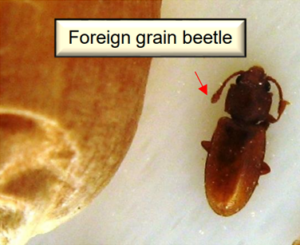
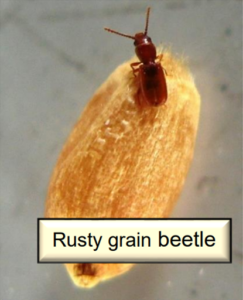
Grain beetles can be an issue in high infestation years, so it is important to review management strategies. The first step is knowing what species of beetle is present and whether it is a species that feeds on the grain itself, or more on fungus growing on the grain or in the bin. Without magnification, it can be difficult to determine the difference between rusty grain beetles, one of the more common beetles feeding directly on many stored grains, and foreign grain beetle, which is primarily a fungus feeder.

Note the club-shaped antennae on the foreign grain beetle in the photo. If placed in a glass jar, foreign grain beetles will climb up the sides, while rusty grain beetles cannot.

Preventing insects being introduced into or establishing in grain bins.

A few steps to reduce stored grain insects establishing in grain bins include:

  • Clean in and around storage facilities.
  • Inspect grain storage facilities for signs of deterioration, leaks or holes.
  • Clean equipment used to move grain. Combines, grain wagons, truck beds,
    augers and other equipment used to move grain should be cleaned of grain
    residue before being used.
  • Dry and cool grain (ideally below 15°C) as quickly as possible after harvest.

Controlling insects found in stored grain.

Knowing the species you are dealing with is important when determining the most effective and economical means of control. If it is a fungus feeder such as foreign grain beetle, practices that result in grain drying may be all that is needed.

For insects that feed directly on the grain, if the grain is being kept over the winter, lowering the grain temperature through aeration or moving the grain can kill stored gain insects.

Grain vacs, if used at a slow enough speed (such as 200 bushels per hour), can kill stored grain insects. Removing too large a volume of grain at a time results in the grain protecting the insects and reduces kill. Insect killing efficiency is greatly increased when a 90° angle is made in the grain vac pipe. The grain should be dry for this method to work well.

Depending on the crop being stored and insect pest, chemical control options can include fumigants (such as phostoxin or fumitoxin), diatomaceous earth (Protect-It, Insecto), or malathion. There are things that should be considered before using any of these chemical control options, however.

Fumigants such as phostoxin and fumitoxin are restricted to applicators with a valid stored agricultural products license. These products can not be used when the grain temperature is below 5°C, as the tablets release the gas too slowly.

Diatomaceous earth damages the cuticle of the insect, reducing the insect’s ability to retain moisture. The insect eventually dies from dehydration. It can take weeks for diatomaceous earth to control insects in grain bins, assuming the grain is dry.

Important note: Some commodities, such as canola, flax and sunflowers, should not be stored in facilities recently treated with malathion.

For more information:

Prevention and Management of Insects and Mites in Farm-Stored Grain, Manitoba Agriculture


Top