
Section Title
Harvesting Flax
- Flax
Desiccation and Swathing
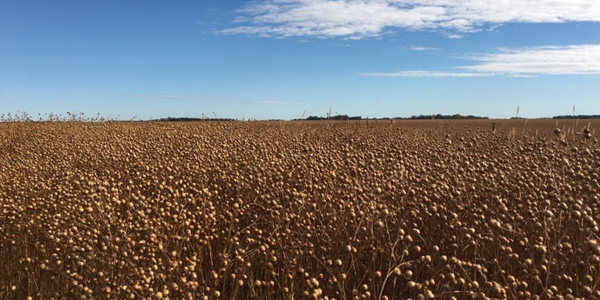
Flax can be chemically desiccated or swathed to dry down stalk tissue and green weeds after the crop has reached physiological maturity (75% of bolls are brown). Desiccated crops can then be straight combined, but swathing may be preferred with the crop is not uniform in maturity; in a swath, seeds are a lot less susceptible to frost damage. Timing is important for swathing and/or desiccation operations, as performing either task prematurely will reduce yield.
Flax can withstand weathering conditions better than canola, as the flax bolls are less susceptible to shelling out than canola pods. If in a late fall situation where standing flax still remains, swathed flax may be easier to pick up later this fall or next spring if the need arises. If left unswathed, the weight of snow on the crop may result in significant stalk breakage and/or lodging. The longer the crop is exposed to freeze-thaw conditions, the more the seed quality and appearance will be degraded. Also, flaxseed overwintered in the field is less suitable for the human consumption market.
Combining
Flax seed with a moisture content of 10% can be safely combined without the need for drying. The combine must be adjusted correctly to minimize seed coat damage to flax. If seed is very dry and the cylinder speed is too high, significant seed damage can occur.
Straw Management
Flax straw can cause problems in seeding subsequent crops if it is chopped and spread, since the straw decomposes very slowly. The straw can be baled and sold to several industries that process the straw. To be sold, straw must be free of weeds and garbage.
Storage
The moisture content in flax can be reduced with aeration under the right conditions, as with canola, but in late fall, a grain dryer may be more effective in bringing moisture down to a storable level. Flax is considered tough from 10.1 to 13.5% moisture and damp if over 13.5% moisture.
If using aeration and natural air to condition flax, sampling of resulting product is critical. Monitor the changes in moisture and temperature in the bin by sampling the bottom, middle and top of bin separately. Grain at the bin bottom close to the aeration will probably be dryer than the grain at the top of the bin. Move grain from the bin bottom to the top to provide mixing and evenly reduce moisture throughout the entire bin.
The sellable product is 10% moisture, but for successful long-term storage, targeting 8-9% moisture will reduce chances of heating and spoilage. Even dry, flax is prone to heating because of its high oil content. Stored flax should be routinely monitored to ensure there are no hot spots developing. A hot spot in stored flax can spread quickly - possibly throughout the entire bin.


-
November 24, 2025
Unlike annual weeds that complete their life cycle within one year, perennial weeds live for multiple years, becoming dormant in… Read More



-
September 8, 2025
Lodging is one of the most common issues across the Prairies. Growers can use tools such as PGRs or select… Read More

-
July 16, 2025

-
June 2, 2025
Research has shown that flax performs poorly specifically after canola and/or mustard, and not only because of disease issues. The… Read More

Seed treatments in wheat, barley and flax: what they are, how they work and when they should be used
-
February 6, 2024
Seed treatments are commonly used across Manitoba on numerous crop types. Here is more information about how they work and… Read More
-
September 1, 2023
We are nearing the end of another season. However, there are still decisions to be made that can help set… Read More
-
May 25, 2023
Recropping restrictions are implemented to prevent crop damage following applications of residual herbicides. The following table is a guide for… Read More

-
May 25, 2023
This edition of the Growing Flax Guide has been thoroughly reviewed and updated. Chapter Leads with subject matter expertise were… Read More
-
May 25, 2023
Flax growth stages (Turner 1987; adapted from Chapter 4 of Flax Council of Canada ’s Growing Flax Production, Management &… Read More